Community theater has no union scale, and that’s the film’s real subject
Jesse Eisenberg’s “The Debut” turns a New Jersey playhouse into a study of what unpaid ambition actually costs.
By The Weekend · · 5 min read
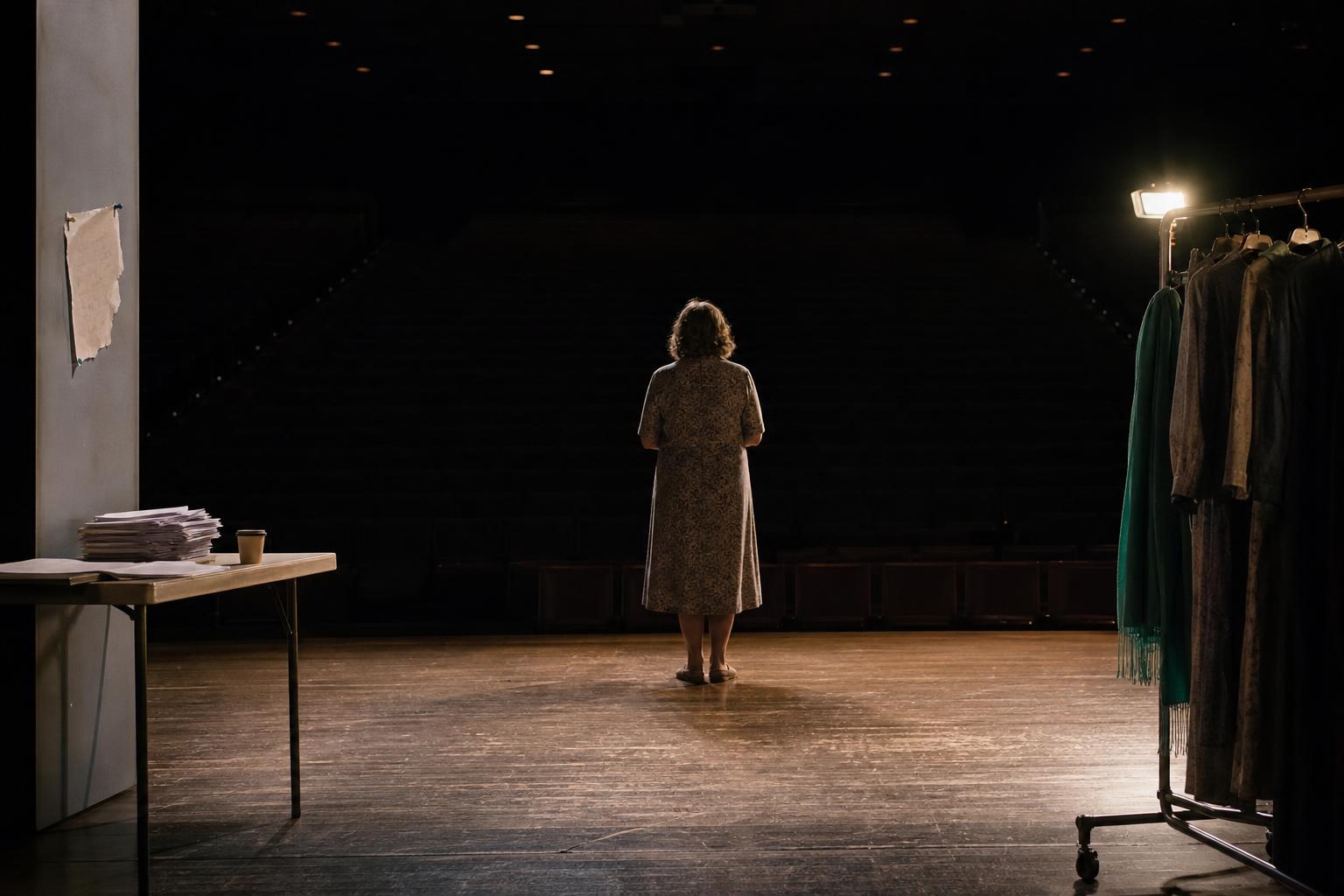
"The Debut" opens on a woman auditioning for a musical that has never left New Jersey, in a theater that pays her nothing, for a role a professional actress just abandoned as too small. That gap — between what community theater offers and what Mona Friedman needs from it — is the whole picture. Jesse Eisenberg's third feature, starring Julianne Moore and Paul Giamatti, premiered at Telluride this month and arrives from A24 in December.
A rehearsal room with no union scale and no ceiling on what it can cost you
Mona is a housewife whose husband wants dinner on the table and whose sole audition credential is that she took the entire casting notice off the supermarket bulletin board, so no one else could see it. She loses the role to Bernadette Peters' Serena Cherry, a returning "star" of a theater whose stardom is a poster in a strip-mall lobby. When Serena drops out for being underused, Mona gets the part by default, then meets Jerry (Giamatti), the director whose full title, per one line in the film, is "basically the biggest name in New Jersey community theater" — a joke that only works because everyone in the room knows exactly how small that pond is.
What follows is not a rise. It's a woman with no professional stakes finding, for the first time, something with stakes attached — and refusing to notice that the stakes are imaginary. She stops keeping house. She moves into a motel to "research" a role that is a building superintendent in an original stage musical nobody outside three towns has heard of. Three critics who saw it in Telluride — at IndieWire, The Hollywood Reporter, and Deadline — all land on the same observation without coordinating: the film is funniest and sharpest exactly when it treats amateur theater's total absence of professional consequence as the engine of Mona's undoing, not a footnote to it.
The Cassavetes comparison is doing real work, not just flattering the poster
Eisenberg's film sits inside a small, specific lineage of theater comedies that use amateur productions to say something about people, not craft — Christopher Guest's "Waiting for Guffman" is the obvious cousin, though "The Debut" reaches further, toward John Cassavetes' "Opening Night," a film about an actress dissolving into a role until the line between performance and self stops holding. That's not incidental staging. Mona's arc — a woman erased at home who becomes visible only by refusing to leave a fictional character — borrows Cassavetes' structure of collapse, not his tone. Where "Opening Night" is bleak, "The Debut" plays the same collapse for laughs, up to and including a rehearsal-room improvisation scene that reviewers single out as one of the most purely well-executed comic set pieces of the festival.
Community theater itself has a long documentary and cinematic history as a subject precisely because it's one of the few remaining spaces where adults with no professional path attempt something artistically ambitious purely because they want to. That absence of a career ladder is what makes the genre reliably funny and occasionally sad in the same scene: nobody's getting discovered, nobody's getting paid, and yet the emotional investment is real. Eisenberg — directing his third feature after "When You Finish Saving the World" and "A Real Pain" — gives himself a minor role in the production too, which puts him inside the joke rather than narrating it from outside.
The film builds a world where nobody has to want less than Mona does — and never explains why they don't
Here's the catch none of the reviews quite name directly, though all three describe it from different angles: "The Debut" surrounds Mona with a cast — Halle Bailey's Steph chief among them — who are unfailingly warm, welcoming, and supportive of a woman who nudged her way into a role, then began rewriting the production's actual show without permission. That warmth is the film's version of a control condition. Everyone else in the community theater accepts the absurd emotional stakes Mona assigns to a three-night run of an original musical about a building superintendent. The joke depends on nobody in the story treating Mona's escalating behavior as strange, which is also why several critics note the supporting cast — particularly Bailey — never gets to develop past being a measuring stick for Mona's transformation. The film's comic engine and its character-development shortfall are the same choice.
Moore plays entitlement, not liberation, and that's the harder note to hit
The read that makes the film work rather than curdle is a specific one: Moore doesn't play Mona's transformation as empowerment. She plays it with what one review describes as "a sense of entitlement that nods to her former life as traditional housewife" — meaning Mona doesn't discover a hidden talent so much as discover permission to want something loudly, for the first time in years, and doesn't know how to want it in proportion. A woman who has spent a marriage being asked to want less finds a rehearsal room that asks her to want more, and she can't calibrate the difference between artistic commitment and running her own life off the rails. That's a harder comic note to hit than "late bloomer finds her voice," and it's the reason three separate outlets, writing independently at the same festival, all land on roughly the same verdict: technically the best work in the film, thematically the part the script hasn't fully resolved.
What the film doesn't decide about method acting
The open question, flagged in more than one review, is whether "The Debut" actually takes a position on the self-destructive pursuit it depicts, or just stages it entertainingly and lets the audience supply the verdict. Eisenberg writes and directs while also acting in the film — a structural choice that puts him inside both the "Jerry" role of skeptical authority and the "Mona" role of committed believer, and reviewers note this dual position may be exactly why the script never fully commits to judging either character. It's an unresolved question the film seems content to leave that way, which is either its honesty or its shrug, depending on how generous a reader you are.
When does it open, and is it appropriate for a family audience?
A24 has set the release for December. The film carries an R rating, driven in large part by a rehearsal-room improvisation scene involving escalating profanity — not violence or sexual content — so it's not a family screening despite the community-theater setting.