A 72-minute concert film has five camera operators and no dialogue
Paul Thomas Anderson filmed Cameron Winter’s solo Carnegie Hall show with five cameras and almost no cuts.
By The Weekend · · 5 min read
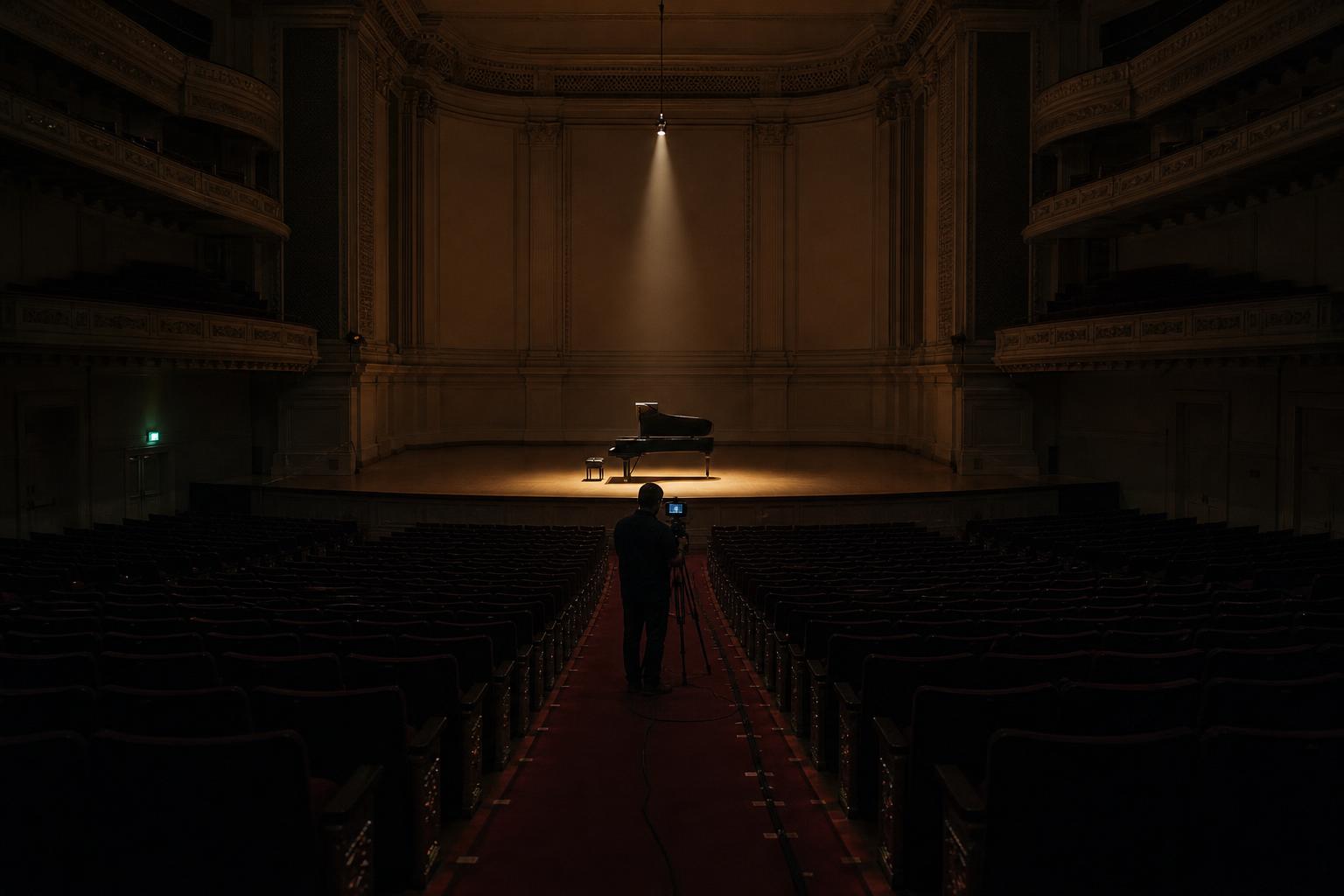
Paul Thomas Anderson's new film runs 72 minutes, contains one performer, one piano, and almost no spoken words. It premiered at the New York Film Festival this week, and it was shot with five camera operators — including Anderson himself and Benny Safdie — working a single December night at Carnegie Hall to film Cameron Winter, the 23-year-old Geese frontman, playing a solo set drawn largely from his debut album "Heavy Metal."
Five cameras, twelve songs, one take that mattered
The number that frames everything else here is five: the count of operators Anderson deployed inside a room built for 2,700 people, none of them visibly directing traffic mid-performance. That is a lot of coverage for a film that ends up looking, by design, like almost no coverage at all. Reviewers who sat in different seats that night — one in the rafters, one closer to the stage — describe the same held-back camera language: long passages on Winter's face, a shot from the back of the stage, one from the ceiling, a POV walk down the aisle with the frame bouncing like a shoulder-mounted rig. The equipment is maximal. The editing philosophy is minimal. Anderson shot wide coverage and then declined to use most of what wide coverage usually buys you — the montage, the cutaway, the crowd reaction shot. The film consists, structurally, of the concert, beginning to end, with a brief prologue of ticket scans and a short coda after the credits.
That restraint is the actual subject of the film, more than Winter himself. A five-camera concert shoot edited down to feel like a static single take is a specific, expensive choice — it means paying for coverage you mostly throw away, in service of an illusion of simplicity. The Hollywood Reporter clocks the runtime at 72 minutes; the Guardian's review lists it as 75. Both agree on the shape: virtually no stage patter, virtually no cutting away, a performer who keeps his back to the house for most of the night.
The quiet is worth more than it sounds, until you count the laughs
Here is the fact that makes the "spartan" label sound smaller than it should: across more than seventy minutes of footage, reviewers independently flag exactly one moment of audience laughter — when Winter wanders from the piano bench, apparently looking for a way off stage, and the room reads it as comic relief from the sustained gravity of everything around it. One laugh in over an hour of performance is not an accident of editing; it is a measurement of how little levity the film permits itself, and therefore how much weight each released moment carries. The Guardian's critic describes feeling "compelled to applaud after each of the 12 songs" despite sitting in a cinema, not a concert hall — which tells you the film is reproducing, rather than merely documenting, the audience behavior of that December night.
The other number worth sitting with: Winter was 23 when he played, one year older than Bob Dylan was when he first headlined Carnegie Hall. That comparison isn't decoration — it's doing real work in how the film is being sold and reviewed, positioning Winter less as an indie-rock frontman doing a solo side project and more as an artist being formally inducted into a lineage. The film's closing title card, which declares Winter "Dead at 23," makes the same joke more bluntly: mythologizing a young performer by pretending his career already needs a historical marker.
The counter-argument: sameness isn't always a virtue
Not every account treats the austerity as an unambiguous success. The Hollywood Reporter's review is the most skeptical of the three, and its critique is specific rather than vague: the songs, mostly written in a similar key and tempo, "bleed into each other with a sameness that ultimately proves monotonous." That's a real cost, not a stylistic quibble — a 72-minute film with one instrument, one voice, and no interstitial structure is betting entirely on the material sustaining tension on its own, and that bet doesn't land the same way for every listener. IndieWire's review treats the same quality as a feature rather than a bug — "many of the songs sort of hover in the same key and bleed into one another, that makes for an all the more transfixing experience" — which means the disagreement here isn't about what happens on screen, it's about whether repetition read as meditation is worth the trade against repetition read as fatigue. Both critics are describing the identical 12-song structure; they just don't agree on what sameness buys you.
There's a second, quieter tension worth naming: the film's intimacy is manufactured by a crew the audience that night mostly didn't register. The Guardian's critic, seated far from the stage, initially mistook the onstage camera operator for a bit — a deadpan joke about our need to film everything — before learning it was Anderson's own five-person crew at work. The closeness the finished film delivers is not what the live room actually offered; it's closer, more controlled, and edited to feel unmediated while being the opposite of unmediated.
What happens to the footage next
The film is being distributed roadshow-style by Janus Films, with 35mm projection at individual engagements rather than a wide theatrical rollout — a distribution choice that treats the film more like a repertory object than a release calendar item, and one outlet notes it will likely end up in the Criterion Collection. A live album, produced by Ariel Rechtshaid — a Grammy winner for his work with Vampire Weekend and Adele — is set to follow the film, meaning the audio half of that December night gets a second commercial life independent of the screen version.
What the film can't carry over, by its own critics' account, is the room itself. The Guardian singles out one moment — the house lights coming up during the line "god is real, I'm not kidding this time" — as the show's emotional peak precisely because it depended on 2,700 people seeing each other's faces at once. On film, that becomes a footnote. The quiet translates. The communal recognition of the quiet, apparently, does not.