A phone number is becoming a setting, not a SIM
iOS 27’s Handoff shares one number across two iPhones — a fix that only works if your carrier agrees to it.
By The Signal · · 5 min read
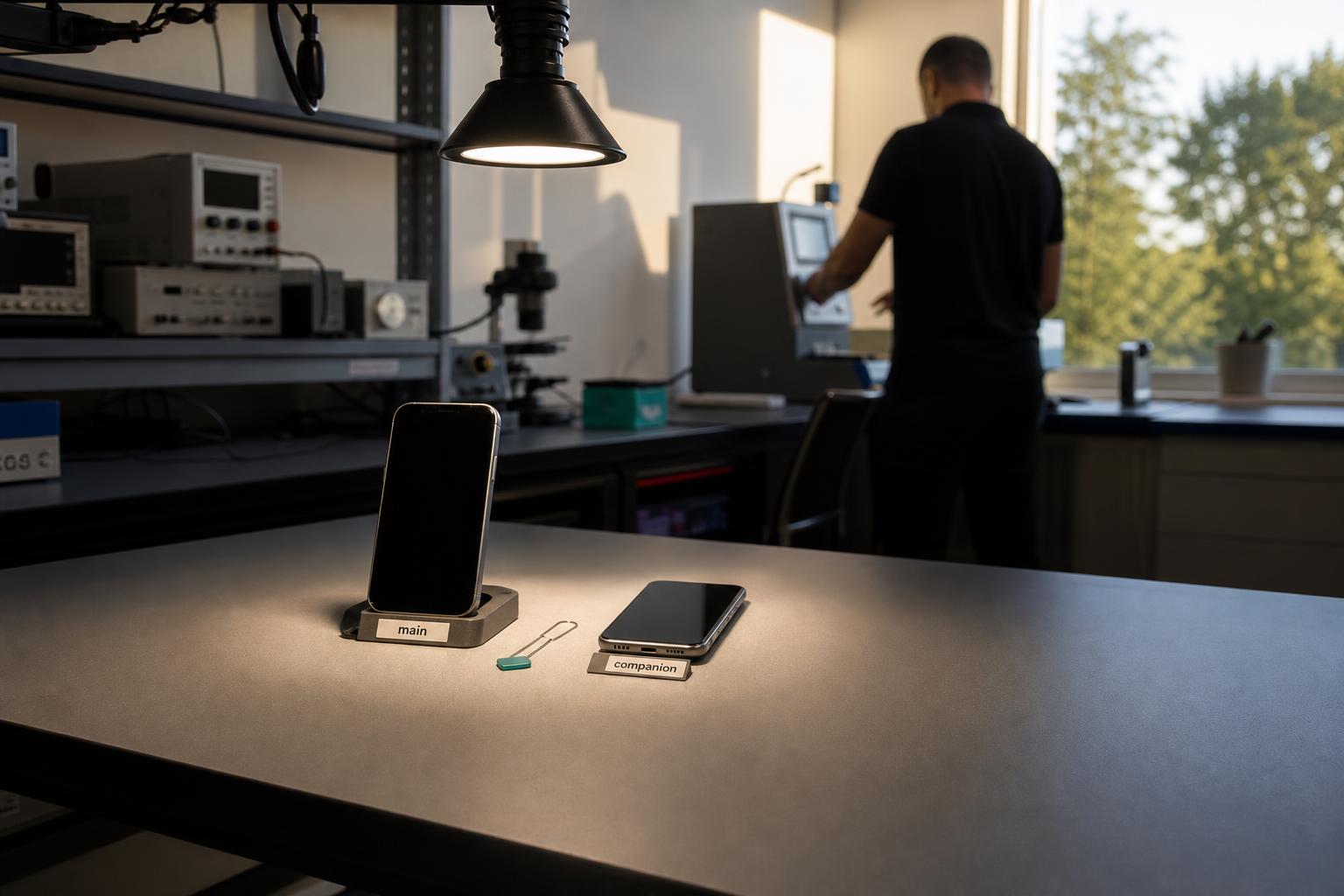
iOS 27 will let a phone number live on two iPhones at once, temporarily. Apple calls it iPhone Handoff, and the code shipped with it names exactly two carriers that currently support it: T-Mobile in the United States and Telekom.de in Germany. Everyone else's phone number stays put, no matter how new their software is.
The feature surfaced first as a one-line mention at WWDC in June 2026, with no demo and no name attached to any carrier. It resurfaced this month inside Xcode 27's Device Hub, in a setup clip that shows one iPhone designated as the "main" device and a second paired to it as a "companion" — meaning calls, texts and the cellular identity tied to that number can move from one physical handset to the other without a SIM swap, an eSIM transfer, or a call to support.
The number that matters is two, and it's a carrier's decision, not Apple's
Two named carriers, out of the hundreds Apple sells iPhones through globally, are the whole current footprint of this feature. That's the figure the story turns on, and it comes from strings found inside the iOS 27 build itself — not from an Apple press statement, which so far doesn't exist. Apple has built the client-side mechanism; whether it does anything on your phone depends on whether your network operator has built the matching server-side piece that lets a number ring on two devices under one account.
That's the part worth sitting with. A phone number was never really yours — it's a routing address the carrier's network maps to a SIM or eSIM profile, the way a postal system maps an address to a specific mailbox, not to you personally. Handoff asks the carrier to temporarily map that same address to two mailboxes and decide, moment to moment, which one gets the mail. Apple can write the software that asks for this. It cannot make Deutsche Telekom, Vodafone, or Verizon say yes.
Why two carriers is a bigger number than it looks, and a smaller one too
It's bigger than it looks because T-Mobile US and its German parent are not small test partners — together they cover close to 200 million subscriber lines, giving Apple a real population to pilot with rather than a sandbox. If the mechanism works cleanly at that scale, the technical case for other carriers to sign on gets easier to make.
It's smaller than it looks because carrier network features historically spread slowly and unevenly. Wi-Fi Calling and RCS messaging both took years to reach full carrier parity after Apple supported them, precisely because each operator has to modify its own core network — the switching infrastructure that decides which cell tower, which device, gets a given call — and that's not work Apple can do for them. A phone number moving between two devices is a harder ask than either of those features, because it requires the network to actively arbitrate between two active SIM registrations in near real time rather than just choosing a data path.
The counter-argument: this was built for the fold, not for convenience
The timing is the strongest evidence against reading Handoff as a general convenience feature. It appears in the same iOS release cycle as Apple's first foldable, expected to launch as the iPhone Ultra at the company's September 9, 2026 event, according to reporting compiled by MacRumors. The Ultra is rumored to open into a roughly 7.8-inch display and fold down to a 9mm thickness — closer to a small tablet than a phone — with a price point analysts expect to sit well above the existing Pro Max line.
A device like that invites a specific problem: people who want the screen for reading and multitasking but don't want to carry a thick, expensive slab to a bar, a gym, or a beach. Handoff solves that by letting the number — and by extension the calls, texts and two-factor codes tied to it — ride along on a smaller, cheaper second iPhone left in a pocket, while the Ultra stays home. Read this way, Handoff isn't a feature for the mass market at all. It's an accessory feature for a luxury device, built to make an expensive purchase feel less like a liability.
What the figure does next: it needs a second phone you already own
The practical requirement nobody's advertising is that Handoff needs two iPhones per person, both running iOS 27, both provisioned by a carrier that's built the server-side switch. That's not a software update — it's a second device sitting in a drawer, charged and ready, which is a very specific kind of customer: someone upgrading to a $2,000-plus foldable who happens to still have an old iPhone rather than having traded it in.
Apple's foldable strategy leans on exactly that customer. The Ultra reportedly drops Face ID for a Touch ID side button and a two-lens rear camera instead of the Pro line's three, trims that MacRumors' preview attributes to fitting a folding chassis rather than to cost-cutting. A companion phone that inherits the "real" number lets Ultra buyers treat the fold as a second screen rather than a primary phone, which softens the case for cutting Face ID or a telephoto lens in the first place — you're not always carrying it.
None of that changes what happens the day a T-Mobile customer with an Ultra travels to a country where their carrier hasn't built support. The number stops moving. The companion phone becomes just another iPhone with its own separate number, and the seamless part of iPhone Handoff turns out to have been a network feature wearing Apple's software as its interface.