A ship held 101 rescued people for a port that moved the goalposts
On two voyages in 15 days, Open Arms’ 101 rescued passengers waited out a distant, shifting disembarkation port.
By The Weekend · · 5 min read
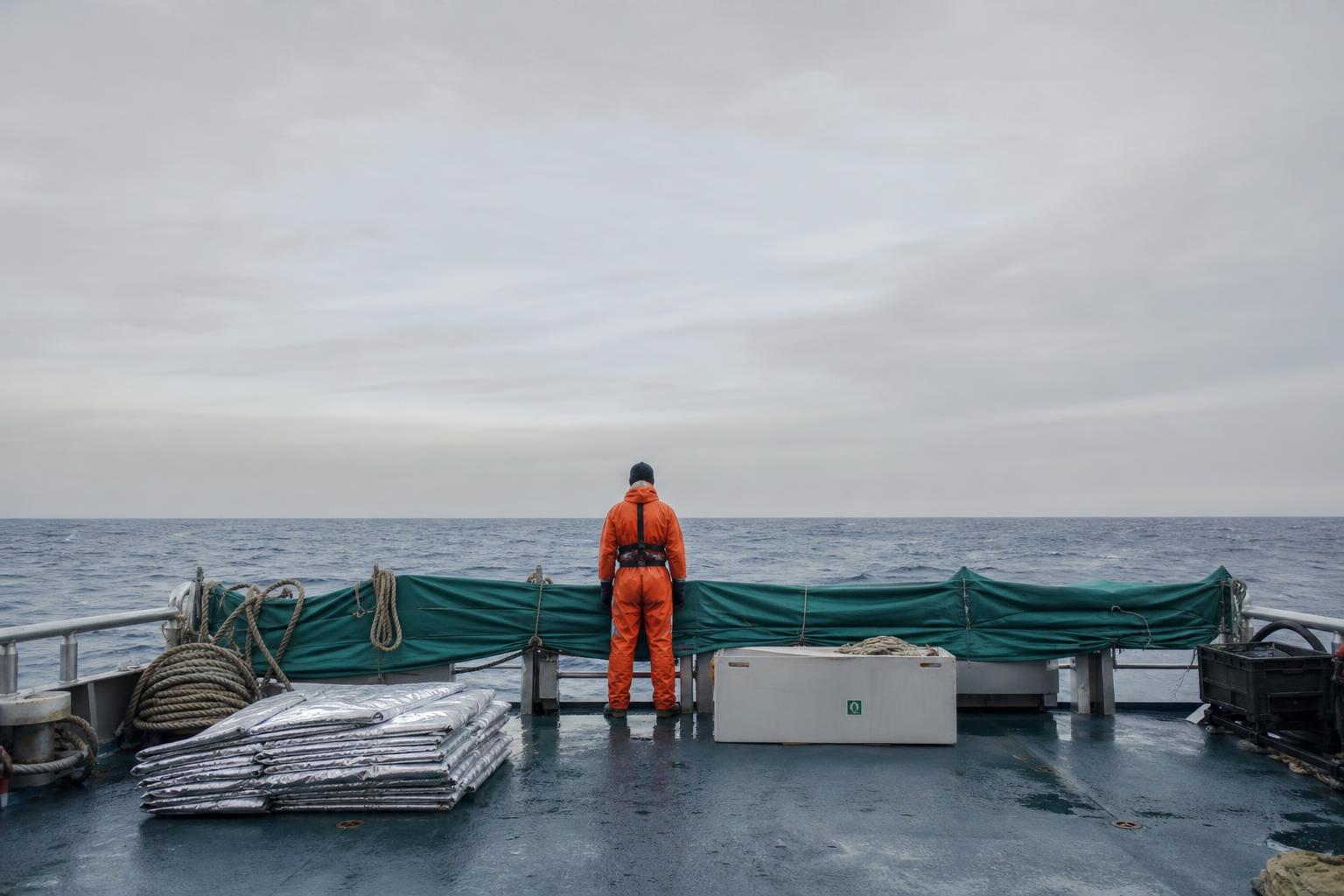
On its 129th mission, the rescue ship Open Arms pulled 101 people from the water in Italy's search-and-rescue zone across two separate operations inside 15 days. Both times, Italian authorities assigned a port far from where the rescues happened — a routine administrative act that, in practice, adds days at sea for people who have often just survived a shipwreck.
A distant port isn't a logistics footnote — it's the policy
Since 2023, Italy has assigned rescue vessels disembarkation ports that are frequently hundreds of nautical miles from the rescue site, rather than the nearest safe harbor. A ship picking up survivors near Lampedusa or Libya's search-and-rescue zone might be sent to a port in Liguria or the upper Adriatic — adding two, three, sometimes four extra days of sailing. The policy has a name in Italian administrative law (the "decreto Piantedosi") and a stated justification: distributing arrivals across the country's ports rather than concentrating them in the south. What it does in practice is keep rescued people, many already dehydrated or injured, confined on small vessels designed for search operations, not extended habitation.
This is the part that gets lost in the word "disembarkation." It sounds administrative. It is actually the main lever governments have found to manage NGO rescue capacity without changing maritime law, which still obligates ships to bring survivors to the nearest place of safety. Assigning a distant port doesn't violate that obligation on paper — Italy still names a port — but it stretches the definition of "nearest" past any geographic sense, and it does so ship by ship, case by case, with no published formula a captain can predict in advance.
Who pays: the people on board, not the ship owner
The costs of a distant port don't fall on Italy's budget or on Open Arms' operating account in any direct way — they fall on the people already most depleted by the crossing. A rescue vessel carries basic medical supplies and food for the expected transit time, not for an open-ended extension. Extra days at sea mean rationed water, delayed access to proper medical triage for injuries sustained before rescue, and more time in close quarters for people who may be traumatized, seasick, or both. Open Arms, like other NGO operators, absorbs the fuel and operational cost of the longer sailing distance — a cost in the tens of thousands of dollars per mission, depending on distance and vessel size — but that financial burden is secondary to the human one. The 101 people rescued across these two operations experienced the assignment as part of the journey, not as a bureaucratic sidebar.
The gain, such as it is, accrues to the policy's stated goal: fewer rescue landings concentrated in Sicily and Lampedusa, more distributed across Italian ports from Genoa to Ancona. Whether that distribution meaningfully eases strain on any single municipality's reception system is a separate, harder-to-verify claim — one that doesn't require extending transit time by days to achieve, since onward transport within Italy is faster and safer than additional time at sea.
The mechanism: safety law gives ground to administrative discretion
International maritime law — the 1974 SOLAS convention and the 1979 SAR convention — requires that rescued people be delivered to a "place of safety" without delay. It does not define "without delay" in hours or nautical miles, and it leaves the choice of port to the coordinating state. That gap is where the policy operates. Italy, as the state coordinating the search-and-rescue zone, retains full legal discretion to name any Italian port as the place of safety, regardless of its distance from the rescue site, so long as it is within Italian territory and nominally reachable.
This is the mechanism worth holding onto: there is no rule being broken, because the rule was never written tightly enough to prevent this. The obligation is procedural — name a port — not substantive — name the port that minimizes harm. A government wanting to discourage NGO rescue operations without confronting the SAR convention directly doesn't need to; it only needs to exploit the vagueness already built into "without delay." Every additional day of sailing time is a day in which a rescue ship isn't available for its next mission nearby, a day in which its running costs climb, and a day in which the people aboard remain in a kind of maritime limbo — rescued, but not yet delivered to anything resembling ordinary services.
It is worth being precise about what this is not. It is not pushback, which international law treats as a distinct and more clearly unlawful act — forcing a boat back toward danger. Distant-port assignment is compliant on its face. That is exactly what makes it durable as a policy tool: it produces much of the deterrent and dispersal effect of a harder line, without the legal exposure of one.
What would actually falsify this story
The claim here is narrow and checkable: that Italy's port-assignment pattern since 2023 has systematically lengthened NGO rescue transits beyond what the nearest-safe-port standard would produce, and that this lengthening carries a real cost to rescued people's wellbeing that the policy's stated goal — port distribution — does not require. If future operations show ports assigned closer to rescue zones, or if Italy publishes criteria tying port choice to distance rather than distribution targets, the pattern weakens. If NGO operators report no meaningful difference in onboard conditions between short and long transits, the human-cost claim weakens too.
What won't change the picture is another single mission's numbers. Open Arms' 129th mission and its 101 passengers are one instance of something that has recurred often enough to be a policy rather than an anomaly — the detail worth tracking isn't this ship's next port, but whether Italy's port-assignment average distance moves up or down over the coming year, and whether that movement tracks arrival numbers or tracks something else entirely.