Ageing became a diagnosis before anyone measured what changed
A Lancet essay argues medicine now treats ordinary ageing as pathology, with no agreed threshold for “abnormal.”
By The Weekend · · 5 min read
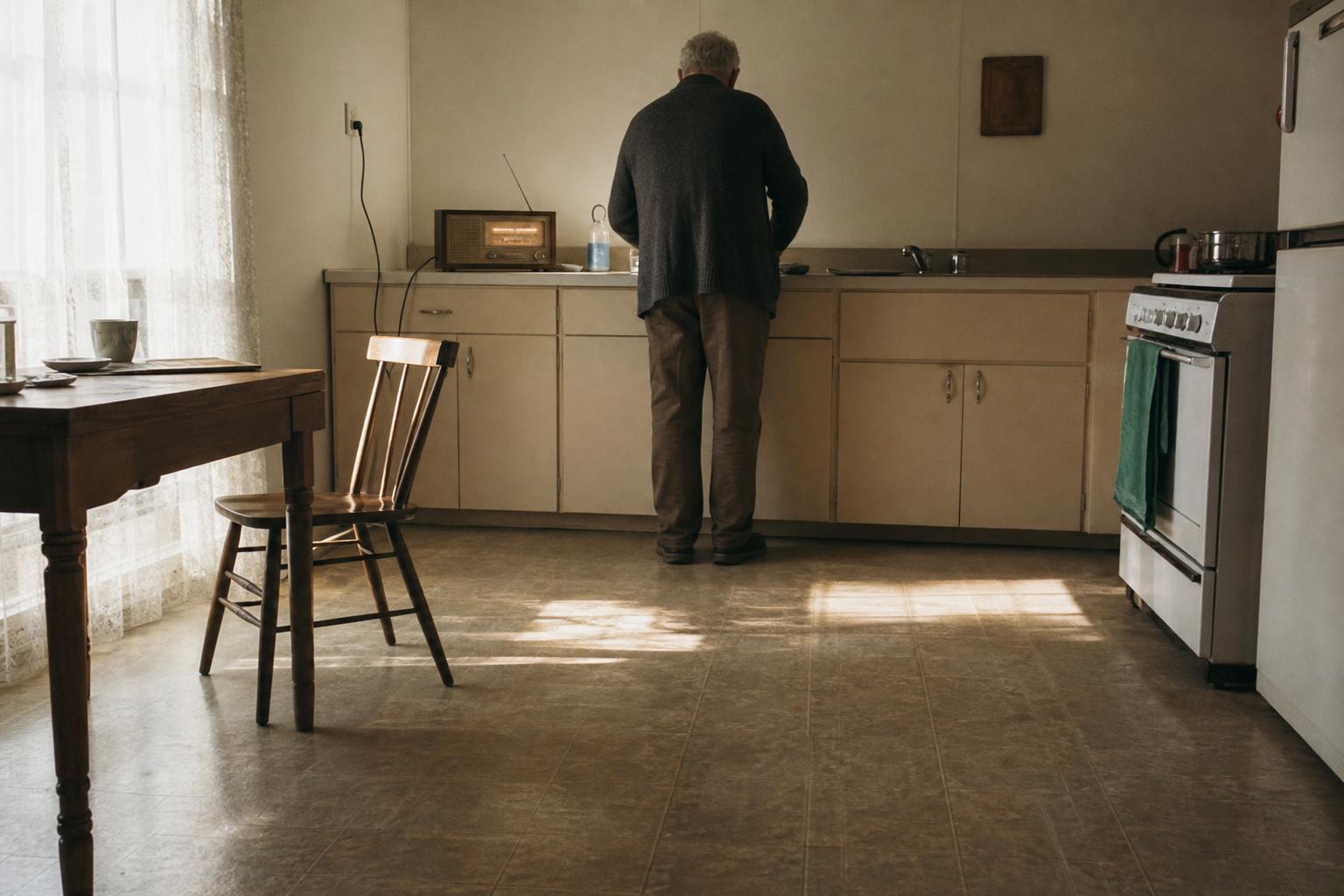
A woman dances alone in her kitchen to music only she remembers loving, and somewhere a chart is being drawn up to decide whether that counts as loneliness, depression, or simply Tuesday. The argument in this month's Lancet Perspectives essay is not that ageing bodies don't change. It's that medicine has stopped agreeing on which changes are the disease and which are just what eighty looks like.
There is no threshold. That's the actual finding.
The essay, written by a physician who spent time as a literary lecturer before finishing medical training, doesn't produce a new trial or a new drug. It makes a narrower, harder claim: that geriatric medicine has no consensus cut-off for where "normal ageing" ends and "pathological ageing" begins — not for gait speed, not for memory lapses, not for the slow retreat from social contact that comes with fewer friends left alive to call. Compare that with, say, hypertension, where guidelines specify 130/80 mmHg as the line. Ageing has produced dozens of screening tools — frailty indices, cognitive batteries, sarcopenia definitions — each with a different threshold, calibrated on different populations, agreeing with each other only loosely. A 2019 systematic review found more than 25 frailty instruments in clinical use, with concordance between them sometimes below 50%. That's not a rounding error. That's two doctors examining the same patient and reaching opposite conclusions roughly as often as not.
Why the number is smaller than it sounds — and also bigger
Fifty percent disagreement sounds alarming until you remember what these tools are actually measuring: not a molecule in blood, but composite judgments about how someone walks, grips, remembers, and copes. Disagreement here is closer to two art critics ranking the same painting than to two lab machines misreading the same sample. In that light, the number is unremarkable — subjective instruments disagree; that's what makes them subjective.
But the number is also bigger than it sounds, because these disagreements have consequences that lab-test disagreements don't. A frailty score above threshold can trigger a cascade: referral to a falls clinic, a medication review, a conversation about moving into supported housing. A World Health Organization aging and health report estimated that over-medicalization contributes to unnecessary polypharmacy in adults over 65, with some regional audits finding more than 40% of nursing home residents on five or more daily medications, a threshold associated with higher fall risk in observational cohorts — the very outcome the prescribing was meant to prevent. The essay's dancing woman is the thought experiment: is she a case, or is she a person who likes a song? The instrument that scores her doesn't know the difference, and neither, often, does the clinician holding the instrument.
The strongest objection: undertreatment kills people too
Take the counter-argument seriously, because it has real evidence behind it. Geriatricians who push back on "overpathologising" critiques point out that ageing populations have historically been undertreated, not overtreated — depression in older adults is underdiagnosed at higher rates than in younger adults, according to multiple primary-care audits, partly because low mood gets waved off as "just getting old." Osteoporosis goes unscreened in men because fracture risk is coded as a women's disease. Hearing loss, which a Lancet Commission on dementia prevention linked to a measurable share of dementia cases through reduced social engagement, routinely goes uncorrected for years because patients and doctors alike treat it as an unavoidable cost of ageing rather than a treatable condition. If the pendulum swings too far toward "leave it alone, that's just ageing," real, treatable disease gets left alone too. The essay's critics would say: the problem was never that doctors pathologise normal ageing. The problem is that ageing has been badly sorted into "normal, ignore it" and "abnormal, treat it," with the sorting done inconsistently in both directions — sometimes overmedicalising the ordinary, sometimes undertreating the real.
That's a fair hit. The essay's answer to it is that both errors have the same root cause: no agreed definition of the baseline. Without a stable idea of what unmodified, healthy ageing looks like, clinicians can't reliably say which deviations from it deserve intervention and which don't. Fix the baseline problem and you fix both failure modes — the overtreatment and the undertreatment — at once. That's the more defensible version of the argument, and it survives the counter-argument rather than being cancelled by it.
Who funds the instruments, and why that matters here
Most frailty and cognitive-screening tools were developed and validated with public research funding — national institutes on aging, university geriatric departments — rather than pharmaceutical sponsorship, which is unusual territory for a wellness-adjacent story and worth stating plainly: there's no obvious commercial incentive pushing clinicians toward over-labelling ageing as disease. The incentive, where it exists, runs through reimbursement systems that pay for diagnosed conditions and coded interventions rather than for judgment calls about what's within normal range. A frailty score that crosses threshold opens a billing code. A frailty score that doesn't, however clinically similar the patient, doesn't. That's a structural nudge toward diagnosis, not a funded campaign for one — a distinction that matters because it means no single actor benefits from tightening or loosening the threshold, which is also why nobody has fixed it.
What changes next, and what a family actually does with this
The essay doesn't propose a new consensus number, and that's honest rather than evasive — inventing one without the underlying validation work would repeat the mistake it's describing. What it does argue for is a shift in the default question clinicians ask, from "does this patient meet the threshold for X" to "has this patient's function changed from their own baseline, and does that change limit something they want to do." That reframes frailty and cognitive screening as longitudinal — tracked against the individual over years — rather than cross-sectional against a population average calibrated on people who may not resemble the patient in the room.
For a reader with an ageing parent, the practical translation is this: a single score at a single visit — a slow walk, a missed word, a quiet weekend — carries less diagnostic weight than the trend. The instrument that matters isn't the frailty index in isolation; it's the frailty index compared with the same person's score a year ago. Ask for that comparison specifically, because most charts don't surface it automatically. The dancing woman in the essay was, by every population instrument, ageing normally. What made her interesting to the author wasn't a number at all. It was that nobody had asked her, before scoring her, what she was dancing to.