Apple’s home hub keeps its face-recognition feature and its old delay
Apple’s smart display, delayed twice since 2025, still relies on Siri fixes and facial-profile software due in September.
By The Signal · · 5 min read
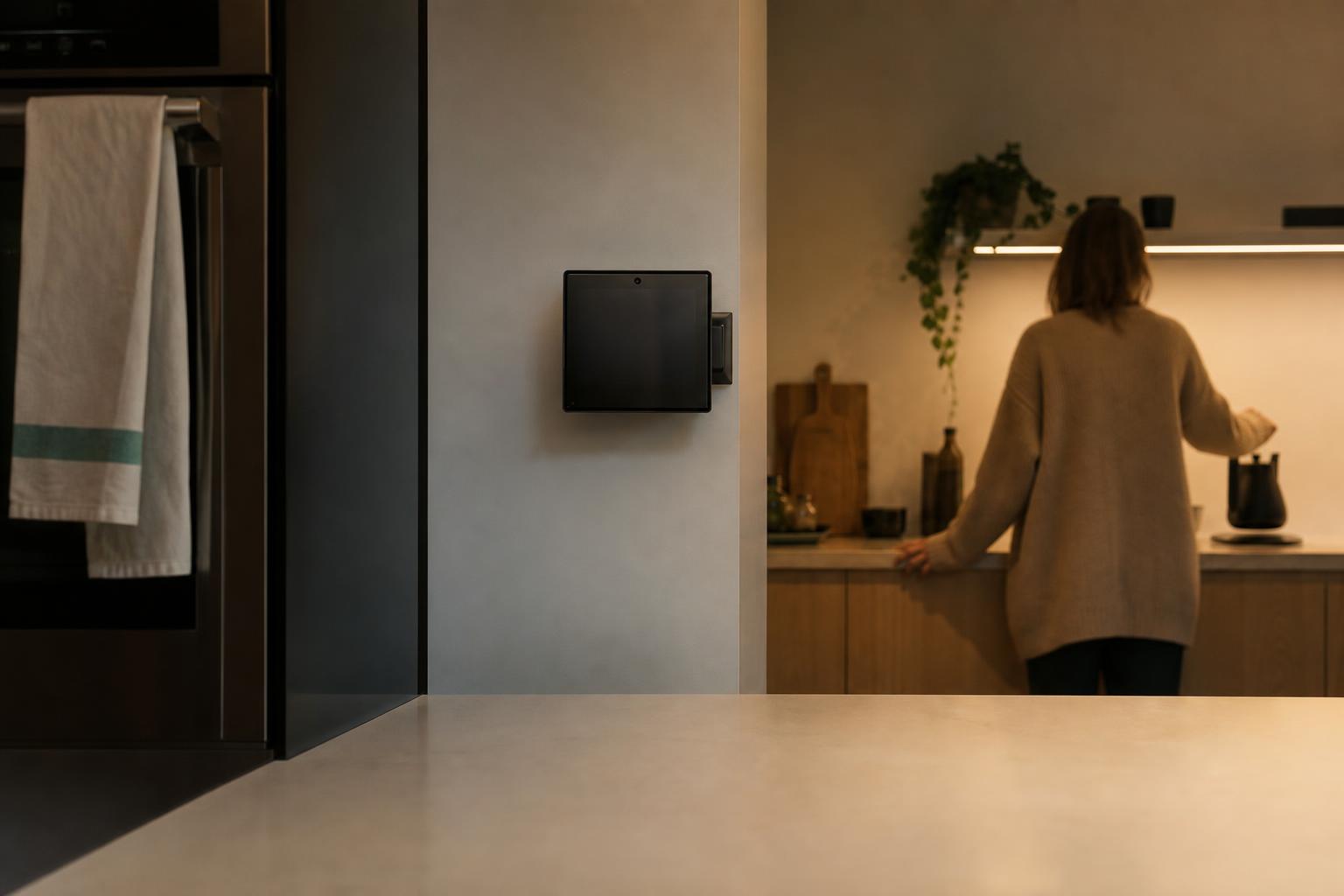
Apple's first smart home display, expected before the end of 2026, will decide who is standing in front of it before it decides what to show them. That single design choice — facial recognition tied to personalized content — has been the device's stated purpose since the earliest reports, and it is also the reason the launch has already slipped twice.
The number the story turns on is small and specific: $350, the price Bloomberg's Mark Gurman has cited as the likely tag for a seven-inch, square-screen hub with a front-facing camera, running software closer to tvOS than iOS. That figure matters less for what it buys than for what it has to include. A screen and a camera are commodity parts. The software that recognizes a face, matches it to a stored profile, and serves that person's calendar, music, or messages instead of someone else's is not commodity software at Apple's chosen bar for shipping something under its own name.
The delay was never about the screen
Apple originally targeted a spring 2025 release, then spring 2026, then September 2026, according to Gurman's reporting. The hardware — a display, a speaker, a camera module — has reportedly been ready for most of that stretch. What kept slipping was Siri. Apple's voice assistant was meant to carry conversational, context-aware requests on a device meant to sit on a kitchen counter and be talked to, not tapped. When that rebuild missed its internal marks, the device missed its ship dates with it.
This is a familiar shape in hardware planning: the enclosure and the sensor stack tend to finish on schedule because they follow supply chain rhythms that are decades old — book capacity, tool the parts, run the line. Software that has to work correctly at the moment a stranger walks into a room does not follow that rhythm. It follows an accuracy target, and accuracy targets do not care what quarter it is.
What "ambient sensing" actually checks
Code found in macOS Tahoe 26.7 describes the hub's identity system using the phrase "ambient sensing" — a term that, read against how facial-recognition systems are typically built, likely means the device is designed to recognize a face continuously and passively as someone approaches, rather than requiring a deliberate scan, a button press, or a spoken wake phrase. The practical difference is the one between a door that unlocks when it sees your key and a door that unlocks when it sees you. The former requires an action. The latter requires the system to be right, quietly, all the time, including when lighting is bad, when someone is wearing a hat, or when two household members look enough alike that the software has to arbitrate.
The code reportedly also describes support for multiple user profiles on one device — the feature that turns face detection from a security gimmick into the product's actual pitch. A single shared screen in a kitchen or hallway that shows one household member their commute time and another their kid's school pickup schedule is a coordination problem, not a display problem. Apple is betting that solving it well enough to trust unattended in a family's most-trafficked room is worth the two-year wait.
A $350 device sits inside a much larger push
The hub isn't shipping alone. Gurman's reporting ties it to a refreshed Apple TV and an updated HomePod mini, part of what he describes as a coordinated return to the home category — one Apple has approached in fits since the original HomePod's 2018 debut. Retail stores are reportedly being reorganized to make room for the new lineup, which suggests Apple expects these three devices to be shopped together rather than as one-off purchases.
That bundling logic is where the $350 number gets more interesting than it looks alone. A standalone smart display at that price competes against Amazon's Echo Show line and Google's Nest Hub, both of which sell far cheaper and neither of which does per-person facial recognition as a headline feature. Apple's device isn't pricing itself against those. It's pricing itself as the fourth screen in a house that already has an iPhone, an iPad, and a Mac synced through the same account — a hub whose main advantage is knowing whose face it's looking at because it already knows everything else about that face's owner.
The counter-argument: cameras that recognize faces have a bad track record in the home
The strongest objection to this plan isn't technical readiness. It's that always-on facial recognition in a shared domestic space is precisely the category of feature that regulators and privacy researchers have flagged for years, and Apple knows it. The company's public materials for Face ID on iPhone have leaned hard on on-device processing — the claim that facial data never leaves the chip it was captured on. A kitchen-counter device is a different threat model: it's not unlocking a phone for its owner, it's continuously scanning a room that includes guests, children, and anyone who walks past, none of whom necessarily consented to being profiled by the appliance on the counter.
Apple's likely answer, based on how it has built Face ID and on-device Photos search, is to keep the recognition local — matching against a small, on-device set of enrolled household faces rather than a cloud database. Whether that framing satisfies regulators in the EU, where biometric processing rules are stricter than in the US, is a separate and unresolved question, and one Apple has not yet addressed in public documentation.
The constraint nobody mentions: a hub is only as good as the network it sits on
A parallel case shows what can go wrong once a home device treats identity as the master key to permissions. A U.S. Cybersecurity and Infrastructure Security Agency advisory published this week describes a vulnerability in Rently's smart home platform — used in rental and multifamily properties — where insufficiently protected credentials let an attacker retrieve a property's master PIN, overriding standard user permissions entirely. Rently patched the flaw in late June, and CISA's advisory carries an 8.1 severity score out of 10.
The Rently case isn't about facial recognition, and it isn't Apple's product. But it's the same category of promise: a device that decides who gets access based on something it thinks it can verify. Rently's system verified a PIN. Apple's hub will verify a face. Both designs concentrate access decisions into a single point of failure, and the lesson from Rently is not that facial recognition is worse than a PIN — it's that any system built to grant personalized access needs its credential-handling audited as carefully as its sensor accuracy. Apple has not published how its hub stores or protects the facial profiles it builds, and that documentation, not the camera resolution, is the detail worth watching when the device actually ships.