Camera AirPods leaked their own status light before Apple did
Firmware code names image resolution, a status LED, and person detection for AirPods still a year from shipping
By The Signal · · 5 min read
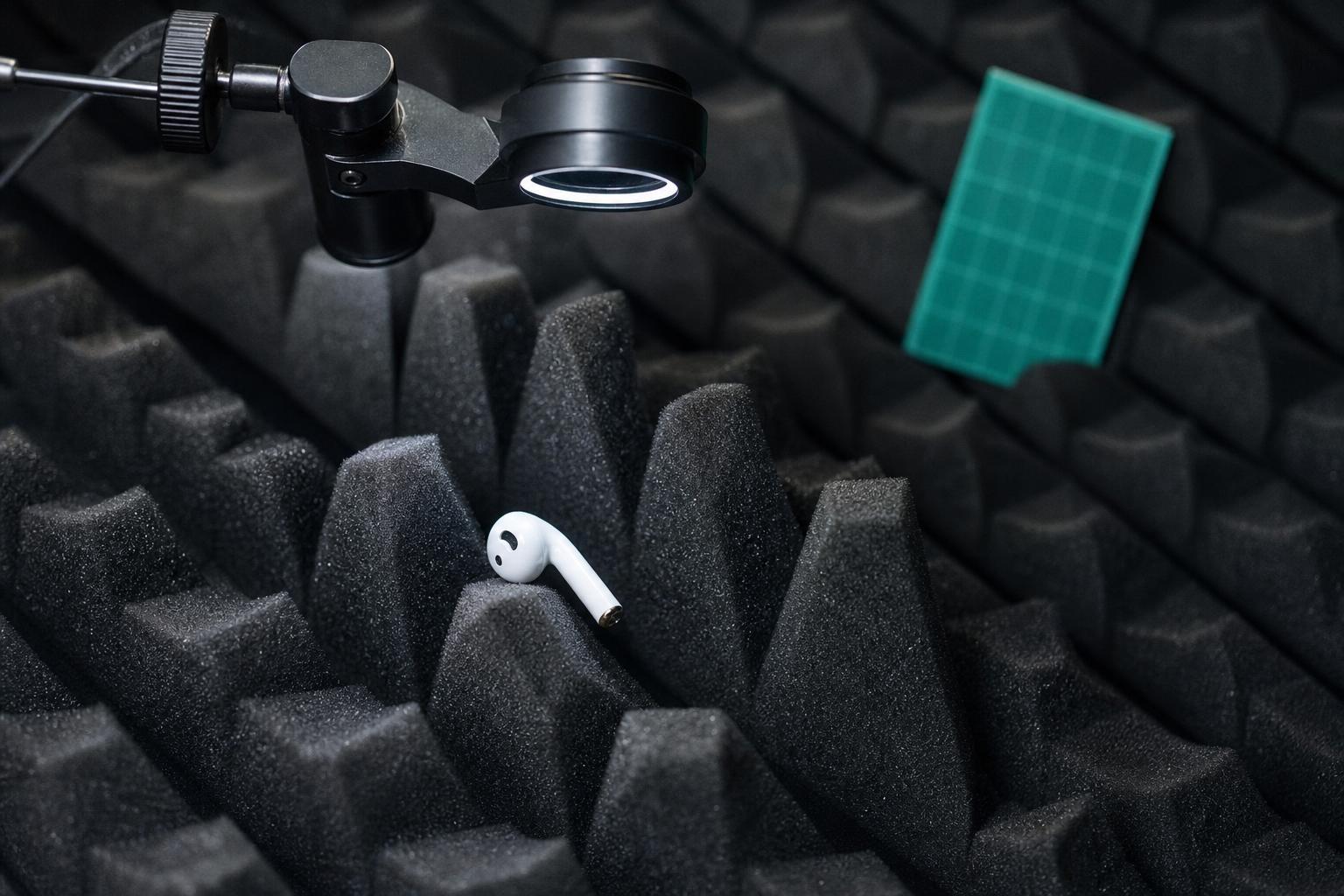
Apple has not announced camera-equipped AirPods. The strings describing them shipped anyway, buried in a macOS Tahoe 26.7 release candidate that MacRumors and 9to5Mac pulled apart this week. The code references an image capture resolution, a status light, and a person-detection routine — the internal vocabulary of a product Apple has not confirmed exists.
The number the leak turns on is one word: "resolution"
The release candidate contains a string tied to image capture resolution for a hardware variant not sold today. That is the whole finding. No pixel count, no sensor size, no field of view. MacRumors credits the discovery to forum member mactracker, working from decompiled code in the same build that earlier this week yielded a demo video of camera AirPods in action — a clip that showed the earbuds using an outward-facing lens to feed Apple's Visual Intelligence system, the same framework behind live translation and object identification on iPhone.
Firmware strings are not specifications. They are labels for features an operating system needs to reference before the hardware exists, so that software teams can build against a stable interface while industrial design and optics teams finalize the parts. A resolution string tells you Apple's software has a slot for that value. It does not tell you what fills the slot. Think of it as a shipping manifest that lists "one crate, contents: camera module" months before the crate is packed. The paperwork exists ahead of the object.
Why a status light matters more than a lens does
The more consequential detail in the code, according to MacRumors' reporting, is a status light and person-detection logic. A camera on a device worn in public ears raises a question no resolution spec answers: how does anyone nearby know it is recording? Apple has answered a version of this before. AirPods with hearing-aid features already carry FDA clearance obtained in 2024, which required Apple to document exactly what the device senses and when. A camera adds an optics-and-privacy problem Apple's wearables have not faced at this scale — Vision Pro's cameras sit on a headset users can see coming; an earbud is smaller than a fingertip and already the least conspicuous camera-adjacent device ever proposed for mass production.
Person detection — code that distinguishes a human subject from background — suggests the camera is meant to trigger contextual software (identifying what you're looking at, translating a sign, reading a label) rather than record continuously. That is a narrower, more battery-conscious design than a bystander might assume, and it matters for the regulatory conversation that will follow any launch: intermittent, sensor-triggered capture invites a different privacy review than an always-on lens.
The strongest reason to doubt any of this ships soon
9to5Mac's own AirPods buying guide, published the same week, states plainly that camera-equipped AirPods "are not expected to arrive until 2027 at the soonest." That is not a leak-driven guess; it is the outlet's working assumption for readers deciding whether to buy AirPods Pro 3 today. A product a year or more out, still being scaffolded into pre-release firmware, is standard Apple practice — the company has historically seeded API references and internal flags for hardware two to four release cycles ahead of retail availability, which is roughly how AirPods Pro 2's hearing-health features surfaced in code before their 2024 rollout.
The counter-argument, made by skeptics of leak coverage generally, is that firmware archaeology overstates certainty. A string can be abandoned. Apple has shelved entire feature sets after they appeared in beta code — features referenced, tested internally, then quietly removed before a public build. The camera AirPods story rests on two independent signals now: a demo video and a code trace, both from the same release candidate, both interpreted by the same community of forum researchers who have a mixed but nontrivial track record. Treat the resolution string as evidence of active engineering, not evidence of a shipping date.
What the beta firmware released this week actually changes today
Separate from the camera speculation, Apple pushed real beta firmware this week for AirPods Pro 3 and select other current models, according to 9to5Mac's reporting on the release. That firmware is unrelated to camera hardware — it is the ordinary maintenance cycle Apple runs alongside iOS and macOS betas, tuning noise cancellation, connection stability, and battery reporting on hardware already in 34 million or more ears, based on AirPods' position as the best-selling wearable audio product globally. It is worth separating cleanly from the camera story, because the two are getting covered in the same news cycle and the beta firmware is the only one of the two that affects a device you can currently own.
The constraint nobody in the coverage names
Every camera AirPods report this week — the demo video, the resolution string, the status light, the person detection — describes software referencing hardware that has not been certified, priced, or scheduled. None of it touches the harder problem: an earbud camera needs a power budget that current AirPods do not have room for. AirPods Pro 3's case and stem already allocate their volume to battery, driver, and antenna. A camera sensor, its processing, and a status LED all draw power inside a chassis that has not grown in a decade of AirPods generations. The resolution string tells you Apple's engineers have decided what the camera should see. It says nothing about how long the earbud runs once it starts seeing it — and that arithmetic, not the code trace, is what determines whether 2027 holds.