Google’s space data center needs 1,800 Starship launches that don’t exist yet
Google’s orbital chip test depends on SpaceX launching 1,800 times by 2036 — current pace is five.
By The Signal · · 5 min read
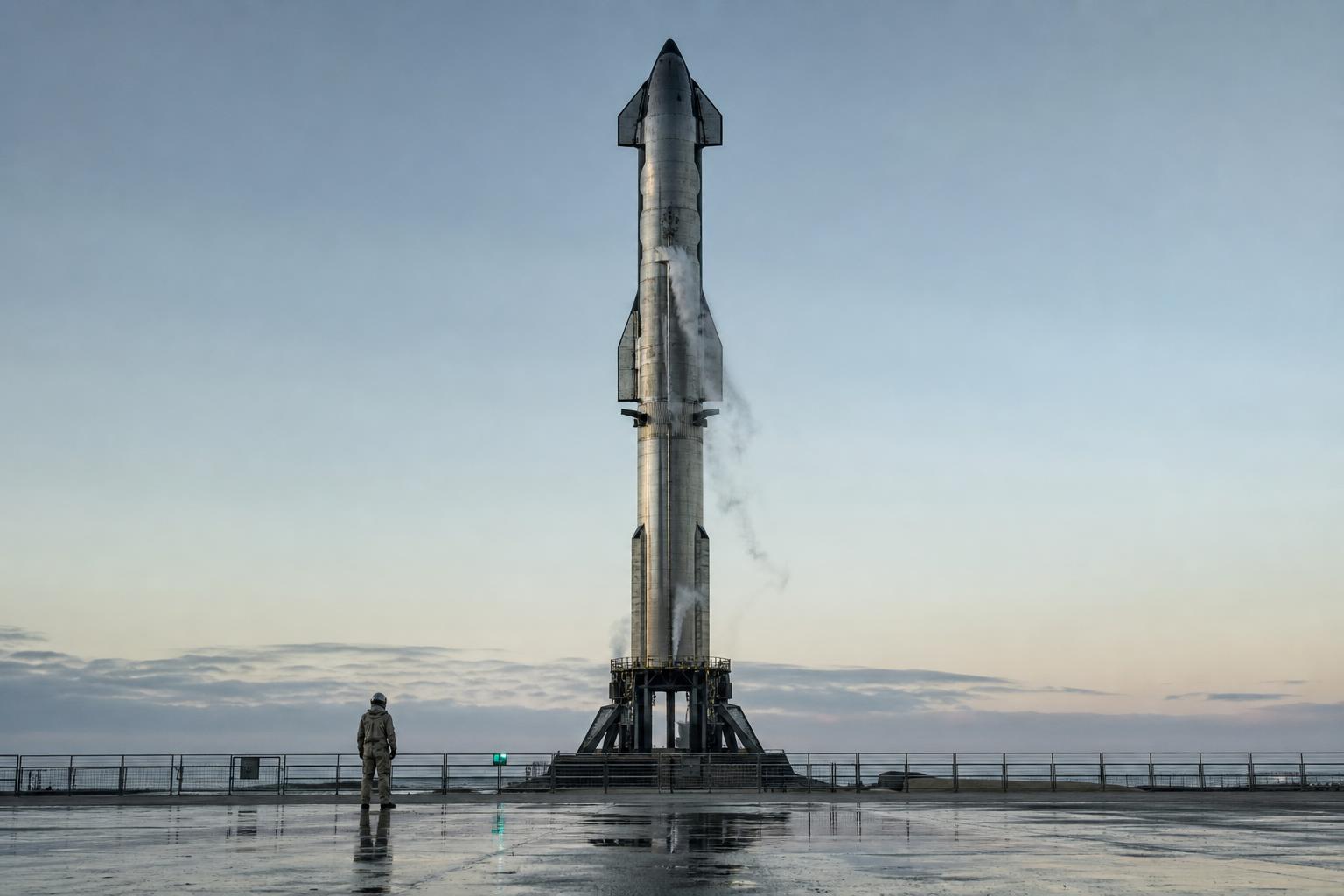
A SpaceX rocket carried a Google chip into orbit this week — the first time one of the company's Tensor Processing Units has flown in space. The satellite itself is modest: a standard platform built by Planet Labs, firing the chip in 15-minute bursts to avoid overheating. The number that matters isn't the chip. It's 1,800 — the number of Starship launches Google's own research says its full orbital data center plan requires, on a rocket that has flown five times in a single year, at most.
One satellite, 81 needed, and the arithmetic in between
Project Suncatcher, Google's effort to build compute clusters in orbit, envisions a network of 81 satellites flying in tight formation, processing workloads in parallel and talking to each other over laser links. This week's launch is the first rung: prove a TPU can survive the trip, run models without failing, and shed heat without a data center's usual cooling infrastructure. Google says it had already tested the chip on the ground, but as Travis Beals, the executive who runs Suncatcher, put it, no ground test is quite like the real thing.
A second demonstration, planned for next year, will fly two satellites built specifically for heavier compute workloads, testing whether they can coordinate across a laser link rather than operate independently. That's the easy part, relatively speaking. The hard part is what it takes to get 81 satellites' worth of hardware, and whatever comes after, off the ground at a price that makes any of this worth doing.
The figure the whole plan turns on: $200 per kilogram by 2035
Google published a peer-reviewed white paper this week, headed for the journal Joule, laying out the economics of orbital computing in more detail than the company has before. Its authors note SpaceX has cut launch costs by roughly 20% a year since the Falcon 1 first flew — a "learning curve" common to manufacturing, where each doubling of production experience lowers unit cost by a predictable percentage. Extrapolate that curve forward, and the paper estimates SpaceX could get Starship's price down to around $200 per kilogram of payload by 2035.
That number is the hinge. At $200 per kilogram, putting serious compute mass into orbit starts to look like infrastructure spending rather than a science experiment. Below that curve, the economics of space data centers don't clear even Google's own, carefully hedged analysis — the company is explicit that this is not an economic feasibility study, just a picture of what has to be true for one to eventually exist.
Why 1,800 launches is a bigger number than it sounds
Getting to that $200-per-kilogram price isn't just a matter of Starship existing. Learning curves are driven by cumulative volume — the more a factory builds, the more it learns, the cheaper each unit gets. Google's paper works backward from the Falcon 9's own cost trajectory to estimate the volume Starship needs to fly to replicate it: 370,000 metric tons of payload carried to orbit. If each Starship flight carries 200 metric tons — a generous assumption, since the vehicle hasn't yet demonstrated that payload to orbit reliably — that works out to roughly 1,800 launches over ten years, or 180 a year.
Starship has never flown more than five times in a single year. Getting from five to 180 is not a 36-fold improvement in a schedule; it's a 36-fold improvement in a vehicle that is also expected to be hauling four times its demonstrated payload. Think of it less like a shipping line adding routes and more like a shipping line that has only ever sent one container ship a year being asked to run a fleet on an hourly schedule — the port, the fuel supply, the dock crews, and the ships themselves all have to scale together, not just the launch cadence.
Musk says an hourly flight rate by 2029. The paper doesn't rely on it.
SpaceX's own projections are more aggressive than Google's math requires. Elon Musk has floated an hourly Starship flight rate as early as 2029, which — taken at face value — would blow past 180 launches a year within months, not a decade. Google's authors don't lean on that figure, and the piece notes dryly that Musk says a lot of things. Their 1,800-launch estimate is built from the slower, already-observed Falcon cost curve, not from Starship's aspirational one.
That's the strongest case for taking the number seriously rather than dismissing it as another space-industry fantasy: it isn't extrapolated from hype, it's extrapolated from a rocket company's fifteen-year track record of actually lowering costs on schedule. The counter-argument is that Falcon 9 solved reusability for an orbital-class rocket roughly the size of a large building; Starship is solving reusability for something closer to a fifty-story building, with a heat shield that has to survive reentry intact enough to refly within days. Nobody has done that at scale, and nothing in the cost-curve math accounts for the possibility that the harder engineering problem simply takes longer, regardless of how many customers are waiting.
The radiation problem got easier. The launch-cadence problem didn't move.
One piece of good news buried in the research: Google had to redo its particle-accelerator radiation tests after discovering that the way the chips are physically arranged inside the satellite provides more shielding than engineers expected. That's a real, measurable result — it means the chips are likely to survive the radiation environment in orbit longer than initial, more conservative tests suggested. It's also the kind of problem engineering solves on a predictable timeline, in a lab, without needing a third party's cooperation.
The launch-cadence problem is not that kind of problem. Google doesn't build rockets. It is, by its own account in the paper, a customer waiting on someone else's manufacturing curve — notably, a customer with equity in the outcome, since Google is also a major investor in SpaceX. That dual position, part customer and part shareholder, means Google's incentive to believe the 2035 price point is reachable is not purely analytical. The paper is careful to flag its own assumptions, but the 1,800-launch figure is still a forecast built on a company Google has a financial stake in actually exceeding its own best year by 36 times, within a decade, while also solving reentry reliability at a size nobody has flown before.
What happens next is unglamorous: more 15-minute burst tests, a two-satellite laser-link demo next year, and a wait to see whether Starship's annual launch count moves from five toward even 20 or 30 — a number that would still leave the 2035 target out of reach, but would at least show the curve bending the direction Google's paper needs it to.