No cancer screening guideline covers a nursing home resident
No major guideline addresses long-term care residents; 8.1% of women 75+ reach stage 4 breast cancer.
By The Weekend · · 4 min read
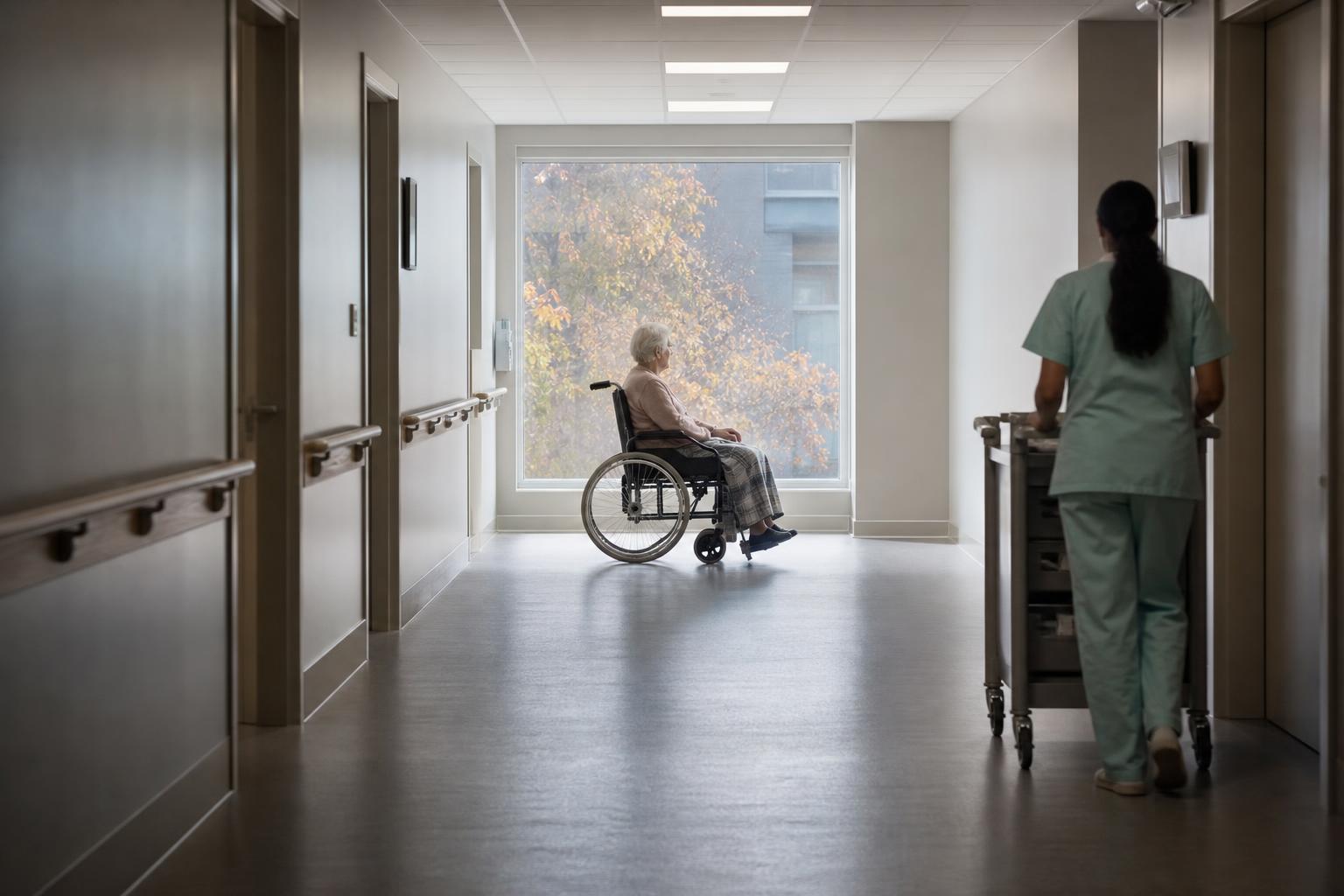
A woman living in a long-term care facility can go six years without a breast cancer screening and no guideline will have been violated, because none exists for her specifically. When she is finally diagnosed at stage 4, the statistics say that outcome hits patients 75 and older at 8.1%, versus 6.0% for those 40 to 74 — a gap that tracks not just biology but who gets checked.
She was admitted for a foot sore. The lump came six years later.
The case that surfaced this pattern is one cancer epidemiologist's account of her aunt: admitted to a long-term care facility in 2020 with a foot sore and arthritis severe enough to limit walking, diagnosed with stage 4 breast cancer in April at 78, dead three weeks later. The cancer was found incidentally, during a hospital visit for a urinary tract infection — not through any breast screening, because she hadn't had one since entering the facility. She had felt a lump herself and never mentioned it. After the diagnosis, according to family, she blamed herself and stopped fighting.
What makes the case instructive rather than merely sad is what didn't fail. No policy was broken. No clinician skipped a mandated test. The facility wasn't negligent by any written standard, because no major national guideline tells long-term care providers whether, or how, to screen residents like her. The gap isn't enforcement. It's that the rulebook has a blank page where this population should be.
Every major guideline hands the decision to someone, and stops there
Breast cancer screening guidance for older adults has always been a patchwork of hedges. The American Cancer Society says screening should continue "as long as a woman is in good health and is expected to live 10 years or longer" — a standard that requires someone to estimate a stranger's life expectancy, which is harder than it sounds for a 78-year-old with arthritis but an active social calendar. The U.S. Preventive Services Task Force says the evidence is simply insufficient to weigh benefits against harms for women 75 and older. The American College of Obstetricians and Gynecologists, in guidance updated this year alongside its new HIV screening recommendations, frames it as a "shared decision-making process" between patient and provider that accounts for health status and longevity.
Each of these is defensible on its own terms — mammography trials have historically excluded or underrepresented women in their late 70s and 80s, so the evidence base to build a firm rule on is thin. But "shared decision-making" presumes a provider who initiates the conversation and a patient positioned to weigh in. Long-term care residents often have neither a consistent physician relationship nor the standing to bring up a lump they noticed themselves. The guidance was written for a decision made in a clinic, between two people who know each other, and it gets applied — or doesn't — in a setting built around different priorities: medication schedules, mobility, infection control.
The literature studies the harm of screening more than the harm of skipping it
Here is the asymmetry nobody states outright: research on screening older or institutionalized women focuses heavily on overdiagnosis, unnecessary biopsies, and the anxiety of false positives in a population with limited life expectancy. That's a real cost, and it's not invented — a mammogram in a frail 85-year-old can lead to a biopsy she doesn't need for a cancer that would never have killed her. But the reciprocal question — how many long-term care residents like this one have operable, meaningfully treatable cancer and are simply never checked — gets almost no dedicated study. There is no registry, no trial, no major guideline population specifically defined as "long-term care resident," so there's no denominator against which to measure how often screening decisions are made well or badly in that setting.
The result is a system that has built careful guardrails against over-screening the elderly in general, while leaving a subgroup — people who cannot easily self-advocate, whose primary contact with medicine is often facility staff rather than a personal physician — without any framework at all. Not overscreened. Not underscreened by a documented margin. Just unaddressed.
The one honest question: who decides, and when?
The open question isn't whether screening guidelines should exist for long-term care residents — it's who would write them, and against what evidence, given that trials have rarely enrolled this population in numbers large enough to generalize from. A guideline built on shared decision-making assumes a decision gets made. In long-term care, the missing step usually isn't a clinical judgment call weighed and rejected — it's that the conversation never starts. Fixing that may be less about mammography thresholds and more about who is responsible for asking the question in a setting where turnover among aides and physicians is high and continuity of care is the exception. No professional body has claimed that responsibility yet.
Does Medicare cover mammograms for long-term care residents?
Yes — Medicare Part B covers annual screening mammograms with no age cutoff, so coverage isn't the barrier; the barrier is whether anyone orders it.
At what age do doctors typically stop recommending mammograms?
There's no fixed cutoff; most guidance shifts from routine recommendation to individualized discussion somewhere around 74 to 75, based on health status rather than birthdate alone.