Two atomic clocks tick at a trillionth the error, still not a standard
Jun Ye’s Wolf Prize-winning clocks are precise enough to redefine the second, but no agency will yet switch.
By The Signal · · 5 min read
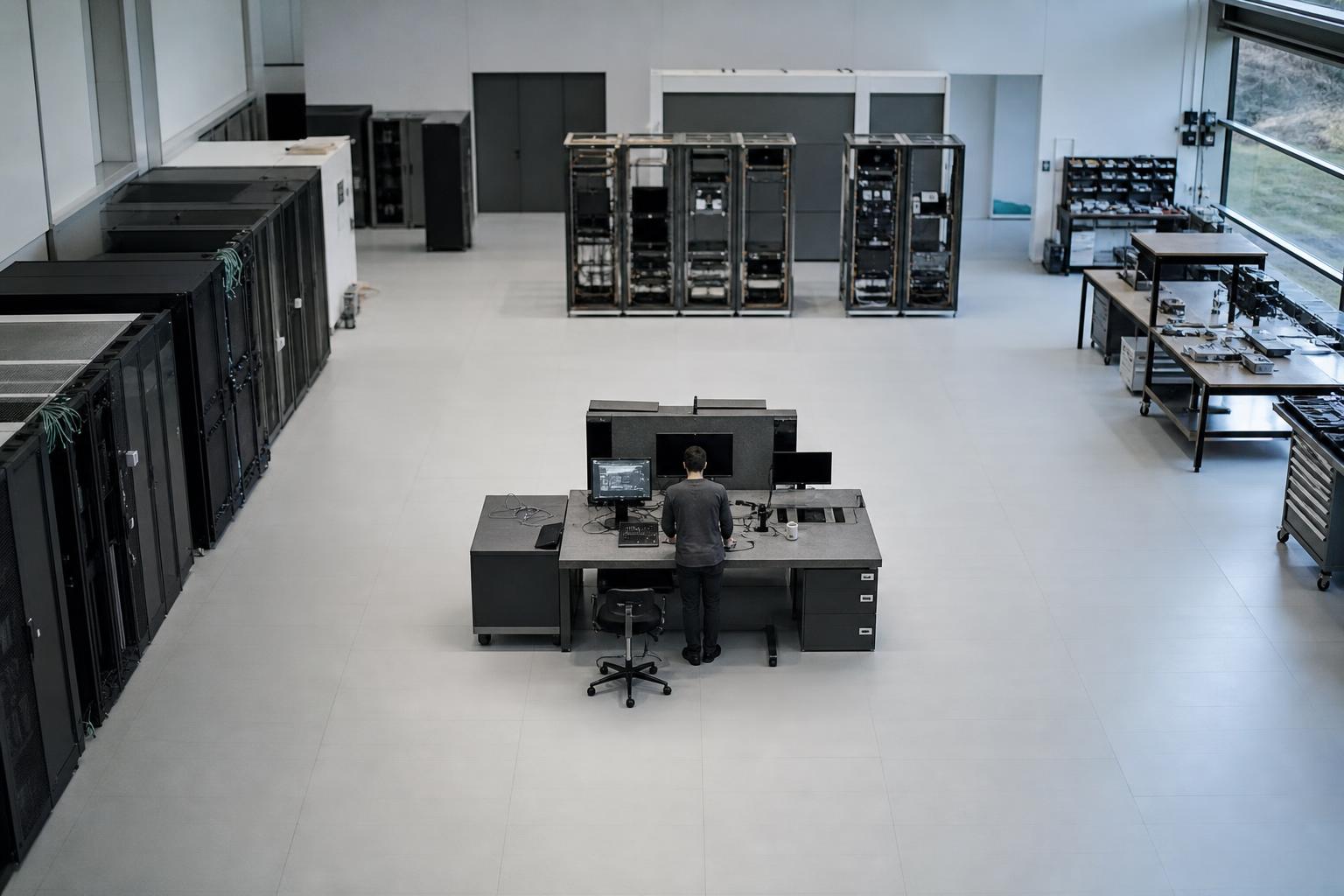
An optical atomic clock built by Jun Ye at JILA, the joint physics institute run by NIST and the University of Colorado Boulder, now loses or gains less than one second over roughly 30 billion years — longer than the universe has existed. On October 2026, the Wolf Foundation awarded Ye, splitting the $100,000 prize with Immanuel Bloch of the Max Planck Institute of Quantum Optics, for what the citation calls "transformative, widely applicable advances in the control of ultracold atomic systems." The clock is accurate enough to replace the international definition of the second. It still hasn't.
A second is defined by cesium, not by the thing that beats it
Since 1967, the official second has been defined by a specific cesium atom transition, counted 9,192,631,770 times by the microwave clocks that anchor global timekeeping. Cesium clocks are good — accurate to about one second in 100 million years. Ye's optical lattice clocks, which use strontium or ytterbium atoms trapped by laser light and probed with ultrastable lasers at optical frequencies rather than microwave ones, are roughly 100 times more precise again. The gap is the difference between a wristwatch and a pendulum clock built to observatory tolerances: both tell time, but only one can catch the other being wrong.
The International Bureau of Weights and Measures, the Paris-based body that holds authority over the definition of the second, has not switched. A redefinition requires multiple labs worldwide to independently reproduce the same clock performance using different atomic species, and for those results to agree within a tolerance tighter than anything cesium clocks can even verify. That verification problem is the quiet joke at the center of the field: the new clocks are so good that the old clocks can no longer be used to check them.
The money is in GPS, not physics
Ye's work, conducted at JILA under the U.S. Department of Commerce, is paid for as metrology infrastructure, not pure research — NIST's mandate is measurement standards that other agencies and industries depend on. The immediate commercial and strategic stakes sit downstream of the physics. GPS timing already depends on atomic clocks aboard satellites; a clock 100 times more stable, if miniaturized and flown, tightens positioning accuracy and resists the kind of drift that forces ground stations to constantly correct satellite signals. Financial exchanges that timestamp trades to the nanosecond, and seismic networks that triangulate earthquakes by comparing arrival times across stations, both gain directly from a tighter global clock — without ever touching a laser-trapped atom themselves.
Ye's clocks have also been used to test whether fundamental constants — the fine structure constant, for instance — are actually constant over time, a question that ordinary physics can't otherwise probe. His group has used the same ultracold-atom control techniques to run the most sensitive search yet for the electron's electric dipole moment, a measurement that constrains theories of physics beyond the Standard Model. None of that pays for itself; it's funded because a government lab system exists to fund exactly this kind of instrument-building that has no product at the end of it, only a better ruler.
Trapping an atom in light is the whole trick
The mechanism is a laser cage. An optical lattice clock holds thousands of atoms — strontium, in Ye's best-known work — suspended at the intersection points of standing laser light waves, the way a shaken sheet traps marbles at its wrinkles. Each atom sits isolated from its neighbors and largely undisturbed by outside heat or vibration, cold enough that its internal "ticking" — an electron jumping between two energy states at a precise optical frequency — isn't blurred by motion. A second ultrastable laser, locked to that transition frequency, becomes the clock's pendulum; counting its oscillations is counting time.
The hard part, and the part the Wolf Prize specifically credits, isn't trapping one atom — it's controlling thousands simultaneously without them interacting with each other in ways that shift the frequency being measured, and without the trapping laser itself disturbing the transition it's supposed to leave alone. Ye's group solved this with what's called a "magic wavelength" trap, tuned so the laser light shifts both atomic energy states by exactly the same amount, canceling out. That single design choice is why these clocks reached stability other atomic systems couldn't.
A grandmother's pencils, a government lab, a shared prize
Ye, born in Shanghai in 1967, credits an illiterate grandmother who gave him a bundle of pencils and paper and told him to draw whatever interested him; he immigrated to the U.S. in 1989, joined JILA in 1992 under NIST physicist John Hall, and has stayed in government-adjacent research ever since — the Wolf Prize is his latest, following a shared 2022 Breakthrough Prize in Fundamental Physics for the same body of clock work. Bloch, his co-laureate, runs parallel work in Germany on ultracold atoms in optical lattices, and the split prize reflects a field where the foundational technique — laser-cooling and trapping atoms precisely enough to study them one at a time — has no single national owner.
That matters for how redefinition will actually happen, if it happens. The metric system's past unit changes — the kilogram's 2019 shift from a physical platinum cylinder in France to a fixed value of Planck's constant — took international consensus built over decades, with multiple countries' labs independently confirming the same number before the vote. A new second would likely follow the same path: NIST's clocks, Germany's, Japan's, and others would need to agree on a candidate atomic transition and demonstrate reproducibility across institutions, not just within one lab.
The clocks are ready. The vote isn't scheduled.
The General Conference on Weights and Measures, which meets roughly every four years, has signaled an optical redefinition could come as early as 2030, contingent on international comparison campaigns that are still running. The falsifiable test is straightforward: watch whether multiple national labs publish agreement between independently built optical clocks — using different atomic species, different lasers, different buildings — within the uncertainty the new definition would require. If that agreement holds across several more years of comparison, a 2030 vote is plausible. If labs keep finding small, unexplained discrepancies between their best clocks, the cesium second survives past its sixtieth anniversary not because it's better, but because nothing has yet proven, in public, exactly how much better the alternative really is.