$150 million buys Alaska a second power line, not cheaper oil checks
DOE’s $150 million grid grant and BLM’s Arctic drilling waiver landed the same month, paid by different accounts.
By The Ledger · · 5 min read
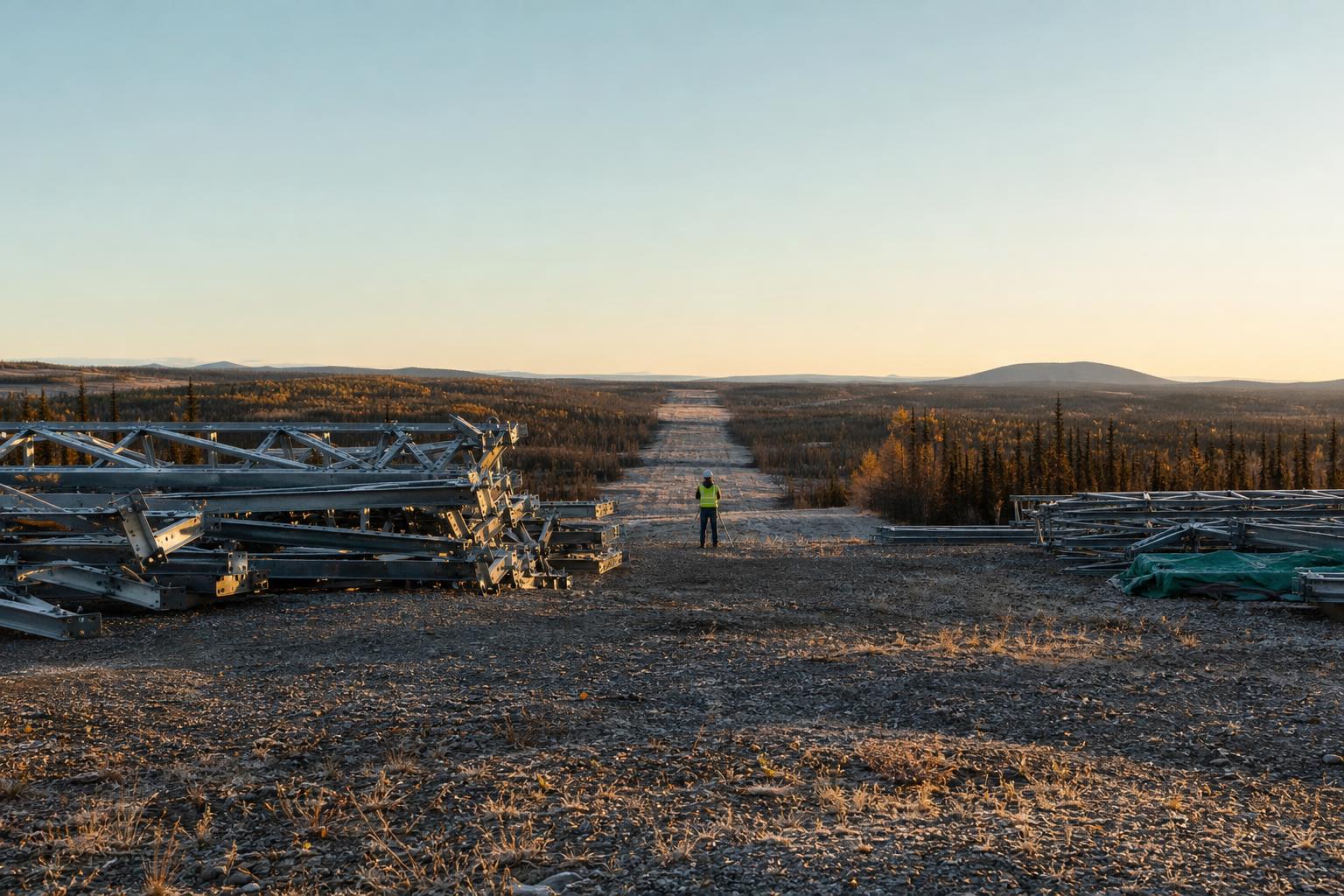
The U.S. Department of Energy is putting up to $150 million of Defense Production Act money into a 223-mile power line across Alaska's Interior. The same month, the Bureau of Land Management removed the environmental review requirement for oil exploration across the Western Arctic's federal land. One decision moves electrons. The other moves drill rigs. Both arrived from Washington with no shared ledger, and no shared timeline for who benefits first.
$418 million, split three ways
The Beluga-Healy Transmission Project carries a preliminary planning estimate of $418 million. The Department of Energy confirmed on its own site that $150 million of that comes from Defense Production Act funds, with the remaining $268 million from non-federal sources — the Alaska Energy Authority and its partners. That federal share draws on a $1 billion pool appropriated under the Working Families Tax Cut for projects the administration has designated critical to national security, under Presidential Determination No. 2026-10.
The line itself is specific: 223 miles connecting Beluga, on the Southcentral grid, to Healy, in the Interior. It gives grid operators a second route between Alaska's two main population centers and its major military installations. The Department of Energy says that benefits roughly 75% of the state's population — the share living along the existing Railbelt corridor the new line would reinforce.
Why 75% of Alaskans sounds bigger than it is
Alaska's population is about 733,000 people. Seventy-five percent of that is roughly 550,000 residents — fewer people than live in Oklahoma City. The number is real, but it describes density, not scale. Alaska's Railbelt, the electrical corridor running from Southcentral to Interior Alaska, already carries most of the state's grid traffic on a single high-voltage line. A second line doesn't add new customers. It adds redundancy for the ones already connected, the kind that matters when ice storms or equipment failure take the first line down.
Energy Secretary Chris Wright framed the project around failure risk rather than growth: Alaska's grid needs "another way to keep power moving," in the words of Office of Electricity Assistant Secretary Katie Jereza. That's an argument about reliability, not expansion. It also doubles as a hedge for new electricity demand the administration is simultaneously inviting in — mining operations and the "major U.S. military expansion currently underway in Alaska," as Wright described it, both of which need power a single transmission line can't guarantee.
The exploration waiver has its own arithmetic, and it skips a step
Separately, and without reference to the transmission grant, the Bureau of Land Management issued a categorical exclusion under the National Environmental Policy Act. It applies to oil exploration across the Western Arctic — the National Petroleum Reserve-Alaska, the largest single tract of federally managed public land in the country. Categorical exclusions let agencies skip the standard environmental review process for actions judged to have no significant individual or cumulative effect. Oil companies can now drill exploratory wells there without the environmental assessment or impact statement NEPA otherwise requires.
The administration's logic ties both moves to the same goal: faster energy development in Alaska, backed by federal money and federal permitting speed. But the transmission project runs on a construction timeline measured in years — engineering, procurement, and 223 miles of line don't go up in a season. The exploration waiver removes a paperwork step that could otherwise take 12 to 18 months. One policy compresses a bureaucratic delay. The other requires one that can't be compressed. They move on different clocks, funded by different accounts, serving different parts of the same industrial ambition.
The strongest objection: redundancy isn't optional in Alaska's grid
The case for the transmission line stands on its own, independent of the drilling waiver. Alaska's Railbelt has one main high-voltage connection between its two population centers. A single point of failure on a grid serving three-quarters of a state's residents is a genuine reliability gap, not a political talking point. Utilities elsewhere in the country typically have two or more interconnections precisely to avoid this. Treating the $150 million as pure industrial subsidy undersells a legitimate infrastructure deficit that predates any oil policy debate.
That argument holds. It doesn't, however, explain why the funding arrived under Defense Production Act authority rather than through the Department of Energy's standard grid modernization grants, which exist for exactly this purpose. Routing it through a national-security designation — one that also covers substations, conductors, and power-control equipment under Presidential Determination 2026-10 — gives the administration discretion that ordinary grant programs don't carry, including looser competitive bidding requirements and faster disbursal.
Who carries the $268 million, and who carries the exploration risk
The non-federal $268 million falls to the Alaska Energy Authority and its partners, which means Alaska ratepayers absorb financing costs not covered by the federal $150 million. The Department of Energy's own announcement frames this as "protecting taxpayer dollars and ratepayers" — language that assumes the project lowers long-run electricity costs enough to offset the local capital outlay. That outcome depends on the line being built on budget; transmission projects of this length routinely run over estimate once permitting, terrain, and material costs are finalized.
On the Arctic side, the categorical exclusion shifts a different kind of cost: environmental review that would otherwise assess effects on permafrost, caribou migration routes, and subsistence hunting grounds before a well is drilled, not after. Removing that review doesn't eliminate the risk — it moves it downstream, to be discovered during or after exploration rather than before it. Local and Indigenous communities in the National Petroleum Reserve-Alaska region carry that risk directly; oil companies carry the cost only if something goes wrong on their lease.
Two federal decisions, two different Alaskas. One builds a power line that mostly protects what's already connected. The other removes a check on what gets drilled into land that was never asked whether it wanted either.