The Amazon absorbs a quarter of carbon output. That share is shrinking.
Heat, drought and fire-driven ozone are compounding to weaken the Amazon’s carbon-absorbing capacity, new research shows.
By The Ledger · · 5 min read
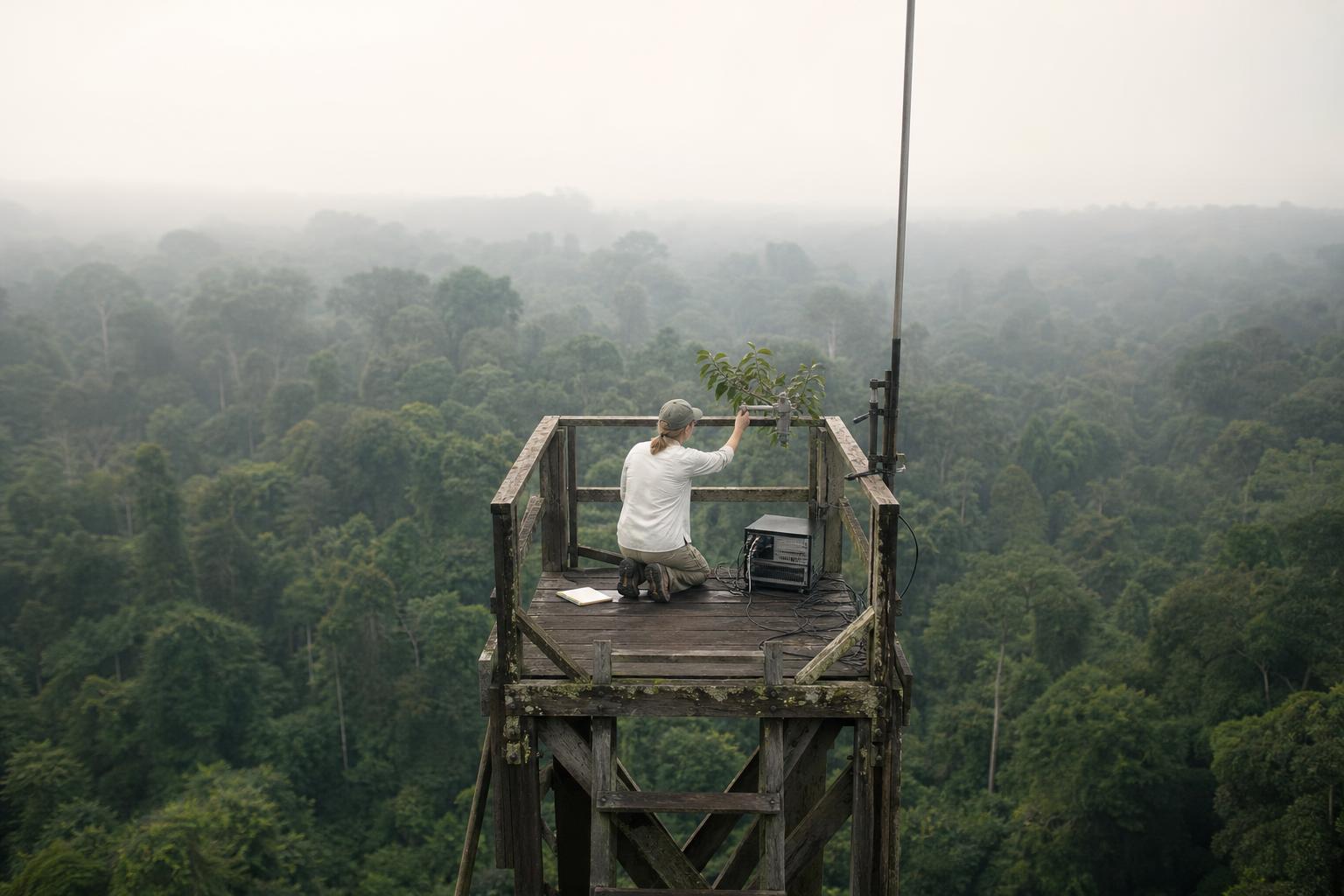
Tropical forests absorb more than 11 billion metric tons of carbon dioxide a year, over a quarter of all human-caused emissions. New research shows that figure is no longer stable. Ozone pollution from fires, layered on top of extreme heat and drought, is cutting into the Amazon's capacity to take up carbon — not from any single cause, but from three stresses hitting the same trees at once.
11 billion metric tons is the number the whole system leans on
That 11-billion-ton figure comes from accounting that treats forests as a subsidy to every government's emissions target. Countries report their fossil fuel output and then, implicitly, count on tropical forests to absorb a quarter of it for free. No treasury pays for this service. No budget line funds it. It simply happens, as long as the forest keeps functioning the way it has for millennia.
The new research breaks that assumption down into mechanism. Fires release ozone precursors. Ozone at ground level damages the stomata — the pores — that trees use to pull in carbon dioxide. Heat and drought independently stress the same trees, reducing photosynthesis and raising the risk of dieback. Each stress alone is survivable. Together, compounding on the same hectares in the same years, they reduce the forest's absorption rate below what single-factor climate models have assumed.
Why the damage is worse than the ozone number alone suggests
Ozone pollution sounds like a localized, almost old-fashioned problem — the kind of smog issue cities solved decades ago with catalytic converters and emissions standards. That framing understates what is happening over the Amazon, because this ozone is not a static urban nuisance. It is generated by the same fires that drought and heat make more frequent, which means the pollutant and its two co-stressors share a common cause and arrive together.
A forest that absorbs carbon dioxide through healthy stomata, under normal heat and adequate rainfall, can tolerate occasional stress. A forest hit by drought-driven fire, which produces ozone, while also experiencing higher average temperatures, is absorbing less carbon through every available channel simultaneously. Researchers measuring any one factor in isolation — heat alone, or drought alone, or ozone alone — would understate the total effect, because the three do not simply add together. They compound: drought increases fire risk, fire produces ozone, ozone further impairs the trees already weakened by heat and water stress.
The counter-argument: forests have survived worse, and models have been wrong before
The strongest case against alarm is historical. The Amazon has weathered droughts in 2005, 2010 and 2015-2016 without converting from carbon sink to carbon source on a sustained basis. Tropical forests are resilient systems with deep root networks and evolutionary adaptations to seasonal dry periods. Climate models that forecast tipping points for the Amazon have, in past decades, sometimes overstated near-term dieback risk — predictions of rapid forest collapse by the 2020s, made in the early 2000s, did not materialize on that timeline.
That history matters, and it should temper any claim that the Amazon is about to flip from sink to source overnight. But the counter-argument has a weaker spot: the three previous major droughts were largely single-factor events, driven primarily by El Niño-linked rainfall deficits. The compounding mechanism this research documents — fire-generated ozone layered onto heat and drought in the same seasons — is a more recent and more frequent pattern, tied to both deforestation-driven fire activity and a warmer baseline climate than existed in 2005 or 2010. Resilience to one stressor is not evidence of resilience to three stressors arriving together.
Who absorbs the cost when the forest absorbs less
The arithmetic here does not run through a company balance sheet or a government budget, which is what makes it easy to ignore. If tropical forests' net absorption falls by even a few percentage points — from a quarter of human emissions to, say, a fifth — that gap does not appear as a line item anywhere. It appears as a higher concentration of carbon dioxide remaining in the atmosphere than current climate projections assume, because those projections largely treat the 11-billion-ton absorption figure as a constant rather than a variable in decline.
Governments that set national emissions targets calibrated against stable forest absorption are, in effect, relying on an uncompensated service that may be shrinking. No nation currently pays Brazil, Peru, Colombia or the other Amazon basin countries a sum reflecting the full atmospheric value of that absorption — carbon credit markets and forest finance mechanisms cover a fraction of the eight countries' forested land, and at prices far below what the avoided-emissions value would suggest if calculated at current carbon prices. The World Bank and various bilateral programs have moved money toward forest protection, but at a scale of hundreds of millions of dollars annually against a service worth, by one rough calculation using $50-per-ton carbon pricing, over $550 billion a year if the full 11 billion tons were priced.
What happens to the number next
The research does not project a specific new absorption figure to replace 11 billion metric tons — the compounding effects are documented as a trend, not yet reduced to a single revised estimate that climate modelers have adopted. That absence is itself a data gap worth naming: the Intergovernmental Panel on Climate Change's next major assessment cycle will need to decide whether to treat tropical forest carbon absorption as declining, stable, or uncertain, and that decision will shift how much carbon-reduction burden falls on fossil fuel-emitting economies instead.
Until that recalculation happens, every government's climate target that assumes stable tropical forest absorption is running on a number that the underlying fires, heat and drought are actively revising downward. The cost of that revision, if it holds, lands first on the atmosphere, and eventually on whichever economies are told their fossil fuel budgets must shrink further to compensate for forests that can no longer absorb as much as the spreadsheets assumed.