$4.2 billion buys 433 megawatts and a 20-year extension
DOE’s loan adds 433 new megawatts to Vistra’s reactors while extending three plants’ licenses two decades.
By The Ledger · · 5 min read
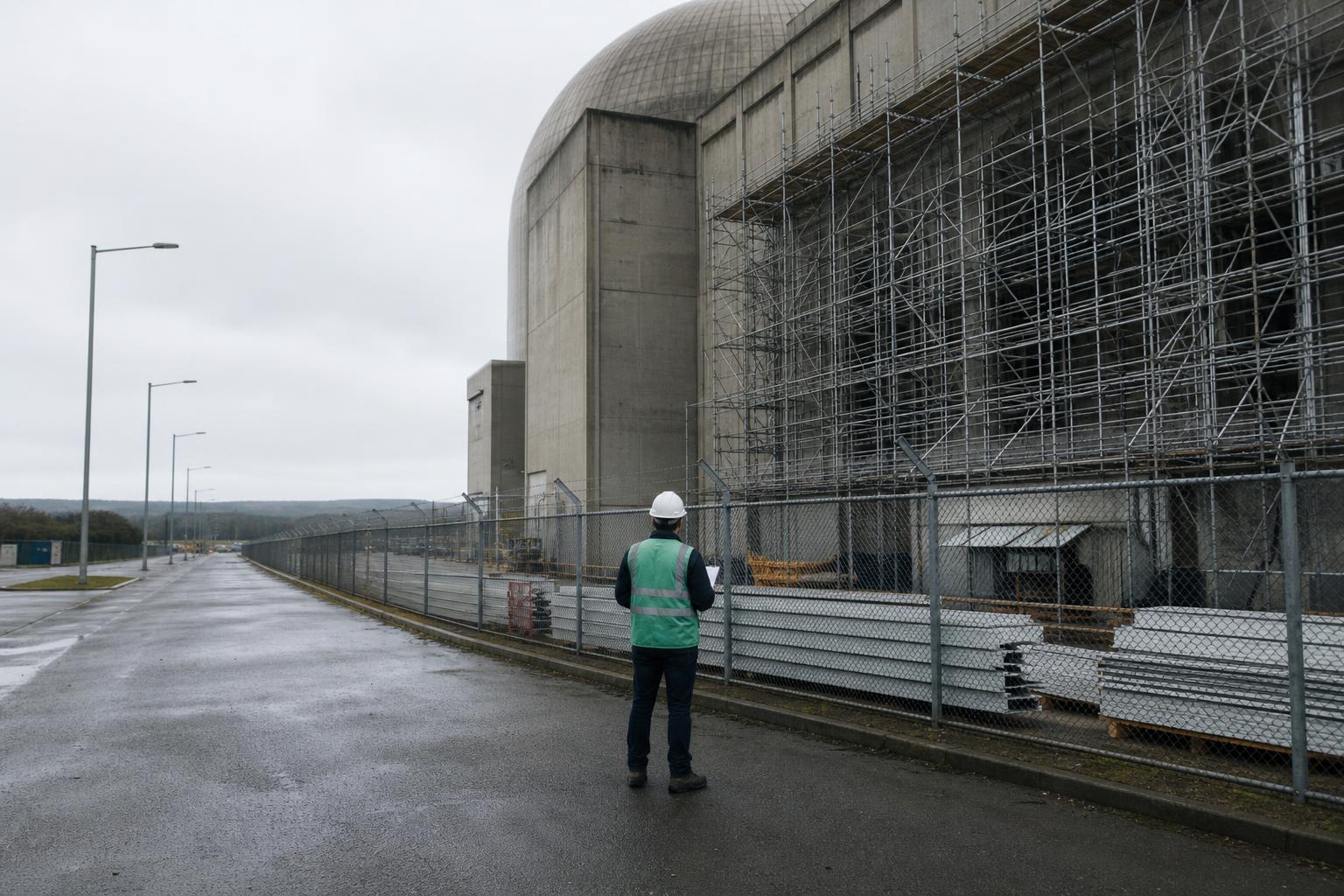
The Department of Energy has conditionally committed up to $4.2 billion to Vistra Corp, financing upgrades at three nuclear plants in Pennsylvania and Ohio. The money buys 433 megawatts of new capacity — about enough to power 400,000 homes — plus 20 extra years of operating life for reactors that would otherwise face retirement decisions within a decade.
Beaver Valley's reactors were built for a grid that no longer exists
Beaver Valley, outside Pittsburgh, began generating power in 1976. Davis-Besse and Perry, both in Ohio, came online in 1978 and 1987. All three were designed for a demand curve that assumed modest, predictable growth. That assumption broke sometime around 2023, when data centers started arriving in the PJM Interconnection — the 13-state grid operator covering Pennsylvania, Ohio, Virginia, and most of the mid-Atlantic — faster than new generation could be permitted, financed, or built.
PJM's own capacity auction prices tell the story in dollars. The 2025/2026 auction cleared at $269.92 per megawatt-day across most of the region, up from $28.92 the year before — a roughly ninefold increase, driven largely by data center load growth outpacing new supply. Uprating three existing reactors sidesteps the two things that make new power plants slow: transmission permitting and siting fights. The Energy Department's own description of the deal is explicit that no new transmission corridors are required.
A loan commitment is not a loan
The Office of Energy Dominance Financing, created to speed federal lending for energy projects, has issued a conditional commitment — not a signed, funded loan. Vistra still must satisfy what the department calls technical, legal, environmental, and financial conditions before money moves. That is a standard structure for Energy Department loan programs, but it means the $4.2 billion figure describes an upper ceiling of federal exposure, not a transaction that has closed. Loan Programs Office deals have taken anywhere from months to over a year between conditional commitment and financial close in past cycles, including solar and battery projects under the Biden administration.
If completed, the loan would extend operating licenses at the three plants by 20 years beyond their current terms — pushing Beaver Valley's authorized life past 2056 and Davis-Besse's past the 2037 license it already holds, depending on how the uprate financing is structured against the relicensing timeline. The deal also includes an option, not a commitment, to finance future uprates at Comanche Peak in Texas, a fourth Vistra plant outside the PJM region entirely.
Preserving a plant is counted the same way as building one
The Energy Department's framing counts nearly 4 gigawatts of existing baseload capacity as something the loan "preserves," alongside the 433 megawatts of genuinely new output from the uprates. That distinction matters for anyone trying to work out what $4.2 billion actually buys. The new capacity — enough for roughly 400,000 homes, using the department's own ratio of 4 gigawatts to 3 million homes — is the marginal product of this financing. The other nearly 4 gigawatts was already running. Without the uprate investment, it would likely keep running too, at least until each plant's current license expires, since Vistra has given no public indication these reactors were slated for near-term retirement.
Put differently: the loan's headline deliverable, "preserving baseload power for 3 million homes," describes capacity that existed before the announcement. The genuinely incremental capacity — the 433 megawatts — is worth roughly $9.7 million in federal loan exposure per new megawatt, before accounting for the license extensions, which have value but are harder to price because they avoid a cost (plant closure and replacement) rather than adding a measurable product.
Who actually pays if a reactor uprate goes wrong
Nuclear uprates are not simple retrofits. They typically involve replacing steam generators, upgrading turbines, and recalibrating safety margins — work regulated by the Nuclear Regulatory Commission, which must approve any increase in a reactor's licensed thermal output before it can run at higher capacity. Uprate projects have a mixed record on schedule and cost: some utilities have completed them on budget, others have seen multi-year delays tied to parts availability and NRC review queues.
The loan is to Vistra, a publicly traded company with a market capitalization in the tens of billions of dollars, not to a government agency building a plant directly. If the project runs over budget or an uprate fails to clear regulatory approval, the first-line financial exposure sits with Vistra and its lenders, including the federal government as one of those lenders. The Energy Department's conditional commitment structure is designed to let it walk away if Vistra fails to meet the stated conditions — but once a loan is funded and construction is underway, walking away becomes costlier for everyone involved, which is the entire point of conditional commitments existing as a category of financial instrument rather than a straightforward grant.
The 3,000 jobs are temporary; the plants were already staffed
The announcement cites about 3,000 project-related jobs in engineering, construction, and planned outage work. These are explicitly temporary positions tied to the uprate construction period, not new permanent headcount at the plants. The department separately notes the investment preserves "thousands" of existing permanent jobs — the current plant workforces — without specifying a number. Nuclear plants of this scale typically employ 500 to 1,000 permanent staff each, suggesting the preserved-jobs figure for three plants runs somewhere in the low thousands, roughly matching the temporary construction jobs in scale, though the department has not broken out a precise count.
What "lower costs" means for a PJM ratepayer
The department's claim that this investment will "lower costs" rests on a straightforward supply-and-demand argument: more capacity in a tight market should, over time, ease the capacity auction prices that feed directly into retail electricity bills across PJM's 13 states. Whether 433 megawatts moves that needle meaningfully against a market where data center demand is adding gigawatts of new load annually is the open question the announcement does not answer. PJM's own long-term load forecasts project demand growth measured in the tens of gigawatts over the coming decade; 433 megawatts is a rounding error against that trajectory, even as it is a genuine, measurable addition in its own right.
The federal government is now a creditor to a merchant power company betting that nuclear uprates are cheaper than new transmission lines. If PJM's capacity prices fall, Vistra's customers and the taxpayers backing this loan both benefit. If uprate costs run over NRC-approved budgets, or relicensing drags past the loan's conditions, the bill lands first on Vistra's balance sheet — and second, if the loan is large enough to matter, on the federal credit line behind it.