$400 million in science grants, zero dollars for what breaks first
DOE’s annual $400 million research call funds discovery but not the lab instruments that decay without separate upkeep money.
By The Ledger · · 5 min read
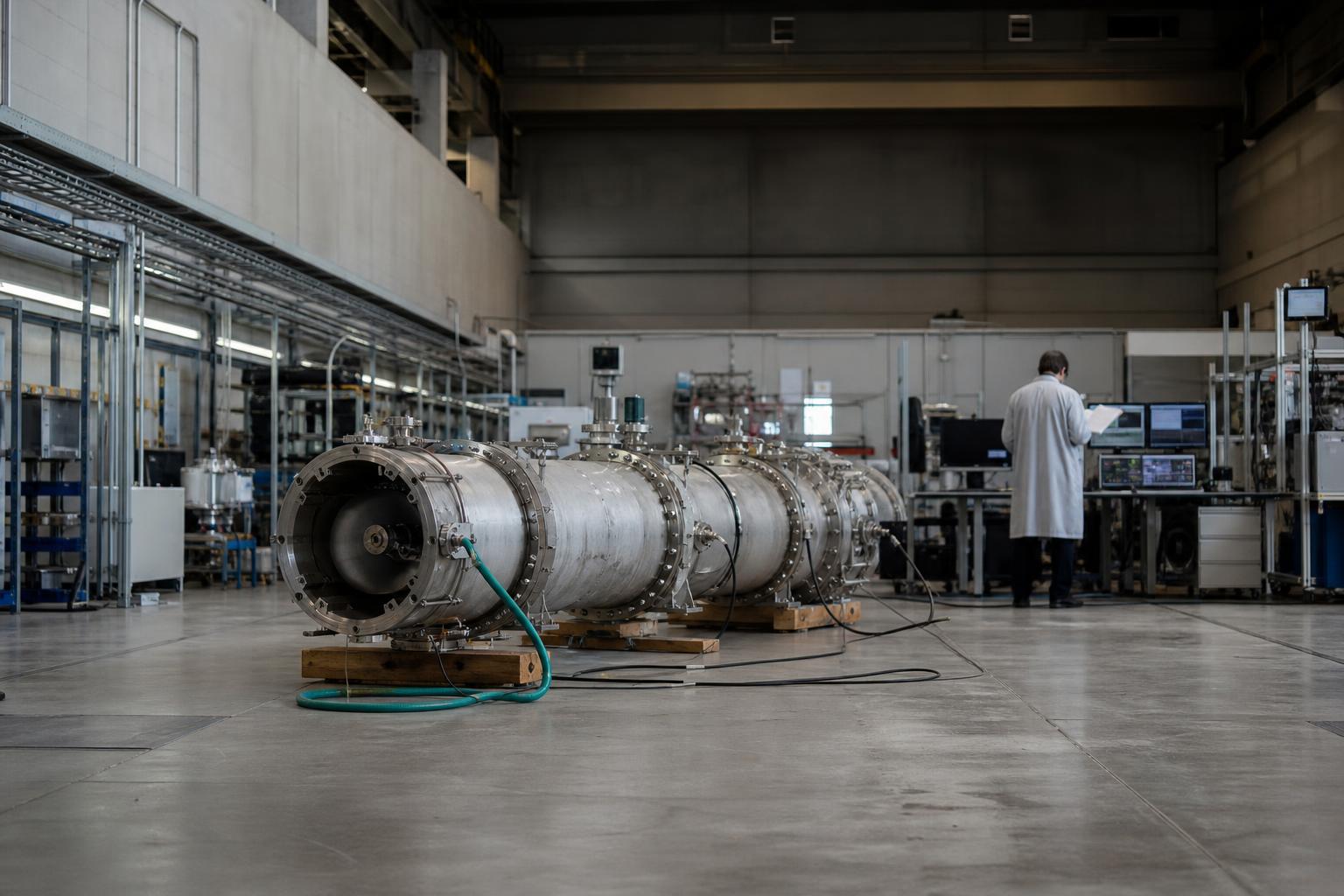
The US Department of Energy will give out up to $400 million this year for basic research nobody has asked for yet. That is the point of the "Open Call" — it funds ideas that don't fit any narrower program. No single project's size was disclosed on announcement day.
The money runs through DOE's Office of Science, the largest funder of physical-science research in the country. It touches seven program areas: Advanced Scientific Computing Research, Basic Energy Sciences, Biological and Environmental Research, Fusion Energy Sciences, High Energy Physics, Nuclear Physics, and Isotope R&D and Production. A university physics department chasing a fusion materials question that doesn't match an existing solicitation applies here. So does a national lab group modeling how isotopes decay in extreme conditions.
A grant program older than the people who run it
The Office of Science traces its funding mission to the Atomic Energy Commission, folded into DOE at the department's creation in 1977. The "Open Call" format — an annual, broad solicitation sitting alongside narrower topical ones — has been how the office caught research that doesn't map cleanly onto a named initiative. Fusion scientists in the 1980s got funded this way when fusion wasn't yet a named national priority. Advanced computing researchers got funded this way before "advanced computing" was its own budget line.
The office now stewards 10 of DOE's 17 National Laboratories and funds researchers at hundreds of universities. That scale is the quiet argument for an open, undirected call: narrow solicitations target known problems, but basic research by definition produces results nobody specified in advance. The $400 million ceiling for fiscal year 2027 sits inside a DOE Office of Science budget that has run in the $8 billion range in recent years — meaning this single call could represent roughly 5 percent of the office's annual outlay, depending on final appropriations not yet finalized by Congress.
The ceiling is not the floor, and nobody printed the floor
"Up to $400 million" is a cap, not a commitment. DOE sets maximum figures for these annual calls and then awards whatever the review process and appropriated funds allow — a number that can land well under the ceiling in years when Congress trims the Office of Science budget after the fact. The department's announcement names the frame — Basic Energy Sciences, Fusion Energy Sciences, Nuclear Physics and more — without naming a minimum dollar figure, an expected number of awards, or an average grant size. Researchers applying this cycle are bidding against each other for a pool whose real size they won't know until awards are announced.
There's a second gap worth naming. The announcement frames this money as support for "foundational research" and "tomorrow's technologies," under the banner of an executive order on "restoring gold standard science." Nothing in the funding opportunity addresses the instruments and facilities that basic research actually runs on — synchrotrons, particle detectors, supercomputing clusters — whose maintenance and upgrade costs sit in a separate, non-overlapping part of the DOE budget. A grant can fund the scientist asking the question. It does not fund the accelerator she needs running to answer it. Those two budget lines have moved at different rates for years, and this announcement does nothing to reconcile them.
Who actually cashes these grants
The direct beneficiaries are university research groups and DOE's own national laboratory scientists — not companies, and not, in most cases, individual inventors chasing a patent. Office of Science funding structurally favors multi-year, multi-researcher teams: a typical award supports a principal investigator, a handful of graduate students or postdocs, and shared equipment time at a national lab facility. The money moves through university grants offices, which take an overhead cut — typically 50 to 60 percent of the direct award, depending on the institution's negotiated rate with the federal government — before any of it reaches a lab bench.
That overhead rate is not disclosed anywhere in DOE's own announcement, but it is why a $400 million notice of funding opportunity does not translate dollar-for-dollar into $400 million of bench science. A fuller public accounting would put both figures side by side: the headline appropriation, and the fraction of it that universities retain before research begins.
What this call does not fund, and why that matters more this year
Basic research grants of this kind fund salaries, materials, and facility access. They do not fund the capital replacement of the instruments researchers depend on — the kind of large one-time costs that fall instead to DOE's separate construction and facilities budget, a line item set by Congress on its own schedule and frequently a target for cuts in years when overall federal discretionary spending tightens. A lab that wins an Open Call grant this cycle to run experiments on a 15-year-old detector gets money to pay the people running the experiment. It gets nothing from this notice if that detector needs replacing.
The honest question: does $400 million buy more science, or the same science later
DOE frames this round as advancing "America's global leadership in science and innovation," language that assumes the $400 million represents net new capacity. What the announcement does not establish is whether this year's ceiling is higher, lower, or flat against the prior fiscal year's equivalent call — a comparison that would tell researchers and taxpayers whether basic research funding is actually growing or simply being re-announced at the same level under a new administration's branding. DOE has not published that year-over-year figure alongside this notice.
Congress has not yet finished appropriating the Office of Science's fiscal year 2027 budget at the time of this announcement, which means the $400 million ceiling could still move before a single grant is signed. Applicants are being asked to propose multi-year research programs against a number that is, by DOE's own description, provisional.
Who can apply, and when do awards land
Eligible applicants include US universities, nonprofit research institutions, and DOE's own National Laboratories, applying through the funding opportunity portal DOE links from its announcement. Award decisions on annual Open Calls of this kind have historically taken six to nine months from solicitation close to funded start date, though DOE's announcement does not commit to a specific decision timeline for this cycle.
The cost of basic research that doesn't happen is invisible by design — it shows up decades later, if at all, as a technology nobody built because nobody funded the question first. That is the argument for funding ideas with no immediate customer. It is also why nobody in this announcement is asked to show their work on what $400 million actually buys, once the universities take their share and the instruments keep aging on someone else's budget line.