China’s grain belt is moving north. The water isn’t.
Warming pushed Chinese grain production toward water-scarce northern provinces, and interprovincial trade quietly followed the harvest.
By The Ledger · · 5 min read
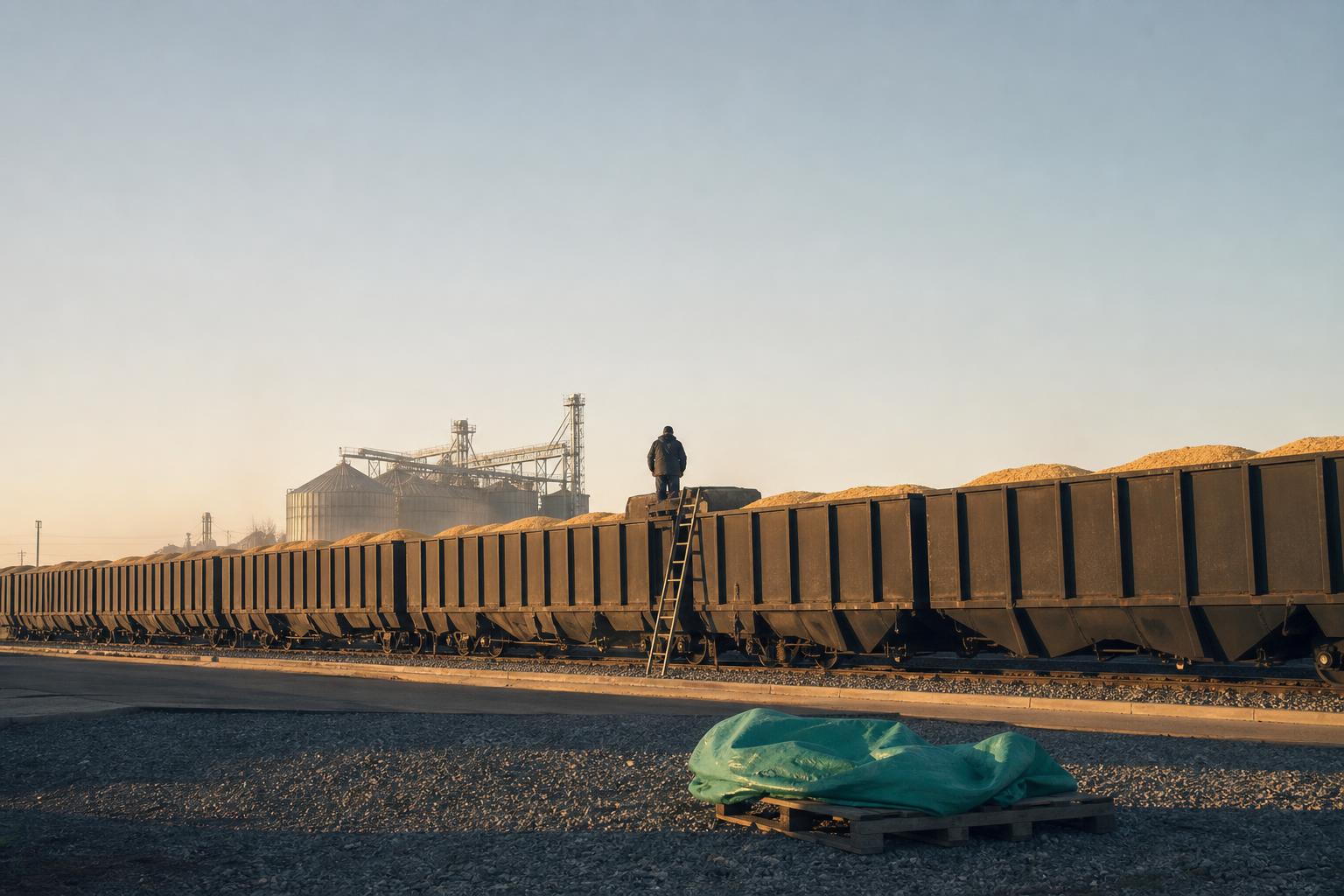
Between 2000 and 2015, China's grain production shifted northward by roughly 300 kilometers, according to research published in Nature. The provinces gaining the most cropland — Heilongjiang, Inner Mongolia, Xinjiang — hold a fraction of the country's water. The provinces losing farmland were, mostly, wetter ones in the south.
What actually happened
Northeast and northwest China now account for a larger share of national grain output than they did two decades ago. Heilongjiang alone produces more than 75 million tonnes of grain a year, roughly 11% of the national total, up from a smaller share in 2000. Warming temperatures extended the growing season in the north by an estimated 10 to 15 days over the study period, making land that was once marginal for maize and rice newly viable.
At the same time, southern and central provinces — Jiangsu, Zhejiang, parts of Guangdong — converted cropland to urban use or higher-value crops, and grew less grain. Interprovincial trade absorbed the difference. Grain grown in the water-stressed north increasingly feeds populations in the water-abundant south, reversing what used to be a more balanced regional supply pattern.
The researchers tracked this using provincial output data, land-use records and a trade-flow model that estimates how much grain crosses provincial lines each year. China does not publish a single unified figure for interprovincial grain trade, so the study's estimate — built from customs and rail-freight proxies — is itself an approximation, one the authors flag as their largest source of uncertainty.
Who pays, who gains
Northern provinces gain agricultural revenue and rural employment. Heilongjiang's grain sector supports an estimated 4 million farming households. That is the visible ledger entry.
The invisible one sits underground. Northern China holds about 20% of the country's water resources while farming an increasing share of its grain. The North China Plain's aquifers have dropped by more than 1 meter a year in some counties for two decades, according to Chinese Ministry of Water Resources monitoring cited in the paper. Grain grown there is, in effect, exported water — embedded in every tonne of maize that leaves Heilongjiang or Xinjiang by rail.
Consumers in the south pay a price that doesn't show up at the market stall: food security increasingly depends on aquifers that are being drawn down faster than they recharge. If northern water constraints tighten — through policy caps or physical depletion — grain costs rise everywhere the trade network reaches, not just at the source.
The mechanism
The link between warming and water stress runs through what economists call embedded resources — inputs consumed in production but invisible in the final product's price. A kilogram of northern maize carries roughly 1,000 liters of water used to grow it. When that maize travels to Guangdong, the water stays behind as a depleted aquifer; only the calories move.
This is the same accounting problem that shows up in carbon border taxes, just inverted. The European Union's carbon border mechanism prices embedded emissions at the point of import. China's grain trade has no equivalent mechanism for embedded water. Nothing prices the aquifer drawdown into the cost of a bag of flour milled in Shanghai from Heilongjiang wheat.
The study's contribution is showing the two trends — climate-driven northward crop migration and trade-driven decoupling of production from consumption — are compounding rather than offsetting. A cooler, wetter north might have absorbed the extra cropland without strain. Instead, the provinces gaining farmland are the same ones with the least water margin, and national trade patterns are moving grain away from where it grows, not toward it.
China's south-to-north water transfer project, the world's largest, already moves roughly 45 billion cubic meters of water northward annually to relieve exactly this kind of pressure. The grain trade now runs the opposite direction across the same map: water pumped north by infrastructure, grain shipped south by rail, both flows papering over a mismatch that climate change is widening rather than narrowing.
What happens next
Watch three numbers. First, Heilongjiang and Inner Mongolia's groundwater extraction permits, renewed or tightened by provincial water bureaus on multi-year cycles — the next major review window falls within this decade. Second, the share of national grain reserves sourced from the three northeastern provinces, currently exceeding a quarter of total stockpiled grain, according to National Grain and Reserves Administration data. A rising share means deepening dependence on the same finite aquifers.
Third, and more falsifiable: China's grain self-sufficiency ratio, currently above 95% for staple cereals. If northern water constraints force yield reductions before southern provinces convert land back to grain production, that ratio will move first — and it is published annually, making this a testable prediction rather than a hedge.
FAQ
Is this primarily a climate story or a water-policy story?
Both, sequentially. Warming created the agronomic conditions for northern expansion — longer frost-free seasons, viable maize further north than before. Water scarcity is the constraint that expansion is now running into. The paper's contribution is connecting the two rather than treating them as separate systems.
Could China simply reverse the trend and grow more grain in the south again?
Some of that farmland is now under cities, industrial parks, and higher-value orchards or aquaculture, uses that generate more revenue per hectare than grain. Reversing the shift would mean forgoing that revenue, which is a harder sell to provincial governments than continuing to import grain from the north.
Does this affect global grain markets or just China's domestic supply?
The study concerns interprovincial trade, not exports. China remains a net grain importer overall, buying soybeans and some maize from the Americas. But if northern domestic production falters under water stress, China's import demand — already a major factor in global grain prices — would likely rise further, which is a global spillover even from a domestic story.