Track speed limits are a budget line, not a warning
Two UK trains derailed in one heatwave. Network Rail’s five-year climate spend already rose fivefold since 2019.
By The Ledger · · 5 min read
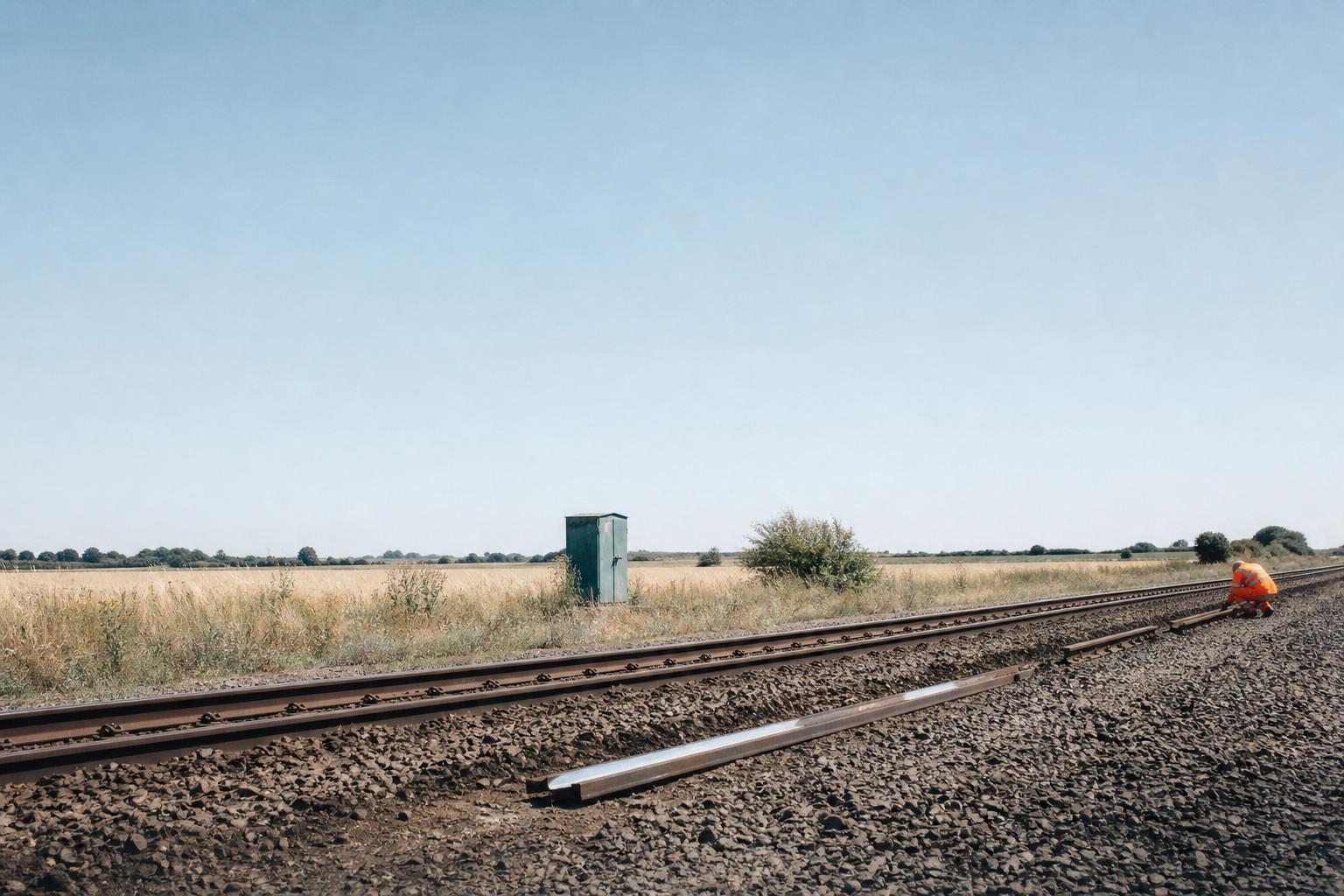
Two trains derailed within 24 hours during Britain's fifth heatwave in August. Network Rail called it "exceptional." The rail is designed for temperatures between roughly -10C and the mid-30s Celsius. Spain's track runs to 45C. Saudi Arabia's runs to 55C. That gap is not weather. It is a spending decision made decades ago and not yet fully unmade.
The track was built for a climate that no longer arrives on schedule
Rail lines expand in heat and contract in cold. Engineers set a design range and pre-stress the steel accordingly, locking in a temperature band the track can absorb without buckling. Britain's railway was designed around a narrower band than countries that plan for real heat. Xueyu Geng, a ground engineering professor at the University of Warwick, says the standard has not moved with the climate it now operates in.
The fix is not exotic. Spain and Saudi Arabia manufacture rail with a higher pre-stress level, built for their known temperature ceiling. Britain would need to do the same, replacing or re-tensioning track to handle a higher top end without losing tolerance for its cold end, which can still hit -10C. That is a manufacturing and maintenance choice, not a weather event.
Network Rail already increased five-year climate spending fivefold
In 2024, Network Rail lifted its projected five-year spending on climate resilience, earthworks and drainage to five times the 2019 allocation. That is the clearest number in this story, and it tells you two things at once: the organisation accepts the risk is real, and the previous budget was sized for a climate that had already changed underneath it.
A fivefold increase sounds decisive. It is also a catch-up figure, not a target figure. Nobody in this story states what the "right" level of spend looks like against the number of assets — bridges, culverts, embankments, overhead line equipment — that now sit outside their original design tolerance. Without that denominator, five times a small number can still be a small number.
Who pays when the track fails, and who pays before it does
When track buckles or a line is speed-restricted for heat, the near-term cost lands on passengers and freight customers: delays, reduced timetables, missed connections. Reduced train speeds to protect poor-quality track, as seen this year, stretch journey times across a schedule that assumes normal speed. That cost is diffuse, unbilled, and paid in time rather than money.
The upfront cost — pre-stressed rail, upgraded drainage, culvert capacity, vegetation clearance — is paid by Network Rail's capital programme, which is publicly funded through the rail regulatory settlement. That means the bill eventually reaches taxpayers and fare payers, the same group absorbing the delay costs now. The question is only sequencing: pay for adaptation ahead of the failure, or pay in disruption and emergency repair after it.
William Powrie, a geotechnical engineering professor at the University of Southampton, points to the Salisbury to Exeter line's extensive single-track sections as a case where past infrastructure decisions are now colliding with soil moisture deficits that force speed reductions. Those speed reductions are not a new cost. They are an old decision presenting its bill late.
The distinction nobody prices correctly: maintenance versus adaptation
Ioannis Koliousis, associate professor at Cranfield School of Management, draws the line that matters most in this story. Clearing a drain prepares the network for the next storm. Redesigning that drain's capacity prepares it for the next 30 years. Both are necessary. Only one shows up as a durable asset on a balance sheet.
This distinction explains why a fivefold spending increase can coexist with reports that resilience work is inadequate. Much of what gets counted as "climate spending" may be maintenance — clearing culverts, inspecting earthworks, cutting back vegetation — rather than adaptation that changes the underlying design tolerance of the network. Maintenance spending recurs every year and shows up in every budget line. Adaptation spending is capital-intensive, shows results over decades, and is easier to defer when a budget is under pressure.
Without a published breakdown of how much of Network Rail's increased allocation is recurring maintenance versus one-off capacity upgrades, the fivefold figure describes effort, not resilience. Effort is countable. Resilience against a specific temperature ceiling is not, at least not from what has been disclosed.
The Met Office is forecasting an event with no modern precedent
Adam Scaife, the Met Office's head of long-range forecasting, says the El Niño developing over the Pacific could push sea surface temperatures more than 3C above baseline — the strongest event in over a century of records. El Niño years correlate with global temperature spikes because the Pacific releases stored ocean heat into the atmosphere. The UK's own forecast, per Scaife, points to a warm, wet winter, then compounding stress: waterlogged ground going into a spring and summer that could bring the same heat extremes that caused this August's derailments.
That sequence matters for infrastructure specifically. Wet ground raises the risk of embankment slippage and drainage failure. Hot, dry ground raises the risk of soil moisture deficit and track buckling. A single year that delivers both, back to back, tests a wider set of assets than either extreme alone. Network Rail's own spokesperson acknowledged bracing for "a warm, wet winter... in line with climate change predictions."
What would prove this wrong, and what would confirm it
This is a falsifiable claim, not a mood. If Network Rail publishes a breakdown showing rising capital spend on re-stressed rail, upgraded culvert capacity and embankment reinforcement — distinct from routine drainage clearance — the adaptation story holds. If the 2027 heat season, which the developing El Niño could intensify, produces derailments or speed restrictions on lines that received "resilience" funding since 2024, the fivefold figure was mostly maintenance dressed as adaptation.
The immediate test is smaller and closer: this coming winter, under a Met Office forecast of unusually wet conditions, on lines like Salisbury to Exeter that already carry known drainage and track-quality problems. If those sections hold through the wet season without new speed restrictions, the recent spending increase is doing its job. If they do not, the bill for deferred adaptation comes due exactly where Powrie said it would — on infrastructure decisions made before anyone budgeted for a hotter, wetter Britain.