US uranium output tripled. Foreign mines still supply 93 percent
US mines produced 2.1 million pounds of uranium in 2025, but plants still import 93 percent of their fuel.
By The Ledger · · 5 min read
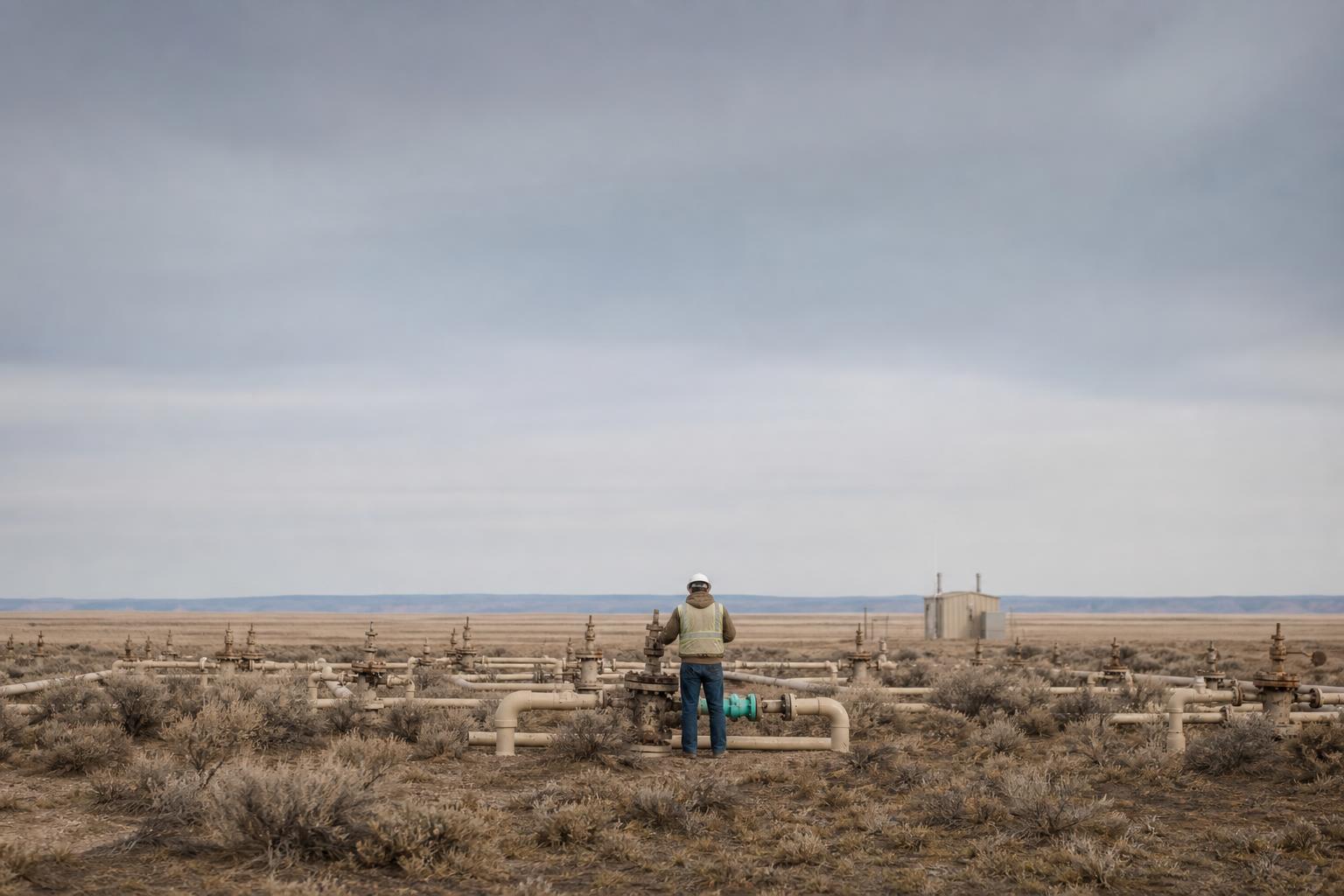
US mines produced 2.1 million pounds of U3O8 in 2025, the country's highest yellowcake output since 2017 and more than triple the 2024 total. Nuclear plants still bought 93 percent of their fuel from foreign suppliers. The arithmetic of a domestic uranium revival runs into the arithmetic of who mined it first.
Canada supplied 32 percent of the U3O8 delivered to US reactors in 2025. Kazakhstan supplied 28 percent. Australia supplied 15 percent. US-origin material, despite tripling in production, covered just 7 percent of what plants actually purchased. Tripling a small number still produces a small number.
A mine in Wyoming feeds a reactor it will never see
U3O8, the powdery yellow compound better known as yellowcake, is the raw material a nuclear plant's fuel supply chain starts from and never touches directly. Miners extract uranium ore, mill it into yellowcake, and ship it to conversion and enrichment facilities, often thousands of miles from the mine. Only after enrichment does the material become fuel pellets, then fuel rods, then something a reactor operator loads into a core. A mine's output and a reactor's fuel purchase are separated by at least two industrial steps and, for most US material, a border crossing to a conversion plant.
That separation explains why 2025's production jump barely moved the sourcing numbers. Owners and operators of US nuclear plants bought 46.9 million pounds of U3O8 equivalent in 2025, actually down from 55.9 million pounds in 2024. Demand fell. Domestic supply grew. The two lines still didn't meet, because 46.9 million pounds of purchases dwarfs 2.1 million pounds of production by a factor of roughly 22 to 1.
The price moved 11 percent while the volume moved backward
Uranium mining in the United States has followed the price of the commodity, not the politics around it, for six decades. Production peaked in the late 1970s and early 1980s above 40 million pounds a year, when Cold War weapons demand and a growing reactor fleet both pulled on the same supply. It then collapsed through the 1990s and 2000s as cheap Kazakh and Canadian material, and a glut from decommissioned Soviet weapons stockpiles converted into reactor fuel, undercut US mining costs. By the mid-2010s, annual US production had fallen into the hundreds of thousands of pounds — a rounding error against global supply.
2017 was the last year production came close to current levels, and it fell sharply after that as spot prices stayed depressed through most of the following decade. The 2025 rebound tracks a price recovery: plants paid a weighted-average $58.46 per pound in 2025, up 11 percent from $52.71 in 2024. Higher prices make marginal US deposits economic again. They also explain why exploration drilling nearly doubled, from 1,324 holes in 2024 to 1,824 holes in 2025, covering over 1.0 million feet of ground. Miners drill more when the payoff per pound justifies the cost per hole.
The catch: reserves take a decade, contracts take a signature
Exploration and development drilling measure what might get mined years from now, not what ships next quarter. Development drilling — the work that defines the size and grade of a known deposit before a mine is built or expanded — rose only modestly, from 2,462 holes in 2024 to 3,708 holes in 2025, a 51 percent increase in hole count that added just 40,000 feet of total footage. That's a wide gap between wells drilled to find new ground and wells drilled to confirm mineable reserves. Finding uranium and turning it into a contracted, licensed, permitted mine are different timelines, often separated by five to ten years.
Nuclear utilities, meanwhile, sign supply contracts years in advance, locking in foreign material long before a new US mine could plausibly deliver at scale. A utility planning fuel purchases for 2027 or 2028 is negotiating today, against a supplier base that is still 93 percent foreign. Domestic production tripling in one year doesn't rewrite contracts already signed. It competes for the next round.
Kazakhstan's 28 percent share sits inside a single state uranium company
The concentration among foreign suppliers matters as much as the foreign share itself. Kazakhstan's uranium exports run substantially through Kazatomprom, the state-controlled miner that accounts for roughly 40 percent of global primary uranium production on its own. A supply chain that leans on one country's state enterprise for over a quarter of US reactor fuel carries a different risk profile than one spread across a dozen private mines. Canada's 32 percent share comes primarily from Saskatchewan's Athabasca Basin, mined by companies operating under different ownership and regulatory structures than Kazatomprom's. The geography of the 93 percent matters, not just its total.
What the tripling doesn't fix, and what happens next
The open question is whether 2025's drilling increase converts into mines that operate for decades, or whether it's a price-driven spike that reverses when uranium costs fall again — as it did after the last comparable rally around 2007, and again after 2017. US production has spiked before without becoming a durable share of supply. The exploration data suggests miners are betting on sustained higher prices. Whether utilities sign long-term contracts with those US producers, rather than renewing with Canadian, Kazakh, or Australian suppliers, will decide whether 7 percent domestic share moves toward 15 percent or stays where it is.
Why did US uranium production fall so low after 2017? Spot prices stayed below production costs for most US mines through the mid-2010s, following a global oversupply and the 2011 Fukushima accident's dampening effect on reactor demand.
Does more US mining lower electricity prices from nuclear plants? Not directly and not soon — fuel costs are a small share of a nuclear plant's operating expense, and US material remains a fraction of what plants buy.
Reactors built to run for sixty years draw on a fuel market that reprices in months and re-sources over decades. The 2.1 million pounds mined domestically in 2025 cost someone $58.46 a pound to sell. The 46.9 million pounds actually burned mostly came from somewhere else, and someone abroad got paid for it.