100 people paid $600 each to rave inside a melting glacier
Iceland Eclipse charges $600 for a glacier rave that documents the ice’s disappearance while selling it
By The Route · · 6 min read
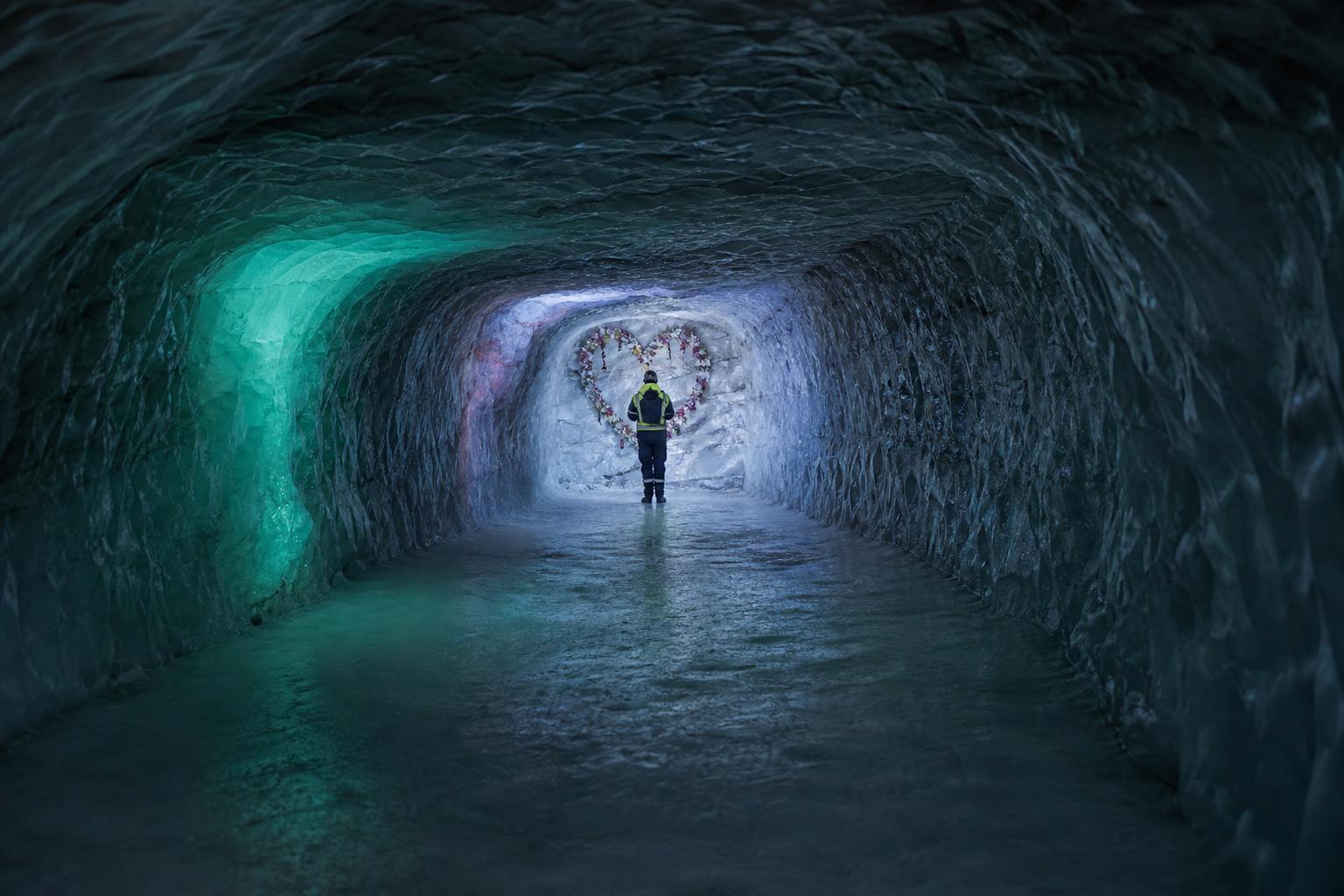
One hundred people paid roughly $600 each — about 83,000 ISK — to dance inside Langjökull, Iceland's second-largest glacier, at an event called Into the Glacier. The tour runs 11 hours, requires no sound system because the ice cave supplies its own acoustics, and sells out at a fraction of the 3,333 tickets for the surrounding Iceland Eclipse festival. The pitch is the phenomenon itself, and the phenomenon is disappearing.
The scarcity is real, and it is not marketing copy
Langjökull covers about 395 square miles, down from roughly 480 square miles in the early 1990s, according to measurements tracked by Iceland's Institute of Earth Sciences over the past three decades. Icelandic glaciers overall have lost close to 750 square miles of surface area since 1890, with the pace of loss accelerating sharply since 2000. A manmade ice tunnel — at 1,640 feet, the largest of its kind in the world — was carved into Langjökull in 2015 for a fixed-route tourist experience. The rave repurposes that same tunnel system for one night, adding DJs, rainbow lighting and a heart-shaped arrangement of faux flowers to a passage that exists because the ice was stable enough, once, to bore a hole through.
That stability is the asset being sold and the thing running out. Every operator offering glacier access in Iceland is, in effect, pricing a countdown. The industry does not advertise it that way — Iceland Eclipse's co-producer described the setting as needing no elaborate production, "the setting itself does the trick" — but the setting is a receding one, and the tour's existence depends on a glacier that has already shrunk by roughly 18 percent over one operator's working lifetime.
The math: $600 buys a car, a driver, and an ice cave for 11 hours
Attendees are driven from festival grounds on the Snæfellsnes Peninsula up onto the glacier in modified vehicles with oversized, low-pressure tires — deflated further as the trucks climb, to spread weight and avoid getting stuck in soft snow. That logistics chain (specialized vehicles, trained drivers, tire management, guide staff distributing crampons) is what the $600 covers, alongside insurance and the risk of operating heavy vehicles on moving ice at 1,300 meters above sea level. For comparison, Into the Glacier's standard daytime tour, without the rave, runs closer to $150 to $200 per person; the eclipse-adjacent rave version costs three to four times more for access to the same tunnel, priced for scarcity of timing rather than scarcity of infrastructure.
The broader festival, Iceland Eclipse, capped attendance at 3,333 — a number small enough to keep the event exclusive but large enough to need cacao ceremonies, whale-communication lectures and multi-day programming to justify the travel cost of getting to a peninsula in Iceland for a two-minute solar eclipse. Attendees interviewed at the event work in fields like architecture in cities like Brooklyn, suggesting a discretionary-income traveler paying not just $600 for one night in an ice tunnel but the airfare, lodging and festival pass required to be there at all — likely $2,000 to $4,000 all-in for the week, though neither Iceland Eclipse nor Into the Glacier publishes a combined package price.
Who gains: guides, drivers, and a five-year-old tunnel that needed a reason to keep charging premium rates
The tunnel was built in 2015. Ten years on, glacier tourism operators across Iceland are competing for a shrinking asset with a growing marketing problem: ice caves collapse, routes shift, and access windows narrow as melt accelerates in warmer months. Pairing the tunnel with a festival timed to a rare celestial event — solar eclipses visible from a given location recur roughly once every 375 years on average — solves that problem by adding a second, unrelated scarcity (the eclipse) to reinforce the first (the glacier). Neither scarcity was engineered by the operator; both were simply available to price around.
Local guides and drivers are the direct beneficiaries: staff work extended, overnight tours requiring specialized certification for glacier travel, work that pays a premium over standard day tours precisely because it happens after dark, in cold, and on ice that behaves less predictably than during daylight monitoring windows. Iceland's tourism sector broadly has leaned on this kind of event-adjacent premium pricing as visitor numbers to the country have leveled off after the post-pandemic surge; Statistics Iceland recorded roughly 2.2 million visitors in 2024, essentially flat against 2023, meaning operators are competing harder for the same pool of high-spending travelers rather than benefiting from raw growth.
The catch
The catch is not the price, which is transparent and comparable to other adventure-tourism premiums worldwide. The catch is that the tunnel's continued existence is not guaranteed year to year. Ice tunnels require re-carving or rerouting as the glacier moves and melts; operators do not publish how many years a given route remains viable, and Langjökull's accelerating mass loss means the infrastructure supporting this kind of tourism is itself provisional. A traveler booking this experience in three or five years may find a different tunnel, a shorter one, or none, and no operator currently commits publicly to how long the current route will last.
The mechanism: selling the disappearance without naming it
What makes this different from ordinary adventure tourism is the framing gap. The festival and tour both market the experience as access to something rare and vast — 500 billion tons of snow, water and ice, in one guide's description — without stating plainly that the mass is shrinking and the access window is closing. This is not dishonesty so much as an industry-wide silence: naming the glacier's retreat as a countdown clock would sharpen the marketing (scarcity sells) but also invite the harder question of whether flying thousands of people to Iceland to rave on a melting glacier accelerates the very loss being monetized. Aviation emissions tied to long-haul travel to Iceland are not offset or disclosed by either the festival or the tour operator, and neither publishes a carbon estimate per attendee.
The tourism pattern here — pricing access to a natural process as it visibly ends — mirrors what has happened with eclipse tourism, receding-coastline tours and vanishing-species safaris elsewhere: the disappearance becomes the product, marketed euphemistically as "witnessing" rather than "closing out."
When this trip disappoints
Skip it during Iceland's peak summer season, June through August, when daylight lasts nearly 24 hours and the atmospheric drama that makes an ice-tunnel rave feel otherworldly — total darkness, aurora potential, the sense of entering a separate world — simply is not available; the tunnel becomes a cold, well-lit cave with none of the sensory theater. Skip it, too, if the specific draw is the eclipse pairing: total solar eclipses visible from Iceland are rare enough that this exact festival-tour combination will not repeat on any predictable schedule, and a standard daytime Into the Glacier tour, at a third of the price, delivers the same tunnel without the premium. The rave format depends entirely on darkness, cold, and an unrepeatable celestial coincidence — remove any one of those and the $600 buys considerably less than advertised.