Airports scored 14 points higher. Bags still got worse at three airlines.
J.D. Power’s airport scores rose across the board while American, Envoy and United mishandled bags at rising rates.
By The Route · · 5 min read
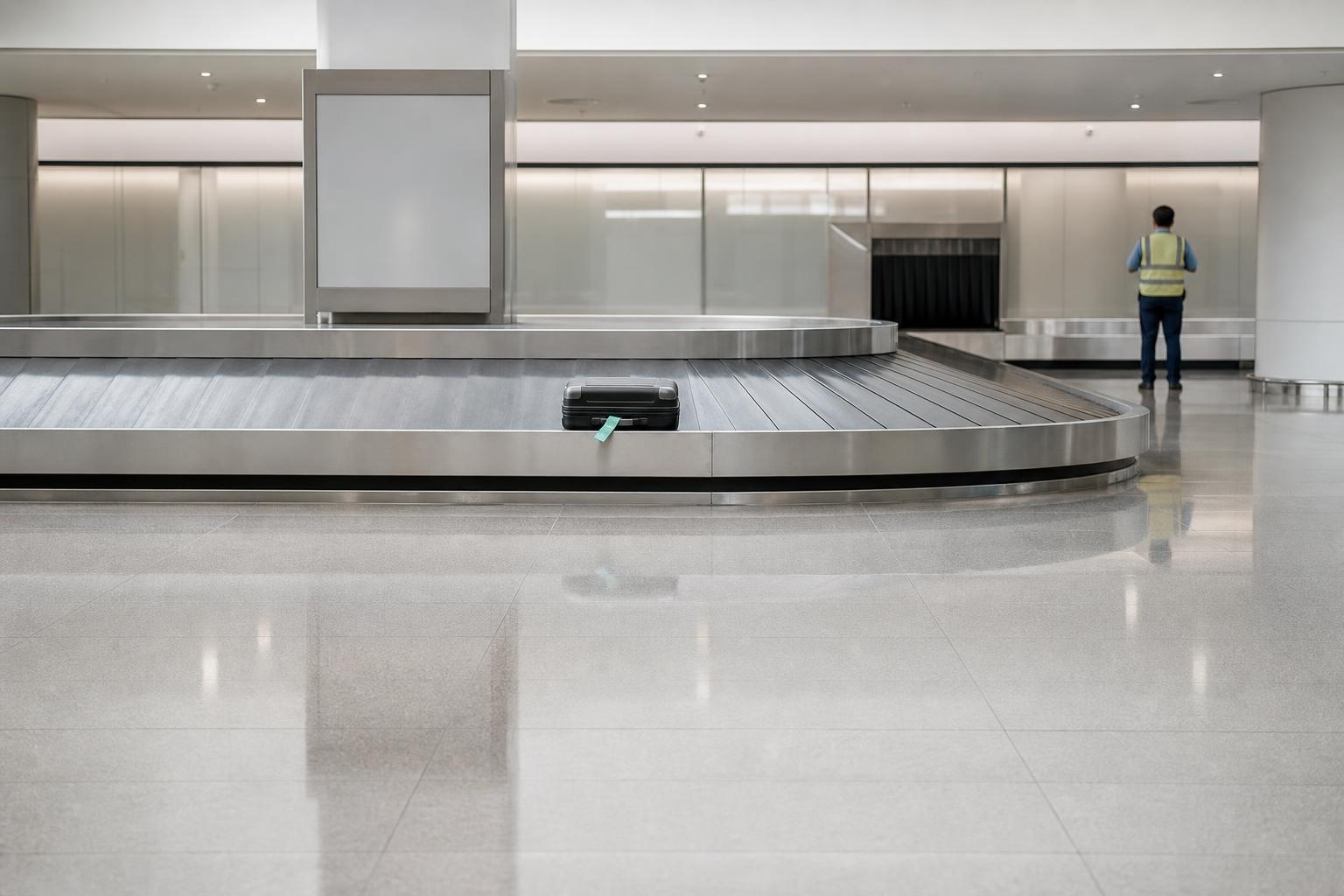
North American airports posted their second straight year of rising satisfaction scores in 2026, according to J.D. Power. Mega airports gained 14 points, large airports gained 13, medium airports gained 16 — all on a 1,000-point scale. But the airlines flying out of those same terminals mishandled 1,120,760 checked bags in the first six months of the year, a rate barely changed from 2025. The terminal got better. What happens to your bag inside it did not.
684 points is Minneapolis's score. It is also the ceiling.
Minneapolis-Saint Paul International Airport (MSP) topped the "mega" category — 33 million or more annual passengers — for a third straight year, with a score of 684 out of 1,000. Detroit Metro (DTW) followed at 663, Phoenix Sky Harbor (PHX) at 642. In the "large" category (10 million to 32.9 million passengers), Tampa International (TPA) led with 715, ahead of Portland (PDX) at 708 and Dallas Love Field (DAL) at 698. Among "medium" airports (4.5 million to 9.9 million passengers), Charleston (CHS) scored 712, Ontario International in California (ONT) scored 705, and Indianapolis (IND) — the category's four-year incumbent — came third at 695.
Look at the shape of those numbers before the trend line. The best mega airport in North America scored lower than the third-place medium airport. Size and satisfaction move in opposite directions. J.D. Power surveyed 24,710 US and Canadian residents who had flown through an airport in the prior 30 days, fielded between July 2025 and July 2026 — a large, credible sample, but one measuring the building, not the flight inside it.
The renovation money explains the gain. It doesn't explain the bags.
The mechanism behind the rising scores is straightforward and well-documented: airports have spent roughly a decade on capital projects — new terminals, runway repairs, food-and-beverage overhauls — and, per J.D. Power's Michael Taylor, those projects are "finally starting to pay off." Every top-ranked airport in the study has either just finished or is close to finishing an extended construction cycle. Reagan National's $800 million expansion and JFK's $19 billion Terminal One rebuild are the visible edge of a nationwide pattern: spend on the physical plant, and the survey score follows within a year or two.
None of that spending touches baggage handling, which sits with the airlines, not the airports. That distinction is the whole story. A traveler walking through a rebuilt Terminal One at JFK can still hand a bag to an airline with one of the worst mishandling rates in the country, because the terminal and the carrier are different businesses solving different problems with different budgets.
0.73 per 100 sounds small. Multiply it by enplanements and it isn't.
The Department of Transportation's first-half 2026 data puts American Airlines at the top of the mishandled-bag rankings, with 0.73 bags mishandled per 100 enplaned. Its regional subsidiary Envoy Air came in at 0.72. United Airlines followed at 0.66. Allegiant Air, a low-cost carrier with a far smaller route network, posted the best rate in the industry at 0.12 per 100 — roughly six times better than American's.
A rate under 1 percent looks negligible until it's applied to the volume major carriers actually move. American alone enplanes tens of millions of bags a year; a 0.73 percent mishandling rate on that base is what produces six-figure counts of lost, delayed, damaged or stolen luggage industry-wide. The DOT's total for the first six months of 2026 — 1,120,760 bags — is close to the 2025 comparison period's rate of 0.52 per 100 enplaned, meaning the industry hasn't improved even as checked-bag fees have risen to an average of $45 for a first bag on domestic and short-haul international routes. Passengers are paying more for a service that isn't getting more reliable.
The counter-argument: airports and airlines were never the same business
The obvious objection is that comparing airport satisfaction to airline baggage performance conflates two separate operators with separate incentives, and that's fair as far as it goes. An airport authority controls terminal design, security throughput, concessions and gate infrastructure. It does not load bags, set connection times, or decide how many minutes a hub allows between an inbound and outbound flight — the scheduling choices that produce most mishandled-bag events. Blaming an airport for American's baggage rate would be like blaming a landlord for a tenant's bad service.
That argument holds for attribution of fault. It does not hold for the traveler's experience of the trip, which does not separate the building from the airline the way the org chart does. Someone who checks a bag at a gleaming, newly renovated concourse and never sees that bag again at the destination carousel has had one trip, with one outcome, regardless of which entity's budget line failed them.
What the two numbers do next
J.D. Power's scores will keep climbing for as long as the current wave of terminal construction keeps completing — Reagan National's expansion and JFK's Terminal One are both due within the next two to three years, and airports that finish major projects tend to see score jumps the following survey cycle, as MSP, TPA and CHS have already demonstrated. That's a genuine, measurable improvement in a part of air travel passengers have complained about for a decade.
The baggage numbers have no comparable improvement mechanism visible in the data. Fees have risen without a corresponding drop in mishandling rates two years running, which suggests the fee increase is funding something other than better handling — likely broader revenue targets rather than baggage operations specifically. A traveler who wants a lower personal mishandling risk has one real lever available now, which is choosing an airline: Allegiant's 0.12 rate versus American's 0.73 is a sixfold difference that has nothing to do with which airport either one flies from. Apple AirTags and similar trackers, now integrated into several carriers' customer-service apps, let a traveler locate a bag independently of the airline's own tracking — a workaround for a problem the industry's own data shows it isn't solving structurally. The terminal has gotten better at a knowable, funded pace. The bag still depends on which airline you trusted with it.