Qantas swaps its A380 for a smaller plane on one route
Qantas drops the A380 from Melbourne–LA on October 22, replacing it with a 787-9 as economy demand softens.
By The Route · · 5 min read
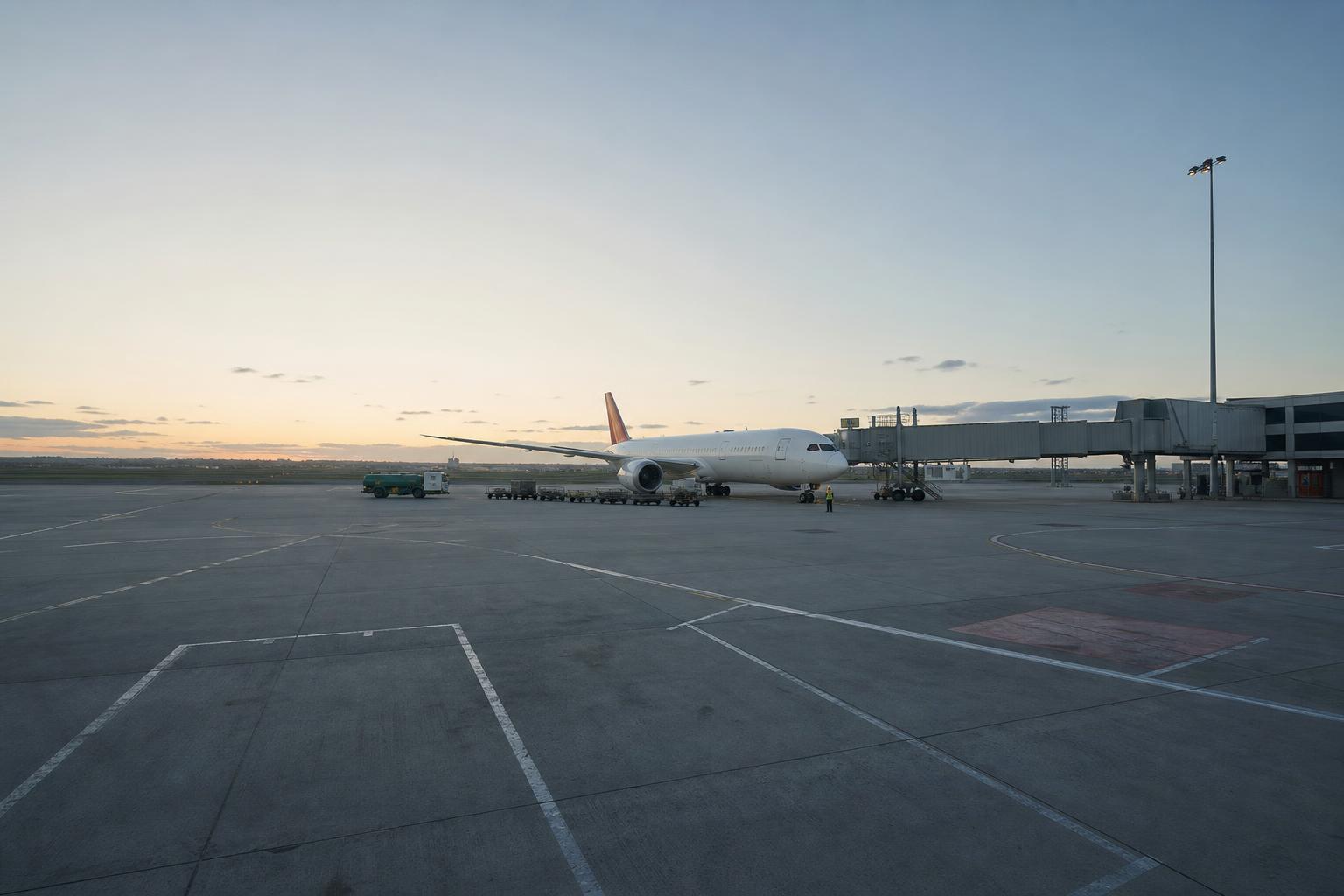
On October 22, Qantas flies its last Airbus A380 between Melbourne and Los Angeles. Three days later, a Boeing 787-9 Dreamliner takes over the route, every day, indefinitely. The reason is arithmetic, not romance: the double-decker's economy cabin has been emptying out while premium and business hold steady, and nobody makes money flying 484 seats two-thirds full across the Pacific.
For a Melbourne traveler booking that flight next year, the change is mostly invisible until boarding. The 787-9 seats around 236 to 300 passengers depending on configuration, against the A380's 484 — roughly half the capacity, on the same 12,748-kilometer stretch of ocean that makes this the airline's fifth-longest A380 run globally and its second-longest, after Sydney–Dallas/Fort Worth. Melbourne Airport handled more than 36 million passengers in 2025, second only to Sydney in Australia, and this is one of only two US gateways it offers nonstop, alongside the seasonal Dallas/Fort Worth service. Losing the superjumbo doesn't mean losing the route. It means losing the illusion that every seat on it needs filling with an economy fare bought at a discount.
The load factor was fine. The mix underneath it wasn't
US Department of Transportation data show Qantas has kept load factors around 80% on this city pair across the past four years — not a struggling route by the usual measure. Passenger volume actually grew: from just over 120,000 two-way travelers in 2022 to more than 172,000 in both 2024 and 2025. The problem sits one layer beneath the headline number. Economy demand has softened even as premium economy and business cabins stayed full, which means the A380 was carrying more empty economy seats to fill a shape of aircraft built around volume. A Dreamliner with a higher proportion of premium seating matches the demand curve Qantas is actually seeing, rather than the one the A380 was designed to serve twenty years ago.
The airline has flown A380s on this route since the type entered its long-haul network, part of a fleet of ten aircraft — the only A380s operating anywhere in the Southern Hemisphere. Qantas has already committed to retiring the whole fleet starting in 2028, and Melbourne–LA is the first visible cut on the way there. What stays on the superjumbo, for now: Sydney to London via Singapore, Sydney to Los Angeles, Sydney to Dallas/Fort Worth, and Sydney to Johannesburg — the last nonstop A380 route left entirely within the Southern Hemisphere. Melbourne becomes a US market served only by narrower planes, while Sydney keeps the biggest ones. It's a two-speed retirement: the hub with more transfer traffic and international connections keeps the aircraft built for scale; the hub without it gets the aircraft built for margin.
The catch: a smaller plane doesn't mean a cheaper fare
The obvious assumption — fewer seats, same demand, higher prices — deserves saying plainly, because Qantas has no reason to pass savings forward here. United Airlines already competes directly on Melbourne–LAX, and the route sits alongside Qantas's other two nonstop US options from Australia's east coast, Brisbane and Sydney. A traveler who can't get the fare they want on the 787-9 has alternatives within the same network, which limits how aggressively Qantas needs to price this particular flight. The airline gains flexibility — a Dreamliner is cheaper to operate per flight and easier to redeploy elsewhere if demand shifts again — but that flexibility belongs to the airline's balance sheet, not automatically to the passenger's wallet. Airlines rarely resize downward and lower prices at the same time; they resize downward because the old price wasn't clearing the market, and the new capacity is calibrated to hold prices roughly where they are while filling more seats proportionally.
The other cost sits with premium travelers who liked the A380's first-class cabin, the only one left in Qantas's current fleet. The 787-9 doesn't carry first class, so Melbourne loses that option on this route entirely — not because demand fell there, but because the replacement aircraft simply doesn't have the cabin. Qantas's answer to that gap isn't ready yet: the Airbus A350-1000ULR, arriving as part of the Project Sunrise plan for nonstop Sydney–London and Sydney–New York flights, will eventually restore a first-class product elsewhere in the network. Melbourne–LA isn't on that list. A Melbourne-based traveler who specifically wants Qantas first class to the US now has to connect through Sydney to find it.
What this says about where Qantas thinks its money actually is
The wider signal is about premium demand outrunning volume demand across long-haul international travel generally — Qantas isn't alone in noticing that a smaller cabin with a richer seat mix can outearn a bigger cabin with a thinner one, even at the same load factor. The airline is betting that Melbourne's US travelers increasingly look like the premium and business passengers already keeping those cabins full, and less like the leisure economy travelers the A380 was built to move in bulk decades ago. Whether that bet holds depends on a market Qantas doesn't fully control: how much of Melbourne's outbound demand to Los Angeles is business travel that can absorb a smaller, pricier plane, versus leisure travel that was only flying because the A380's economy seats were cheap to fill.
The honest open question is what happens if leisure demand recovers instead of staying soft. A 787-9 can't absorb a surge in economy bookings the way an A380 could; if cheap seats to Los Angeles from Melbourne become popular again — a weaker Australian dollar, a fare war, a tourism campaign — Qantas will have already removed the aircraft built to handle that. Reversing course would mean either squeezing a bigger plane back onto a route it just downsized, or turning away the exact demand surge that made the original economics work.
Does this affect Qantas's Sydney or Brisbane flights to Los Angeles?
No — Sydney keeps its A380 service to LAX, and Brisbane's nonstop LA flights are unaffected; only the Melbourne route changes aircraft.
Will the new Melbourne–LA flight still be daily?
Yes — the Boeing 787-9 replacement operates daily from October 25, the same frequency the A380 flew.