100 U.S. Open credentials are for creators. 500,000 seats aren’t
The U.S. Open nearly doubled creator credentials to 100 while fans paying full ticket price filed complaints.
By The Route · · 5 min read
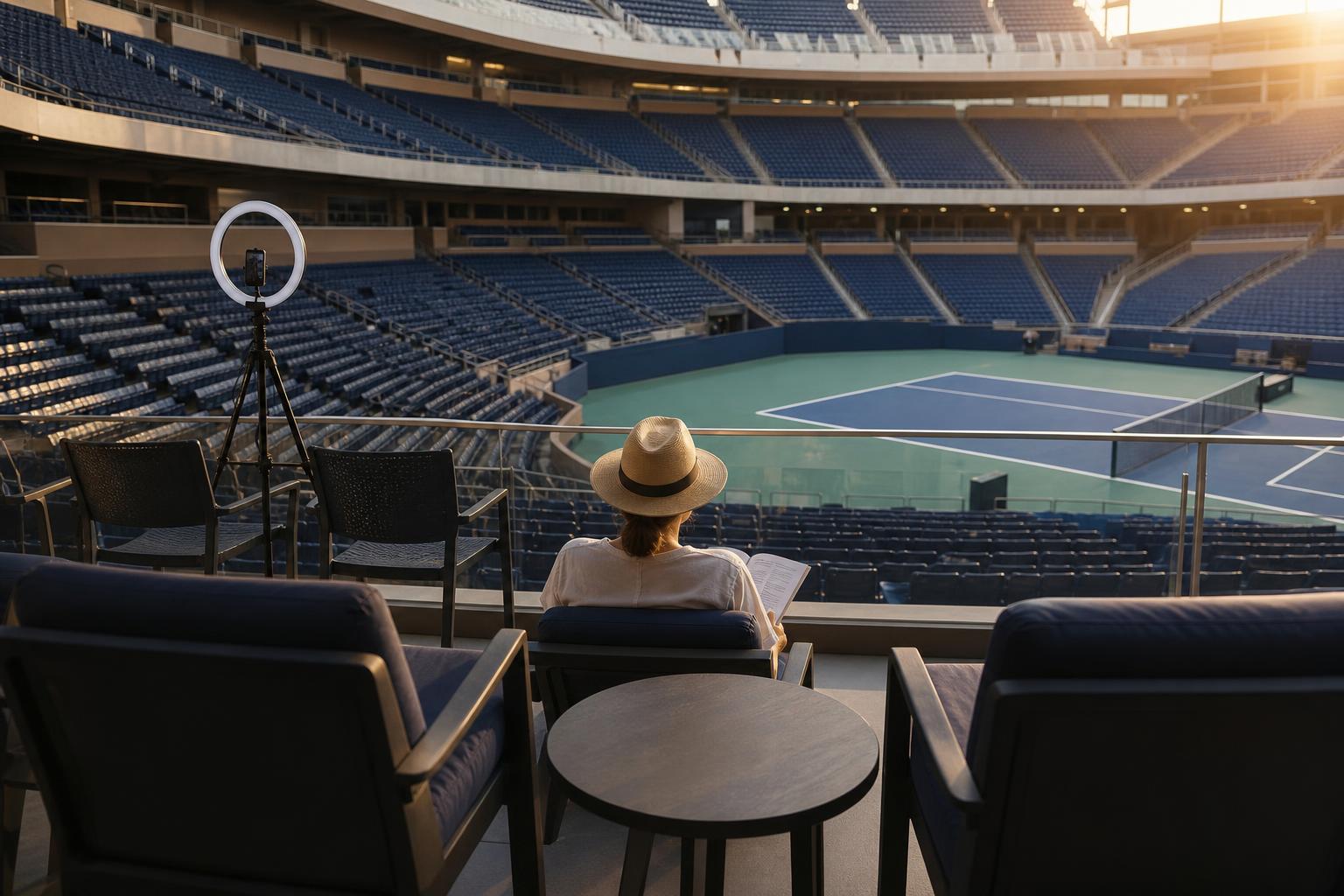
The U.S. Open issued close to 100 content-creator credentials this year, nearly double the prior count, to a tournament that drew more than one million attendees. A single TikTok of an influencer posing with a ring light mid-match has pulled over 750,000 views — and the complaint underneath it isn't really about lighting.
The number worth sitting with is 100. That's how many creator credentials the United States Tennis Association handed out for this year's tournament, roughly double the figure from recent years, according to Skift's reporting. The U.S. Open sold tickets to more than a million people across its run, and the USTA's own estimate puts 40% of attendees from outside the New York area, with 8% arriving from other countries. A credentialed creator isn't buying a ticket. They're being given access that a paying visitor — often one who flew in, booked a hotel, and budgeted the trip for months — did not get for the same seat.
Forty creators becomes a hundred, and nobody voted on it
Credential counts at live events aren't published the way attendance figures are, so "nearly doubling to 100" is a Skift-sourced estimate rather than a USTA press release. That matters because it means the shift happened without the kind of public disclosure ticket-price increases get. A fan who pays $150 for a grounds pass can look up exactly what that costs them. A fan sitting two rows from a ring light has no equivalent number to point to — no line item that says "this suite was allocated to reach a TikTok audience instead of a corporate sponsor or a walk-up buyer." The opacity is the first cost, and it's cheaper for the event than the second one.
The second cost is disruption, and it has a name attached: chair umpire Kader Nouni, mid-match, asking a group in a hospitality suite to sit down. That's not a hypothetical nuisance. A paying guest in a suite — hospitality packages at the U.S. Open run from roughly $600 to several thousand dollars a session depending on tier and day — was watching a point get interrupted by people positioned there for a different purpose than watching tennis.
The arithmetic that makes 100 credentials look small
Set against a million-plus attendees, 100 creators is statistically nothing — 0.01% of the crowd, if credentials map one-to-one with individual people on site on a given day, which they don't precisely. The U.S. Open's organizers would reasonably argue the number is too small to meaningfully alter anyone's experience, and on a pure headcount basis they're right. The complaints aren't coming from people being physically crowded out by 100 extra bodies among a million.
What the headcount hides is concentration. Creator access isn't spread evenly across 23 days of play and dozens of courts — it clusters at marquee matches, in hospitality suites, courtside, in the sightlines that television cameras and paying premium-ticket holders share. A hundred people distributed across a tournament is invisible. A hundred people rotating through the same handful of high-value vantage points, on the days when the biggest names play, is a credential system in direct competition with the people who paid the most for those same sightlines. The USTA's tourism pitch — that 40% of attendees travel in, that 8% cross a border to be there — depends on exactly those vantage points being worth the airfare. A visitor who flew from Seoul or São Paulo for a quarterfinal didn't budget for a ring light.
The case for doing exactly this, and why events are making it
The honest counter-argument is that the U.S. Open's calculation isn't wrong on its own terms. Young audiences increasingly discover live events through short-form video, not broadcast television or ticket-office marketing, and a single creator with an engaged following can reach more prospective ticket buyers in a week than a sponsorship banner reaches in a season. Cruise lines are running the identical playbook — giving influencers cabin access and onboard credentials to reach audiences that traditional advertising doesn't touch, per Skift's reporting on the broader trend. For an event or an operator trying to lower the average age of its customer base, a handful of credentialed creators is a cheap, trackable acquisition channel. The content gets made, it gets watched, some fraction of those viewers eventually buy a ticket or book a cabin. That's a real return, and it's one ad dollars increasingly can't buy at the same cost per impression.
The catch is that this return is being extracted from inventory that already has a paying customer attached to it — the suite seat, the courtside sightline, the quiet required to watch a point. Unlike a billboard or a pre-roll ad, a creator's "placement" is physically occupying space a ticket-holder is also occupying, in real time, during the thing that ticket-holder paid to watch. The acquisition channel's marginal cost isn't zero. It's borne by the person sitting next to the ring light.
What a hundred credentials turns into next season
If this year's roughly 100 credentials draws measurable backlash — and a 750,000-view complaint video is a measurable signal, whatever its tone — the USTA and comparable live-event organizers face a choice that has nothing to do with whether creator marketing works. It's a seating-plan problem: whether creator access gets walled off into designated zones that don't overlap with premium ticket sightlines, the way photographer pits and broadcast positions already are. That's a solvable logistics question. What's less solvable is the incentive underneath it — a tournament selling access twice, once to the fan with the ticket and once to the platform with the audience, from the same physical seat.
This disappoints most in the exact moment organizers value creators most: the marquee night session, the suite behind the baseline, the match everyone flew in for. If you've paid full price for a seat at a signature event — court-side tennis, a cruise's best-view excursion, a stadium concert's floor package — the season to be wary is whichever one has just doubled its creator program. The access you bought and the access given away are, for one point in one match, indistinguishable from the stands, and only one of them paid for it.