Goma’s airport is closed. The embassy’s number still rings.
UK advice now tells travellers in eastern DRC to leave while routes exist, not wait for rescue.
By The Route · · 6 min read
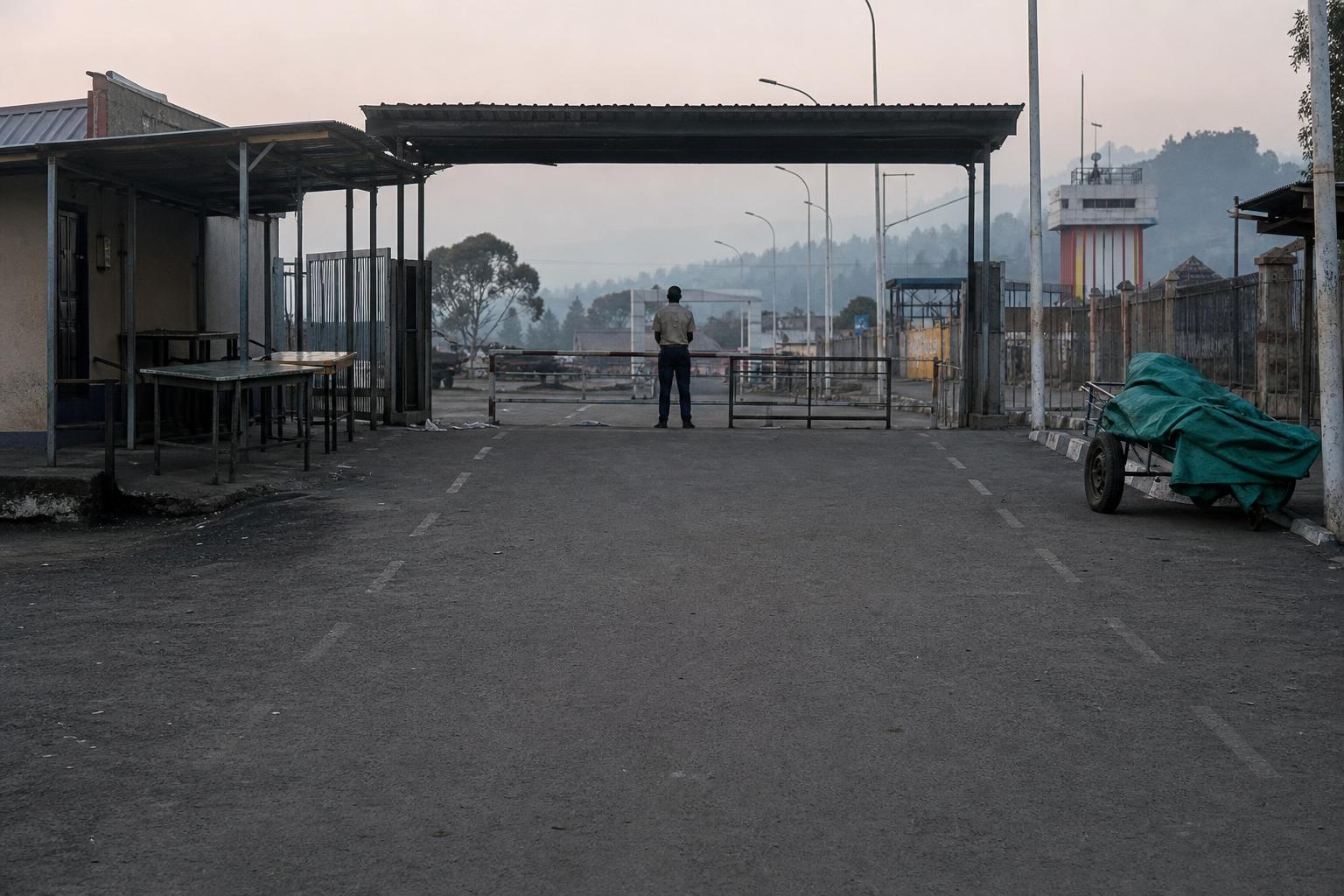
Commercial flights no longer operate from Goma or Bukavu airports. Both have been attacked, both cities were captured by M23 rebels and Rwanda Defence Forces, and the official advice from Britain's Foreign, Commonwealth & Development Office is no longer "avoid travel" — it is "leave now, if you judge it safe and a route exists." That is a different kind of warning, and it changes what anyone in North or South Kivu needs to do this week, not someday.
The advice moved from avoidance to evacuation, and that's a narrower instruction
Most FCDO guidance tells people where not to go. The guidance for North and South Kivu tells people already there to get out, conditionally: "if you judge it safe to do so, and if routes are available." That phrasing matters because it puts the judgment on the traveller, not the government. There is no blanket assurance of extraction. The two official border crossings — Gisenyi-Goma and Ruzizi-Bukavu, both linking into Rwanda — are explicitly flagged as capable of closing "at short notice," which means a route judged safe on Tuesday may not exist on Wednesday.
The territorial facts behind this: M23 and the RDF hold Goma, Bukavu and the surrounding areas in North and South Kivu. They took Uvira in December 2025, withdrew in January 2026, and clashes continue around the city despite the withdrawal. Describing this as "the situation" undersells it — it is a front line that moves without warning, inside a country roughly the size of Western Europe, where the capital, Kinshasa, sits more than 1,600 kilometres from Goma by the shortest available routes.
Kinshasa gets consular support; the Kivus largely don't
The advice states plainly that UK government support is "severely limited outside Kinshasa." That is not a bureaucratic caveat — it is the operative fact for anyone calculating risk. The emergency number given, +243815566200, routes through the British mission in the capital. For a British national in Bukavu, that number offers advice, not an airlift. FCDO says explicitly not to assume it can help you leave "in the event of serious unrest or crisis." Insurance follows the same logic: cover bought in dollars or pounds in a traveller's home country can be voided by UK advice against travel, and insurers will apply their own judgment on top of the government's, which is a second gate, not an automatic payout.
There's no published daily cost for travel to this region because almost no legitimate commercial travel is happening there. A seat on one of the few remaining charter or humanitarian flights out of eastern DRC, where available at all, runs into the hundreds of dollars one-way when capacity exists — but capacity is the variable, not the fare. The real price of being in Goma or Bukavu right now is measured in how fast you can act, not what you pay.
The catch
The catch is that "leave if you judge it safe" assumes information most people on the ground don't have. FCDO is not providing real-time route assessments inside the Kivus; it is asking individuals to make a call it cannot make for them, using local knowledge, local contacts and a security picture that changes by the day. Anyone who waited for an official evacuation order in a crisis zone with this profile — limited consular reach, closed airports, borders that can shut without warning — has usually waited too long. The guidance is honest about this gap rather than papering over it, which is more useful than false reassurance but doesn't make the decision easier.
Three other zones are closed by name, and one of them has an outbreak attached
Beyond the Kivus, the advice marks out specific no-go areas with precision rather than vague caution. All travel is advised against within 50 kilometres of the Central African Republic border. The Kwamouth territory of Mai-Ndombe Province — the strip between and including the towns of Kwamouth and Bandundu down to the province's southern border — is also off-limits entirely. Upemba National Park gets a softer line: avoid all but essential travel, and if you go anyway, tell park authorities your plans in advance, which is as close as this advice gets to acknowledging that some people will go regardless.
Bangoka International Airport in Kisangani carries its own essential-travel-only warning after drone attacks on 23 May disrupted flights in the area, with further disruption called "possible" rather than ruled out. Layered on top of all of this is a Public Health Emergency of International Concern: the World Health Organization declared the Ebola (Bundibugyo virus disease) outbreak in DRC a PHEIC on 17 May, describing it as "highly active, evolving and geographically widespread." Travellers are directed to separate guidance on Ebola and similar diseases before any trip, and the advice flags that other countries may apply entry screening or restrictions on arrivals from DRC — a traveller could clear every DRC checkpoint and still be stopped at the next border.
The mechanism: advice as a legal trigger, not just a suggestion
The single sentence that does the most work in this entire document is the first one: travel insurance can be invalidated by travelling against FCDO advice. That turns a safety recommendation into a financial contract clause. It means the practical question for most travellers isn't "is this dangerous" — intuitively, yes — but "does my policy still pay out if something happens here." Insurers generally tie coverage explicitly to government advice status, so a policyholder who enters an area under an "advise against all travel" designation may find medical evacuation, repatriation or loss claims rejected outright, regardless of what actually happens to them. This is the quiet enforcement mechanism behind travel advisories everywhere, not just in DRC: the state doesn't need to stop you at the border if your own insurer will stop paying the moment you cross it.
When this advice would ease, and why it probably won't soon
This guidance would soften if three things happened together: both Kivu airports resume commercial service, the Gisenyi-Goma and Ruzizi-Bukavu crossings hold open on a predictable schedule rather than closing without notice, and the WHO downgrades the Ebola outbreak from PHEIC status. None of those look close. Goma and Bukavu airports are not simply suspended for maintenance — they've been attacked, which is a different repair timeline than a damaged runway. The front line around Uvira shows a pattern of capture and partial withdrawal rather than resolution, which argues for continued instability rather than a clean handover. And PHEIC declarations are reviewed periodically by WHO but rarely lifted quickly once an outbreak is called "geographically widespread."
The season to avoid eastern DRC entirely is, plainly, now — not a month or a region, but this specific and unresolved period where front lines, airports and disease status are all moving at once. Anyone with no reason to be in North or South Kivu has no reason to go. Anyone already there has been told, as clearly as a government ever tells its citizens anything, to leave while a route still exists.