India wants 9.2 million visitors to become 100 million
India’s arrivals fell 9.4% in 2025, yet its 2047 target needs 12% annual growth to hit 100 million.
By The Route · · 5 min read
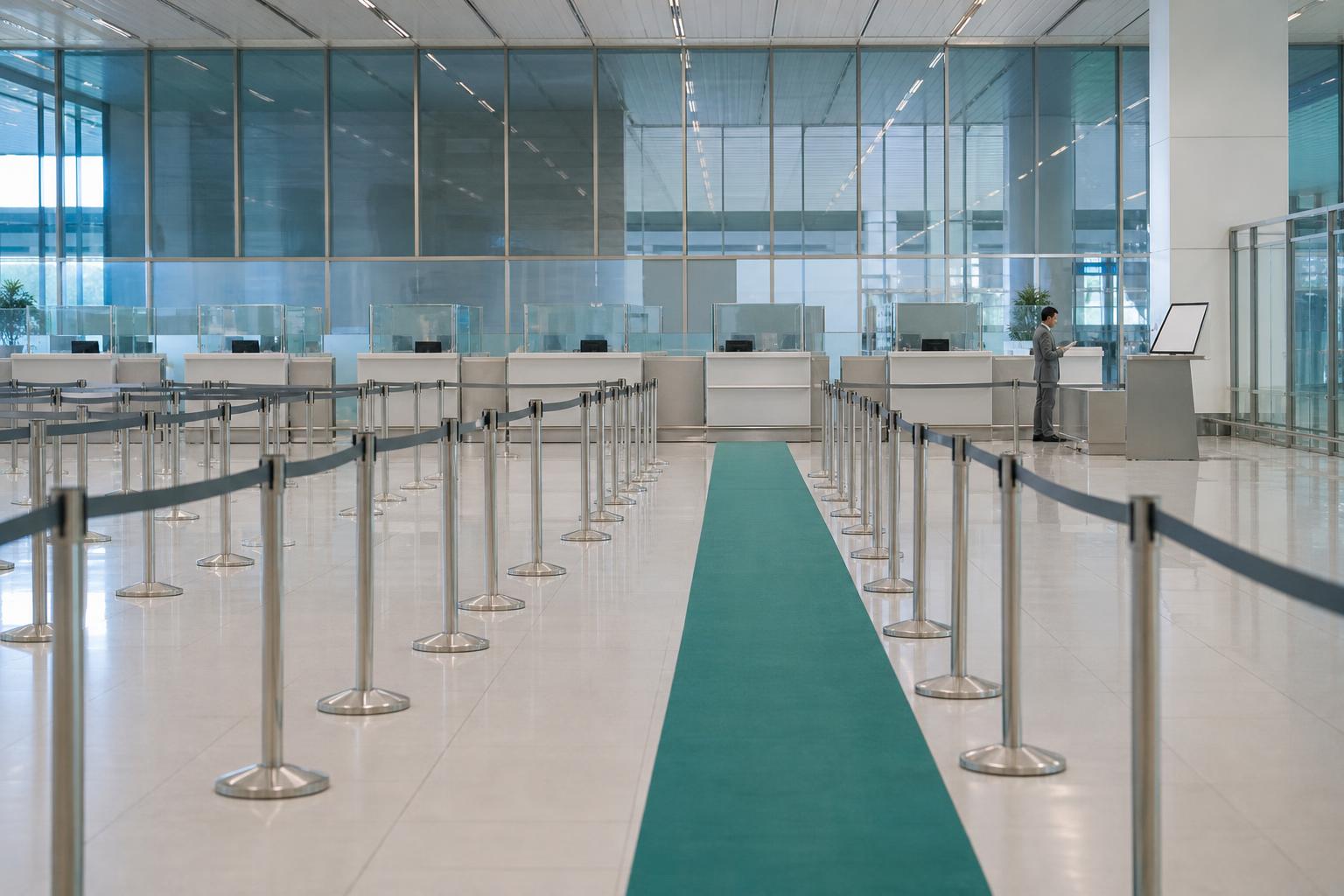
India welcomed 9.2 million foreign tourists in 2025, a 9.4% drop from the year before and 17% below the country's own 2019 record of 10.9 million. Its tourism minister, speaking to a global audience in Malta, set a target of 100 million arrivals by 2047. The gap between those two numbers is the story.
Four words, no arithmetic
At the World Travel and Tourism Council summit, Gajendra Singh Shekhawat offered a framework built on alliteration: political will, public spending, partnership, people's participation. Four Ps, delivered to a room of tourism executives who deal in forecasts for a living. What he did not offer was a year-by-year build — no interim target for 2030, no capital figure attached to "public spending," no named partnership and what it costs to join. A target without a published path is a hope wearing the clothes of a plan.
The arithmetic is unforgiving. Getting from 9.2 million to 100 million over 22 years requires compounding annual growth above 12%. India's tourism sector has not managed that rate in any recent stretch — it has instead posted two straight years of decline. A 12% compound rate, sustained for over two decades without interruption, would be a historic outlier for any national tourism market, not a continuation of a trend already pointed the other way.
$1,500 a visitor, and shrinking
Context the ministry did not supply in Malta: a PHD Chamber of Commerce report estimates inbound tourism could fall a further 15-20% in 2026, largely because the Iran war has severed air corridors that long-haul visitors from Europe and beyond used to reach India affordably. Airspace closures do not show up in a minister's four Ps. They show up in a routing map, and in the fare a traveller in Frankfurt or London pays when their flight now tracks south around a conflict rather than over it.
Who pays for a missed target like this is not abstract. India's tourism ministry and state tourism boards have built budgets, hotel licensing pipelines and airport capacity plans around growth projections. Hotel groups financing new properties in Rajasthan, Kerala and Goa are underwriting rooms against an arrival curve that assumes recovery, not further decline. If 2026 lands at the low end of the PHD Chamber estimate — call it 7.4 million arrivals, a 20% cut from 9.2 million — occupancy assumptions baked into recent hotel debt look optimistic by a wide margin, and that is before anyone asks about the 100-million target at all.
The catch is the corridor, not the campaign
Here is the plain problem: India's tourism target depends on long-haul arrivals from distant, wealthy markets — the visitors likely to spend most per day and stay longest — and those are precisely the travellers most exposed to the Iran war's effect on flight paths. A domestic tourism campaign, however well-funded, cannot route a plane around closed airspace. "Public spending" and "partnership" describe marketing budgets and bilateral tourism agreements; neither describes an air corridor. The four Ps are a communications framework for the easy 80% of the problem. The hard 20% — getting international carriers reliable, affordable routes into Delhi and Mumbai from Europe while a regional war reshapes the airspace map — sits outside the ministry's own stated levers.
A traveller pricing a trip to India from outside the subcontinent in 2026 should expect this to show up as fare volatility more than outright unavailability. Lufthansa, Air France and British Airways have all adjusted routings around Iranian and nearby airspace at various points over the past two years; each reroute adds flight time, fuel burn and, eventually, ticket price. A long-haul economy fare from London to Delhi that ran roughly £450-£550 ($570-$700) before the disruption has, on routes requiring longer diversions, pushed past £650 ($825) on some carriers during peak conflict-affected periods — the kind of swing that changes whether a mid-income European family books the trip at all.
₹83,000 crore of ambition, no ledger to match
India's government has previously floated tourism infrastructure spending in the tens of thousands of crores — figures in the ₹80,000-90,000 crore range ($9.6-10.8 billion) have appeared in budget discussions tied to airport expansion, heritage site upgrades and visa processing modernisation. None of that figure was restated or itemised in the Malta remarks. A 100-million-arrival target implies roughly 11 times the current visitor count; even a generous reading of existing airport capacity in Delhi, Mumbai and Bengaluru suggests infrastructure, not marketing, is the binding constraint, and infrastructure of that scale does not arrive on a tourism ministry's say-so. It arrives through civil aviation budgets, state government land acquisition, and multi-year construction timelines that a 2047 deadline does not, by itself, accelerate.
For a traveller or operator trying to read the real signal here: a government naming a target at a summit is not the same as a government publishing a capital plan, a visa-processing-time reduction schedule, or a route-recovery timeline with named airlines attached. Thailand's post-pandemic tourism recovery, by contrast, came with specific visa-free arrangements for named countries and published arrival targets revised quarterly against actual data. India's target, as stated, has none of that texture yet.
When the 100-million figure stops being credible
The number to watch is not 2047 — it's 2027. If arrivals for 2026 land anywhere near the PHD Chamber's 15-20% decline estimate, India will have posted three consecutive years of falling foreign tourism against a target requiring sustained double-digit growth. At that point the 12% annual compound rate needed to reach 100 million by 2047 becomes mathematically harder still, since each lost year raises the required growth rate for every year that remains. A plan announced without a published trajectory is hard to falsify in year one. By year three of decline, it falsifies itself.
This is not a season to book India expecting ease: visa processing remains slower than regional competitors, long-haul fares carry war-related volatility that shows no sign of resolving quickly, and the infrastructure meant to receive 100 million annual visitors does not yet exist in any published form. The country remains worth visiting on its own terms — but not on the strength of a target with no ledger behind it.