$105 million bought one hotel back. It didn’t buy certainty.
Host Hotels spent $105 million restoring one storm-hit resort, and still can’t promise the next one holds.
By The Route · · 5 min read
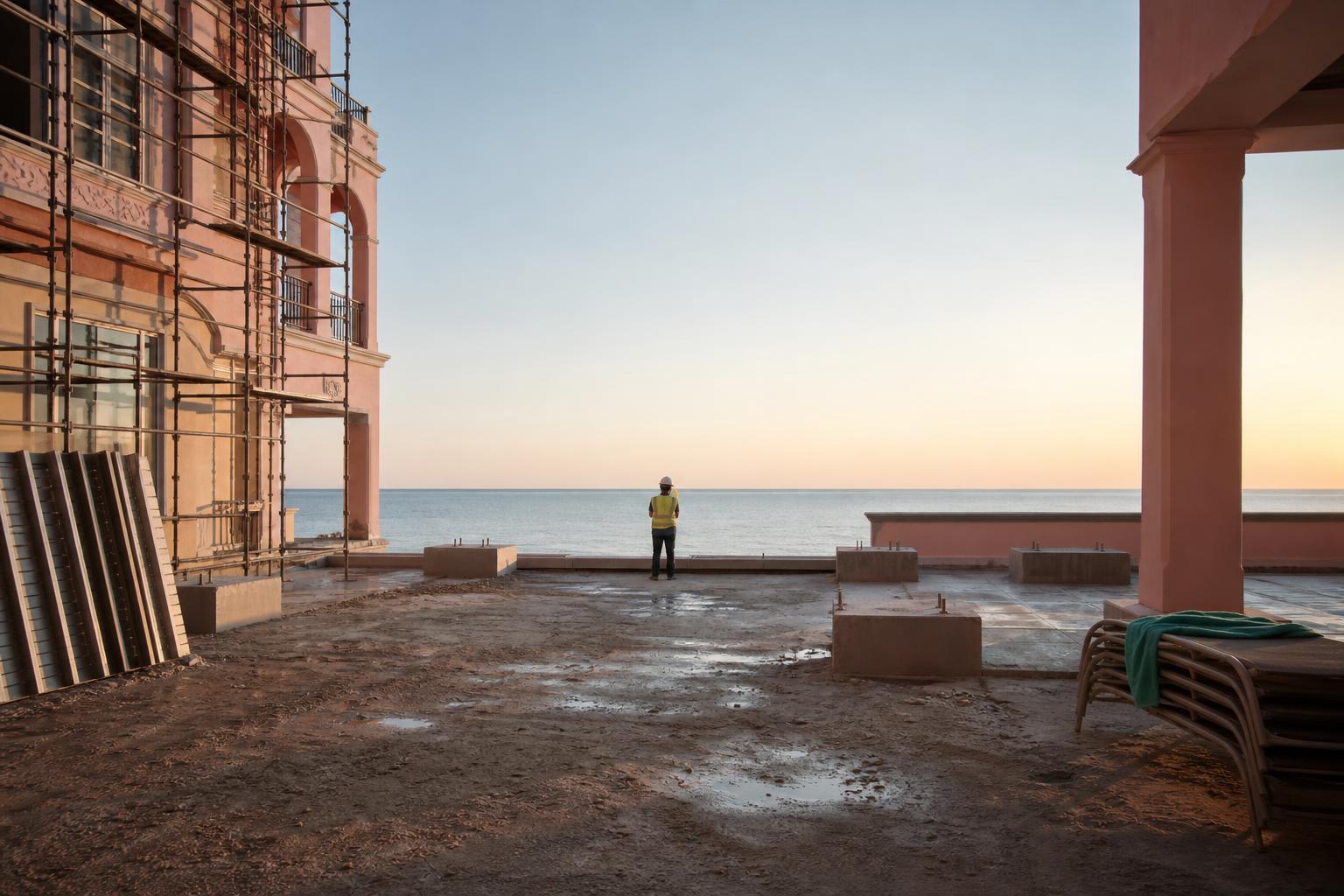
The Don CeSar, the pink Gulf-front hotel in St. Pete Beach, Florida, reopened fully in the third quarter of 2025 after two hurricanes closed it for the better part of a year. The bill: $105 million. Insurance covered $73 million of the related losses. The gap is the real story — and so is the fact that the company that owns the hotel says none of this guarantees the next storm costs less.
The number the filing turns on: $105 million, and 30 percent of it was just cleanup
Host Hotels & Resorts, a real estate investment trust that owns luxury and upper-upscale hotels across the US, put a specific figure on hurricane damage in its 2025 year-end filing: an estimated $105 million in costs tied to hurricanes Helene and Milton, which struck The Don CeSar in 2024. Thirty percent of that — roughly $31.5 million — was remediation: drying out, demolishing, and stripping the building down before anyone could rebuild anything. The rest went to the actual reconstruction and the resilience upgrades layered on top.
This is an unusually clean disclosure. Hospitality companies typically fold storm damage into a general capital-expenditure line, alongside routine renovations and brand-standard refreshes, which makes it nearly impossible for anyone outside the company — investors, insurers, competing owners — to know what a hurricane actually costs a hotel. Host's filing breaks that habit for one property, one storm season, and gives the industry a number to argue with.
Host spent $75 million in 2025 on hurricane and other restoration work — about 11.6 percent of its total capital expenditure for the year — with much of that going into The Don CeSar specifically. Over the six years to December 2025, the company put roughly 8 percent of its overall capex toward making properties more resilient to climate risk generally: reinforced building envelopes, elevated mechanical equipment, distributed energy systems that keep power running when the grid doesn't.
Why $73 million in insurance sounds like coverage and isn't
On paper, $73 million in insurance payouts against $105 million in costs looks like a company that got most of its money back. It didn't. The $73 million reflects business interruption losses too — the revenue Host didn't collect while The Don CeSar sat closed from landfall until late March 2025, roughly five months of zero room revenue at a property that anchors a stretch of Florida coastline built on Gulf views and wedding packages. Strip out the business-interruption component and the insurance recovery against direct property damage is smaller than the headline number suggests.
The other reason the payout undersells the exposure: insurance reimburses what existed before the storm. It does not fund the resilience work Host layered on top — the elevated equipment, the reinforced envelopes — because that's new capital investment, not replacement. Host paid for the upgrade itself, on top of the repair, out of the 11.6 percent of 2025 capex that went to restoration. The company is, in effect, buying insurance against the next storm with money the last storm didn't return to it.
The counter-argument, taken seriously: resilience spending worked at Naples
Host credits its prior resilience investment for a genuine result: the company's Ritz-Carlton in Naples, on Florida's Gulf Coast roughly 150 miles south of St. Pete Beach, came through the same 2024 storm season with materially less damage than The Don CeSar, and the company attributes that to earlier hardening work — the same category of building-envelope and equipment upgrades it's now expanding across its portfolio. That's a real data point, not a marketing line, and it's the strongest case for treating the 8 percent resilience-capex figure as money well spent rather than money spent nervously.
But Host itself declines to promise the pattern holds. The company's own filing language is careful: investing in resilience reduces damage, it doesn't reduce it to zero, and it offers no guarantee against a storm that arrives with more intensity, more water, or simply worse luck than the ones that hit Naples. That caution matters because it's coming from the party with every incentive to oversell the fix. A hotel REIT that told investors resilience spending eliminates hurricane risk would be making a claim the insurance industry itself won't make. Host isn't making that claim.
What the 8 percent number does next: it becomes the industry's benchmark, whether or not it should be
Once a number like this exists in a public filing, it stops being one company's internal accounting and starts becoming a reference point other owners get measured against. Boards asking their own hospitality operators "how much are we spending on climate resilience relative to total capex" now have 8 percent to cite, even though it was built around one coastal REIT's specific property mix — beachfront luxury resorts in one of the most hurricane-exposed regions in the country — and may not transfer cleanly to an urban convention hotel in Ohio or a ski lodge in Colorado.
The timing gives the number extra weight it may not deserve. The 2025 Atlantic hurricane season has run unusually quiet, suppressed by record vertical wind shear that's been tearing storms apart before they can organize. That's given Gulf and Atlantic coast hoteliers a season to catch their breath and rebuild balance sheets — The Don CeSar's full reopening among them — without the pressure of a second consecutive bad year. The Pacific has taken the opposite turn: Category 3 Hurricane Lowell tracked near Hawaii this season, triggering airline fare waivers and event cancellations on islands that don't carry the same hurricane-hardening infrastructure Gulf Coast properties have spent decades building. Climate scientists studying storm behavior don't expect total storm counts to necessarily rise, but they do expect the storms that form to intensify faster and hit harder — which means the resilience math Host just disclosed for one Gulf property may need rewriting for a Pacific one that never budgeted for this category of risk at all.
Travelers weighing a Gulf Coast beach trip against a Pacific island one this year are, whether they realize it or not, pricing exactly this asymmetry: one coast just spent six years and 8 percent of its capital hardening against a threat it understands intimately; the other is absorbing storms it built its tourism economy without expecting. Skip the Gulf Coast in the peak of hurricane season, roughly August through October, when even a hardened hotel can still close for months. The building might survive. The booking window won't.