A leaf blower found what a $15 billion program could not
Boeing traced 777X thrust-link cracks to a 0.76cm gap using hardware-store leaf blowers, not lab instruments
By The Route · · 5 min read
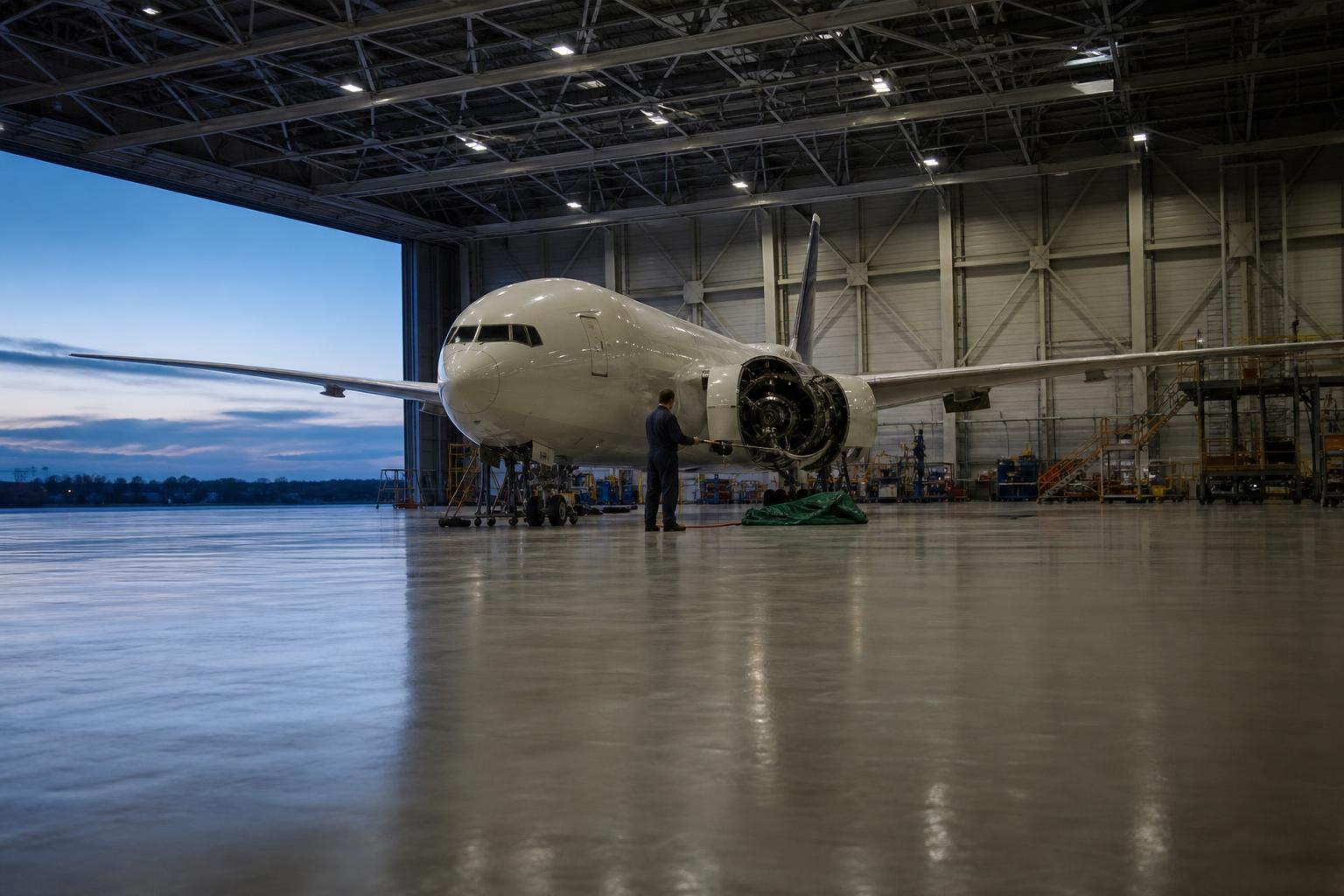
Boeing's engineers spent months chasing the cause of a cracked engine mount on its newest jet — a 10-foot titanium part unlike anything the company had built before. They found the answer with a leaf blower bought off a shelf, aimed at a gap three-tenths of an inch wide.
The part in question is a thrust link on the 777-9, the largest variant of Boeing's long-delayed 777X family. It carries close to 21,000 lb (9,525 kg) of engine load from the GE9X engine into the airframe. In 2024, during a test flight out of Hawaii, inspectors found one had snapped clean on WH003, a test aircraft. Checks on the rest of the fleet turned up cracks in other units. Boeing grounded every 777X test aircraft it had — the entire flight-test program stopped while engineers worked out why a component engineered to aerospace tolerances was failing in a way nobody had modeled for.
A jet's certification, held up by a gap you could slide a coin through
This is a story about tolerance stacking — the way small, individually acceptable deviations can combine into a failure nobody designed for. The thrust link itself was not defective. It was the largest single titanium tube Boeing had ever manufactured, built to handle unprecedented loads on an aircraft that is itself unprecedented: the 777-9 will seat around 400 to 425 passengers depending on configuration, wider and longer than the 777-300ER it replaces. Near the thrust link sits a protective blanket wrapped around hydraulic tubing, there to shield the tubing from engine heat. Normally there's clearance between the blanket and the link. On the affected aircraft, that clearance had shrunk to roughly 0.76 cm — under a third of an inch.
That gap turned a cooling vent's job into a problem. A nearby port pushes high-speed air across the thrust link to manage heat. With the blanket sitting that close, the airflow had nowhere to go but through the narrow channel, and the compressed air changed pressure around the link enough to make the 10-foot titanium tube vibrate. Under the right combination of conditions, that vibration built into resonance — the same physics that lets a soldier's marching step collapse a bridge, applied to a jet engine mount. Sustained resonance is what produces fatigue cracks in metal that has no business cracking.
Two paragraphs of history: why the 777X keeps missing dates it sets itself
Boeing launched the 777X program in 2013 with roughly 250 orders and commitments from four customers, betting on a straightforward evolution of a plane already flying reliably worldwide. More than a decade later, it still isn't certified, with the Federal Aviation Administration now expected to clear it sometime in 2026. The delay compounds a program that has absorbed regulatory tightening across the entire Boeing lineup since the 737 MAX groundings in 2019, when the FAA and international regulators stopped taking the manufacturer's internal sign-offs at face value and started re-examining certification processes line by line.
The thrust-link crack is one entry in a longer list of technical setbacks — engine issues, structural findings during stress testing, software validation delays — each of which has pushed the timeline further from Boeing's original target of 2020. None of those setbacks map cleanly onto a single design flaw. That's the pattern worth naming: this is not a story about Boeing getting an engineering calculation wrong. It's a story about a part so large and load-bearing that its behavior under real flight conditions couldn't be fully anticipated on paper, and had to be reproduced physically before anyone could trust the fix.
The catch: verifying a theory is not the same as solving it cheaply
Here is the paragraph worth sitting with. Finding the mechanism with a leaf blower is a genuinely elegant piece of engineering improvisation — cheap, fast, physically intuitive. But identifying the cause is the easy half of a fix that costs the program in a currency nobody prices in press coverage: time. Every month the 777X sits uncertified is a month Boeing carries inventory costs on parked aircraft, a month airline customers push back delivery-dependent fleet plans, and a month competitors — chiefly Airbus's A350 — keep selling into the same widebody segment unopposed. The leaf blower is a good story precisely because it's disproportionate to the stakes: a five-dollar diagnostic tool sitting inside a program whose total investment runs past $15 billion. Cheap confirmation of a cause does not mean cheap or fast certification. Boeing still has to redesign the clearance, requalify the modified assembly, and prove to regulators who are, after 2019, deliberately slower to sign off, that the fix holds under every flight condition the original problem didn't.
The open question this leaves
Boeing hasn't said publicly how it's re-specifying the blanket clearance across the fleet, or whether every one of the roughly dozen 777X test and pre-production aircraft needs the same rework applied and reverified individually — a detail that determines whether this adds weeks or months to a 2026 certification target that has already slipped multiple times. Until Boeing or the FAA disclose that scope, the honest answer is that the crack is explained, but the calendar effect of fixing it is not.
What is a thrust link, in one sentence?
It's the structural connector that transfers an engine's forward thrust and weight into the airplane's airframe, so the engine stays attached and its force gets used to move the aircraft rather than shake it apart.
Why does a titanium part vibrate from airflow at all?
Long, rigid components have natural resonant frequencies, and if airflow across them oscillates at or near that frequency, the vibration amplifies over time the way pushing a swing at the right rhythm builds height rather than canceling out.