BRICS countries are building a tourism bloc without visas
South Africa joins Brazil, India and BARMM regions in coordinating tourism policy while the actual visa barriers between them stay untouched.
By The Route · · 5 min read
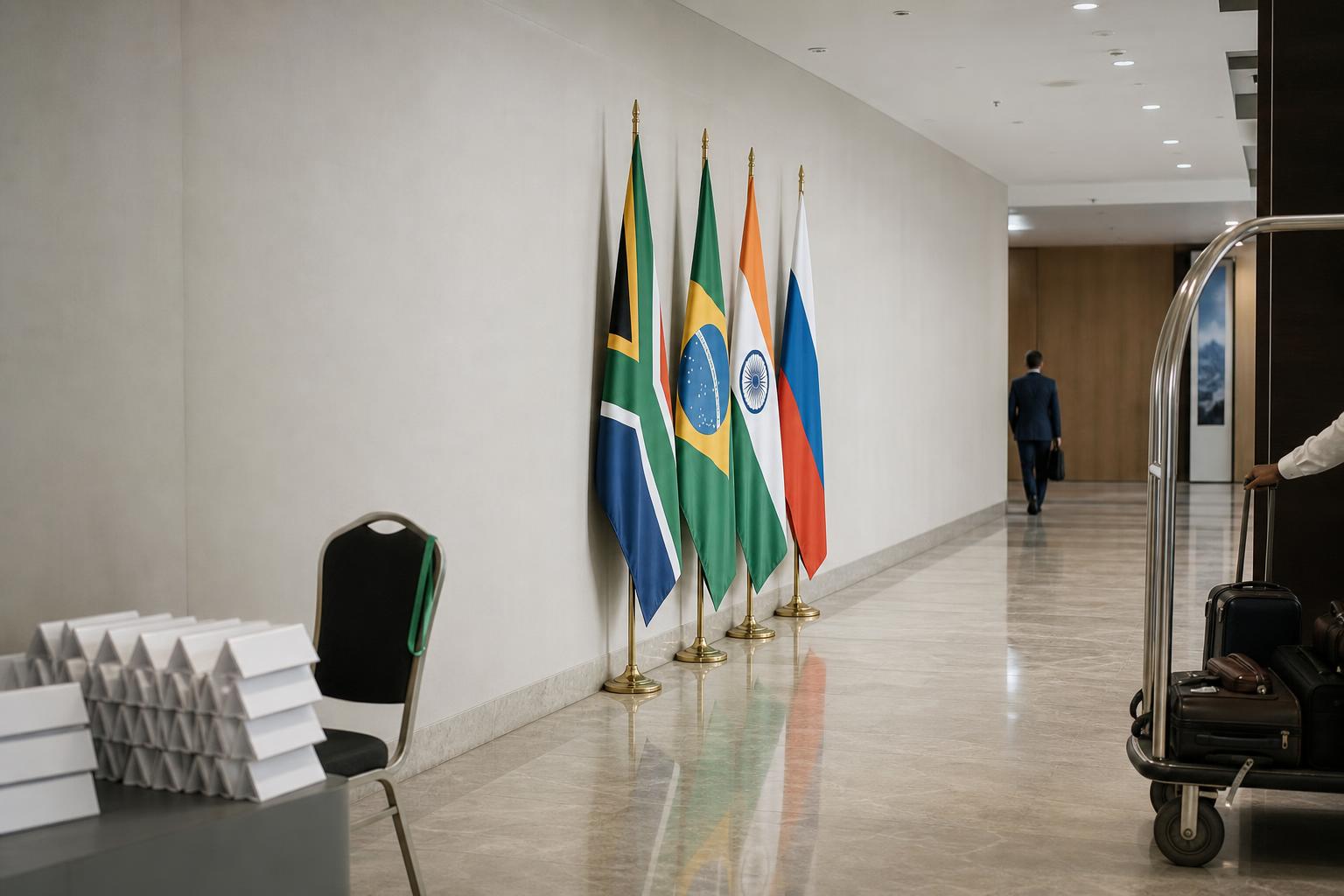
South Africa's tourism minister, Patricia de Lille, will sit in Jaipur this month with counterparts from Brazil, Russia, India, China and a widening BRICS roster to talk about coordinating tourism policy. Nobody at that table can waive a visa. That gap between the meeting's ambition and its actual power is the story.
What actually happened
De Lille is travelling to India for the BRICS Tourism Ministers Meeting, a gathering that has become an annual fixture since South Africa joined the bloc in 2010. The agenda, per Travel Trade Journal and Travel Daily Media reporting, centers on cross-border promotion, joint marketing budgets and standardising how member states count and court visitors. It's the same week Brazilian villages are separately lobbying the UN's tourism body for official recognition as "best tourism villages," and the same window in which the Bangsamoro Autonomous Region in Muslim Mindanao (BARMM) ran its own travel fair to court investors into a tourism sector still rebuilding after decades of conflict.
None of these are one story dressed as three. They are three governments doing the same thing at the same moment: treating tourism as an export line item that needs its own diplomacy, separate from trade ministries and foreign affairs. BRICS tourism ministers first met in 2015; the bloc has since added Egypt, Ethiopia, Iran, the UAE and Indonesia, each bringing a visa regime, a currency and a set of entry rules that talk of "coordination" does not touch.
Who pays, who gains
The gains are concentrated and immediate for national tourism boards. South Africa recorded 8.9 million foreign arrivals in 2023, per Statistics South Africa, and the tourism ministry has said it wants to cross 10 million by mid-decade — a target that leans on exactly the kind of joint-marketing budget BRICS meetings produce. A South African show-round in Jaipur costs the ministry a delegation's airfare and hotel bill, likely under R150,000 ($8,200), against a sector that already contributes R181 billion ($9.9 billion) to GDP.
The BARMM travel fair works the same arithmetic at a smaller scale: a regional government spending a few million pesos to put local operators in front of buyers is cheap compared with the potential of a tourism sector that, before the fair, barely registered in Philippine Department of Tourism arrival statistics for Mindanao. The Brazilian villages angling for UN Tourism's "best village" tag are chasing something similar — a label that costs nothing to apply for and, if won, functions as free marketing for towns most international itineraries skip entirely.
Who doesn't gain: the traveller booking around any of this. A South African visa for an Indian tourist still runs ₹2,000-₹10,000 ($24-$120) depending on duration and processing speed, unchanged by ministerial handshakes. BRICS tourism cooperation has, in a decade, produced marketing statements and the odd co-branded campaign. It has not produced a shared visa, a common entry fee, or reciprocal fast-track lanes — the things that would actually move arrival numbers rather than press releases.
The mechanism
Tourism ministries operate with a structural advantage over trade or foreign ministries: they can announce cooperation without needing legislative ratification. A joint communiqué on "promoting each other's destinations" requires no treaty, no parliamentary vote, no currency clearing arrangement. That is precisely why BRICS tourism meetings happen every year while BRICS trade and monetary coordination — the stuff that would require actual sovereignty trade-offs — moves at a crawl measured in reports and studies, as seen in the bloc's slow-walked climate finance proposals.
So tourism becomes the visible, photographable layer of a bloc that otherwise struggles to agree on much. Ministers shake hands, sign memoranda, and each government goes home to run its own visa policy, its own entry fee, its own marketing budget exactly as before. The BARMM fair and the Brazilian village campaign are the small-scale version of the same logic: a local or regional government using the language of international recognition — UN tags, foreign investor meetings — to do domestic marketing that doesn't require Manila's or Brasília's central approval.
The catch is that arrival statistics measure infrastructure and visa friction far more than they measure marketing spend. South Africa's 8.9 million arrivals in 2023 remain below its 10.2 million pre-pandemic peak in 2019, and the gap has persisted through five years of tourism ministry activity, BRICS meetings included, because the binding constraint is direct flight capacity and visa processing times, not brand awareness. A minister flying to Jaipur to discuss cooperation cannot, by that act, add a direct route between Johannesburg and São Paulo, and no BRICS communiqué has yet done so.
What happens next
Watch for whether any BRICS tourism statement in Jaipur includes a concrete visa or fee commitment — a reciprocal fast-track category, a shared e-visa platform, anything with an implementation date. If the Jaipur outcome is, again, a joint statement on promotion and no infrastructure change, the pattern holds: tourism cooperation as the bloc's easiest photo opportunity, arrivals moving on separate tracks entirely. South Africa's next arrivals data, due from Statistics South Africa in early 2025, will show whether the ministry's travel is buying anything measurable. Expect it not to move the needle beyond normal year-on-year variation of 2-4%, because visa friction with India, Brazil and China hasn't changed since the last meeting either.
FAQ
Does BRICS membership make it easier to visit South Africa? No. South Africa's visa requirements are set unilaterally by its Department of Home Affairs and have not been altered by tourism ministry cooperation. Chinese and Indian visitors still apply for visas through standard consular channels.
What would actually increase arrivals to BRICS member countries from each other? Direct flight routes and visa-on-arrival or e-visa schemes move numbers; marketing campaigns move awareness. South Africa's own arrival data shows the biggest single-year jumps have followed airline route additions, not tourism board campaigns.
Is the BARMM travel fair part of the same BRICS push? No — BARMM is a Philippine autonomous region with no BRICS connection. It's a separate government using a similar playbook: a low-cost trade event to attract tourism investors to a region with minimal existing arrival infrastructure.