Nepal’s flood zone is 1,900 square kilometres of a 147,000 km² country
Rasuwa’s floods hit one river corridor; Everest, Annapurna and Pokhara remain open and want the visitors back.
By The Route · · 5 min read
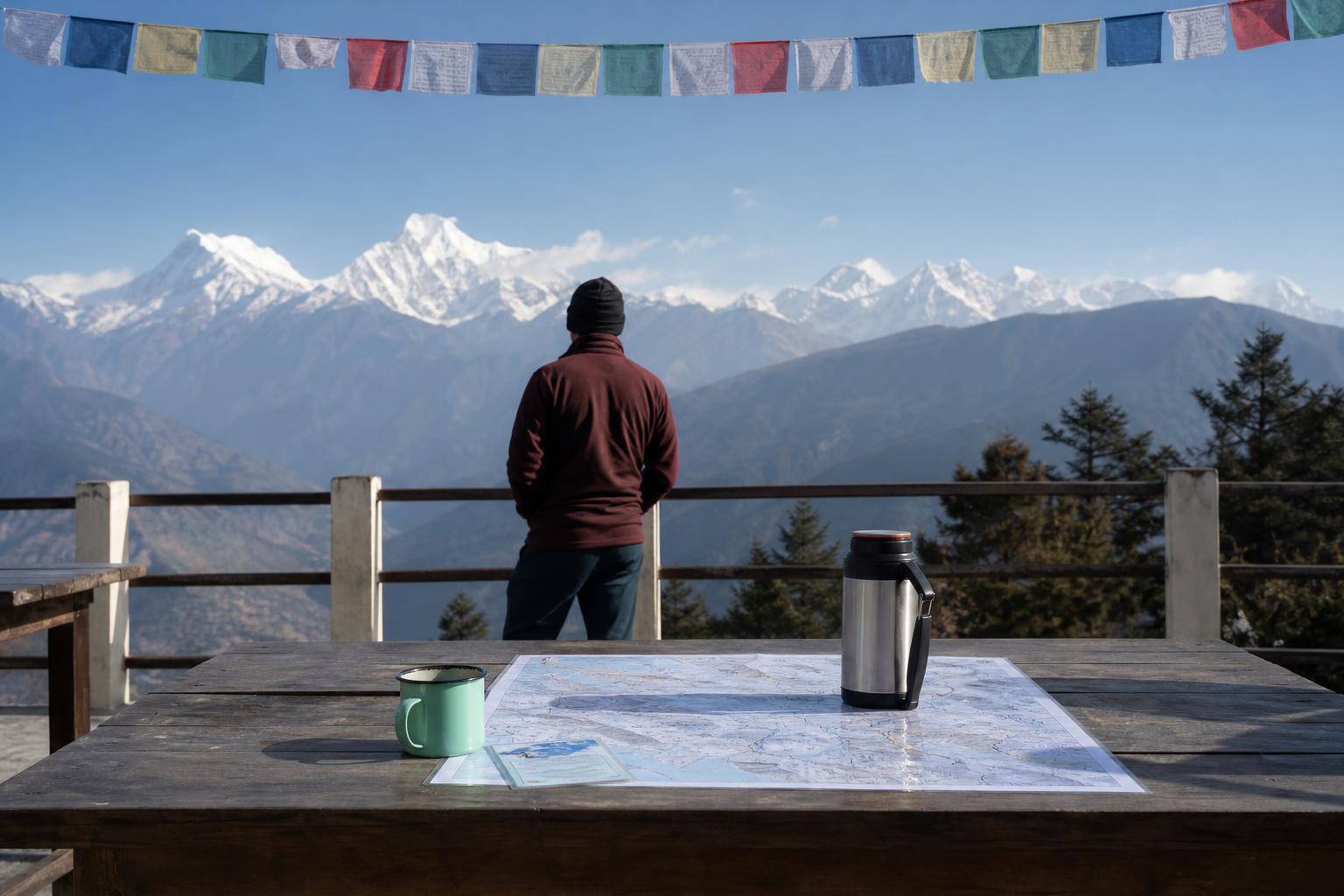
Nepal's peak trekking season opens with a hotel owner in Kathmandu fielding cancellations for rooms nowhere near the disaster. The floods that killed hundreds and left thousands missing struck the Bhote Koshi and Trishuli river corridors — a slice of Rasuwa, Nuwakot and Dhading districts. Everest Base Camp, the Annapurna Circuit, Pokhara and Kathmandu itself sit outside that zone, and they are open.
Three districts, not seventy-seven
Nepal has 77 districts. The flooding, triggered by a glacier and rock collapse on the border with China at the end of August, concentrated damage in three: Rasuwa, Nuwakot and parts of Dhading. That's the geography the Nepal Tourism Board keeps repeating, and it's worth taking literally rather than as reassurance. The country's mountainous terrain means there's no direct road between the flood corridor and the Kathmandu Valley — the rivers that flooded don't drain into the capital's basin. A trekker on the Annapurna Circuit or at Everest Base Camp is not adjacent to the disaster in any way that changes their itinerary. They're on a different watershed.
Nepal welcomed 1.16 million visitors in 2025, and tourism is one of the country's largest foreign-currency earners in an economy of roughly $50 billion. The flood damage bill runs near $5 billion — a tenth of GDP — which is precisely why officials are treating cancellations as a second disaster stacked on the first. Khadak Raj Paudel, the tourism minister, posted a direct appeal on September 1: airports open, trails open, hotels open. That's not spin so much as an accurate description sitting inside an unavoidably emotional appeal, and the two things can be true together.
The catch
The catch is that "unaffected" doesn't mean "unconnected." A guesthouse in Pokhara or a lodge on the Annapurna trail may sit outside the flood zone and still be economically tethered to a national tourism system now absorbing a wave of cancellations, plus a rescue and rebuilding effort competing for the same guides, porters, vehicles and hotel staff. Monsoon rain was still falling on Kathmandu in early September, which does nothing for access roads into the affected districts and does nothing for the recovery timeline either. Travelers heading to Everest or Annapurna won't cross paths with flood damage, but the country hosting them is running two operations at once — welcome and rescue — with the same limited infrastructure.
There's also a bureaucratic lag worth pricing in: trekking permits, TIMS cards (roughly NPR 2,000, or about $15, for most routes) and park entry fees haven't changed, but staffing at district offices near the affected zone has been diverted toward relief work. If your route touches Langtang — which sits partly within Rasuwa district and has historically been a popular add-on trek near Kathmandu — that region is affected and currently not the place for a casual detour. Everest, Annapurna, Mustang, Chitwan and Lumbini are a different matter; Sherpa Hospitality, which runs lodges and treks across those regions, has been telling clients there's no operational reason to cancel.
The strongest case for waiting
Take seriously the traveler who cancels anyway. Flash floods driven by glacial lake outburst events aren't singular; Nepal has an estimated 47 glacial lakes now considered higher-risk than previously catalogued, and the UN's post-flood debris estimate — 2.2 million tonnes — signals a landscape still unstable in ways that aren't confined neatly to a map boundary. Monsoon season itself runs roughly June through September, and a traveler arriving mid-storm, watching rain hammer Kathmandu's rooftops through the night, is not being irrational to wonder whether the next slope failure picks a new river. The tourism board's message is geographically accurate for today. It isn't a guarantee about the following week, and nobody selling a trek should pretend otherwise.
What tips the calculation back toward going is the actual mechanics of the request. René Vijay Shrestha Einhaus, who runs the Dwarika's Collection of hotels in Kathmandu, describes cancellations arriving in a flurry immediately after the floods — bookings pulled from a city that experienced no flood damage at all. Every one of those cancelled room-nights is revenue the hotel, its staff, and the broader Kathmandu Valley economy don't recoup by rebooking later, because the traveler often doesn't rebook — they simply go elsewhere. A canceled trip to Pokhara doesn't send aid to Rasuwa; it removes income from a hospitality worker in Pokhara who had nothing to do with the flood and now has one fewer paying guest during the three or four months a year that carry the whole business.
What a trekking day actually costs right now
Budget travelers on the Annapurna or Everest routes are typically running NPR 4,000–6,000 per day (roughly $30–$45), covering a teahouse room, three meals and a guide's daily rate if traveling with one; add porter costs of around NPR 2,500–3,000 ($19–$23) per day if you're not carrying your own pack. Kathmandu hotel stays vary enormously — from budget guesthouses near Thamel at $15–$25 a night to heritage properties like Dwarika's running several hundred dollars — but none of those prices have moved because of the floods. What's moved is occupancy, and that's the number the tourism board is trying to correct before high season, which typically runs October through November for trekking, fully sets in.
The pressure point ahead is straightforward: October and November are when Nepal earns the bulk of its annual tourism income, and any sustained drop in bookings compounds through a season that doesn't repeat until spring. If cancellations continue through peak months, the shortfall shows up not in Rasuwa — which needs direct aid, not tourist footfall — but in Kathmandu, Pokhara and the trekking economy that funds guides, lodges and transport operators with no connection to the disaster.
When this isn't the right trip
Skip anything routed through Langtang or the Rasuwa-Nuwakot-Dhading corridor for now — that's an active recovery zone, not a scenic detour, and road access remains monsoon-compromised. If your trip depends on flexible rerouting through those districts, or if you're arriving during continued heavy monsoon rain before the season properly breaks in late September, reconsider timing rather than the country itself. Everything else — Everest, Annapurna, Mustang, Kathmandu, Pokhara, Chitwan, Lumbini — is open, priced the same as before the floods, and, per the people running its hotels and treks, in genuine need of the booking.