2.2 million tonnes of debris, and no line item to clear it
UN estimates 2.2 million tonnes of flood debris in Nepal, where 47 known glacial lakes are now an undercount.
By The Ledger · · 5 min read
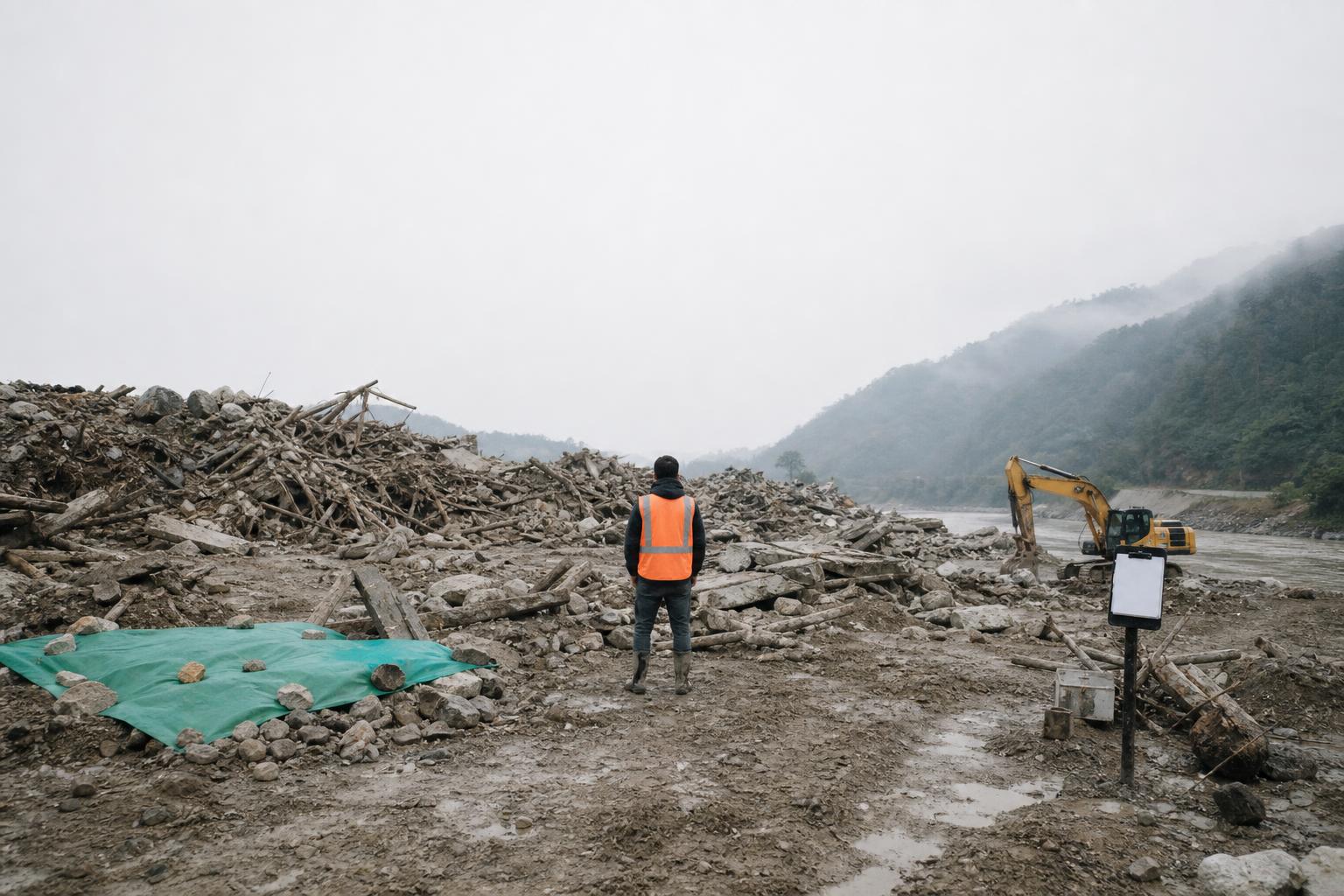
The Nepal-Tibet floods have left at least 2.2 million tonnes of debris behind, according to a preliminary United Nations estimate. That figure — buildings, rock, sediment — is the size of the cleanup, not the disaster. The death toll, now past 1,050 in Nepal with roughly 4,000 still missing, is the size of the disaster.
The number the story turns on: 2.2 million tonnes
The United Nations Development Programme produced the debris estimate this week, calling it preliminary. It is the only quantified measure so far of what the flood physically did to the built environment, as opposed to what it did to people. Debris tonnage matters because it converts directly into labour, machinery-hours and disposal capacity — inputs a government has to budget, not abstractions it can mourn.
Compare it to what triggered it. A section of glacier near the Langtang Lirung peak collapsed, sending a landslide into the valley floor and a flood wave down the Trishuli River. One rockfall, one river, 2.2 million tonnes of downstream wreckage. The ratio is the story: a localised geological event produced a regional-scale cleanup bill.
Why the death toll and the debris toll move on different clocks
The death toll updates daily and will keep rising as search teams work through roughly 4,000 missing people, including 592 foreigners who came for trekking or pilgrimage to Mount Kailash. Families abroad have been asked to submit DNA profiles by email to Nepal police, a detail that says more about capacity than protocol — a country running search-and-rescue at this scale does not have spare forensic infrastructure to spin up overnight.
The debris figure moves on a slower clock. It does not shrink until someone hires the trucks, funds the landfill capacity, and pays the labour to move 2.2 million tonnes somewhere. Kanni Wignaraja, assistant secretary-general at the UN, told Reuters that “technology cannot move fast enough to prevent loss along these massive river systems.” That sentence is usually read as a comment on early-warning systems. It applies just as well to reconstruction: no amount of drone mapping accelerates the actual tonnage a backhoe can move in a day.
Why 47 lakes is already the wrong number
In 2020, researchers counted 47 potentially dangerous glacial lakes across Nepal, China and India. Wignaraja said the real count, using data the UNDP and partner organisations compiled in June, is now “significantly higher” — though no updated figure has been published. That gap between a hard 2020 count and a vague 2026 estimate is itself informative: the monitoring infrastructure has not kept pace with the melt rate driving new lake formation.
A glacial lake outburst works on simple mechanics. Meltwater collects behind a natural dam of rock or ice. Pressure builds. The barrier breaks or overtops, and the built-up volume releases downstream as a flash flood. Warming accelerates two inputs simultaneously — the melt filling the lakes and the rock loosening around the barriers holding them back — so the count of dangerous lakes and the fragility of each one are both climbing at once. A 2020 tally undercounts both.
The population exposed follows the same undercounting problem. Wignaraja put the number at risk in “the millions,” without a fixed figure, because the exposure calculation depends on how many lakes are now dangerous — a number nobody has finished updating.
The counter-argument: this was one glacier, not a system failure
The strongest case against reading this as a regional emergency is that a single, specific collapse caused it — one section of one glacier, on one river. Weather systems and dam failures are diffuse; this was a point event. On that reading, the response is triage and rebuild, not a wholesale re-rating of Himalayan river valleys as uninhabitable.
That argument holds for the immediate death toll but not for the exposure math. The Trishuli flood is one realised event out of a population of lakes that is growing and increasingly unmonitored. Insurers and infrastructure planners do not price single events; they price frequency. If the number of dangerous lakes has moved meaningfully past 47, the probability of the next Trishuli-style collapse has moved with it, even though this particular flood traces to one identifiable point of failure.
Ten percent of Nepal's power capacity is now offline
The flood overran hydropower facilities and knocked out roughly 10 percent of Nepal's generating capacity — a country that depends on hydropower for the large majority of its electricity. That is not a rebuild-when-convenient loss. It is a immediate hit to industrial output, refrigeration, water pumping and the hospitals now running triage on flood casualties, arriving at the exact moment the country needs power the most.
International aid pledged so far totals more than $42 million. Set against 2.2 million tonnes of debris and a tenth of national power capacity gone, that sum covers search-and-rescue logistics — the life-detecting machines, refrigeration units and prefabricated bridges Nepal specifically requested — not reconstruction. Nepal declined general foreign search-and-rescue manpower last week but asked for that narrower technical support, a distinction that matters for what the $42 million is actually buying: equipment and expertise, not labour.
Who inherits the riverbank
The open question is not the death toll, which will be finalised in weeks. It is whether the riverbanks where millions currently live remain habitable once the immediate crisis passes. Wignaraja's warning was explicit on this point: entire stretches of river valley could become effectively uninhabitable if the glacial lake population above them keeps growing unmonitored.
That decision — resettle, fortify, or monitor and hope — falls to a government now also managing a debris-clearance bill in the millions of tonnes and a power grid missing a tenth of its capacity. The families posting photographs of missing relatives outside a Kathmandu hospital are the immediate cost. The unresettled riverbank population is the deferred one, and nobody has priced that bill yet.