Indonesia’s fires and America’s wells share one El Niño, not one ledger
Indonesia’s 2026 fires match 2015’s record 333MtC as El Niño also lifts US oil output to 13.8 million b/d.
By The Ledger · · 5 min read
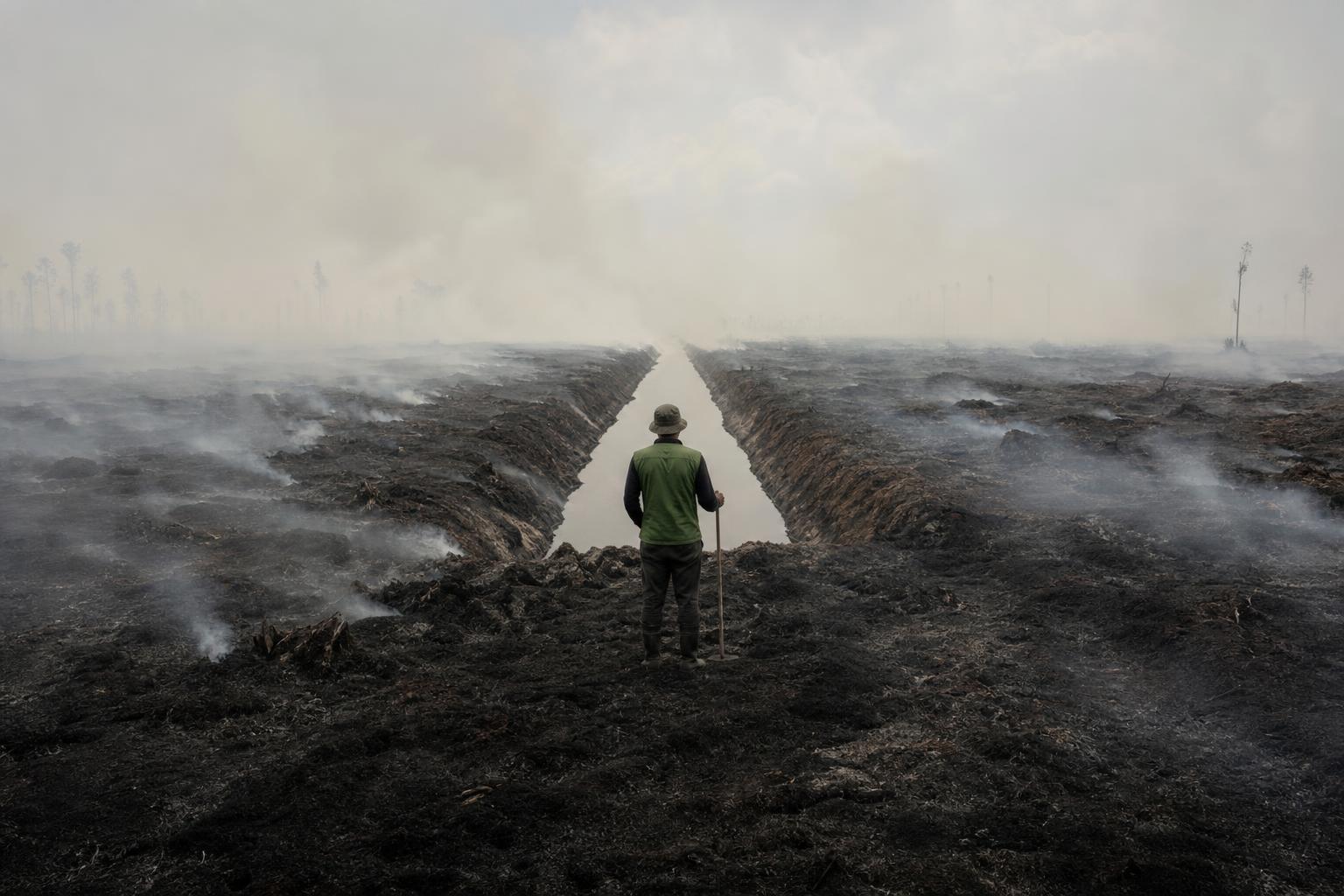
Indonesia's fires have released 76 million tonnes of carbon as of September 7, 2026. The Global Fire Emissions Database puts that on the same trajectory as 2015, when the season finished at 333 million tonnes. The same El Niño pattern that dries out Indonesian peatland is also cutting hurricane risk in the Gulf of America — where US crude production is now forecast to hit a record 13.8 million barrels a day.
One climate pattern, two unrelated bills
El Niño is a Pacific Ocean warming cycle. It does two things at once this year, neither one caused by the other. In Indonesia, it dries out land that would otherwise stay wet through the dry season, from August into November. In the Atlantic, forecasters at Colorado State University say the same El Niño conditions are producing a below-normal hurricane season — fewer storms to threaten the Gulf's new oil infrastructure.
Dr Guido van der Werf, a fire researcher at Wageningen University, says Indonesia's 2026 fires are "more or less on track" to match 2015. Parts of Papua province are, in his words, burning more than they ever have. Dr Mark Parrington of the Copernicus Climate Change Service says this year's dry-season fires are running well beyond anything seen in previous El Niño years, including 2015 and 1997.
Meanwhile the US Energy Information Administration says crude output averaged 13.7 million barrels a day in the first half of 2026, up 2 percent on the same period in 2025. The agency credits calmer Gulf weather, among other factors, for letting four new offshore projects come online without disruption.
The carbon math: 333 million tonnes versus a fraction of global fuel emissions
Indonesia's 1997 fire season is the benchmark for scale. Researchers estimated it produced carbon emissions equal to 13 to 40 percent of that year's global fossil-fuel emissions — from one country's peat fires alone. The 2015 season, smaller than 1997 but still severe, generated more carbon dioxide than every fossil-fuel source in the European Union that year, according to a study of south-east Asian emissions. Public health researchers linked the resulting haze to more than 100,000 premature deaths across the region.
2026's fires, at 76 million tonnes of carbon through early September and still burning, sit on a path toward that same order of magnitude. Whether they close in on 333 million tonnes depends on how long the dry season runs and how well Indonesia's post-2015 peatland restoration holds up under pressure it hasn't faced before.
Peat is not wood: why the fuel is underground
Dr Nisa Novita, peatland lead at the Indonesian NGO Yayasan Konservasi Alam Nusantara, describes the mechanism plainly: when peatland is drained for agriculture, the water table drops, and the peat itself becomes fuel. Unlike a forest fire that burns above ground and eventually runs out of trees, a peat fire smoulders underground. The soil is the fuel supply, and it can keep burning long after the visible flame front has passed.
That is why El Niño matters so much here. Novita is careful to say the weather pattern "does not directly cause most fires" — most are set to clear land for palm oil and other agriculture. El Niño is the amplifier: it dries the drained peat further, making ignition easier, spread faster, and containment much harder. Indonesia's government responded to the 1997-98 disaster with a moratorium on new plantation licenses over forest and peatland, and after 2015 it created a dedicated peatland restoration agency. Those measures are credited with limiting fire activity during the 2019 El Niño. 2026 is the first sustained test of whether that infrastructure holds against a fire season this intense.
Who pays for one, who profits from the other
The costs of Indonesia's fires land on people who never drained the peat. Regional haze, blamed for over 100,000 premature deaths in 2015 alone, falls on populations across south-east Asia regardless of where the fire started. Indonesia's own restoration agency, and the moratorium enforcement behind it, is a budget line funded by a government now watching a record-tying fire season unfold despite that spending.
The Gulf of America's calmer hurricane season is, by contrast, a gain that shows up directly in a production forecast. The EIA credits higher West Texas Intermediate prices — up from an average of $65 a barrel in 2025 to $84 a barrel through August 2026 — for pushing Permian output 3 percent higher, well past the $69 and $63 per barrel breakeven costs reported by drillers in the Dallas Fed's survey. Four new Gulf projects added 0.2 million barrels a day in the first half of the year, a 10 percent jump versus the same period in 2025, without a major storm to threaten the build-out. A milder hurricane season is not a subsidy anyone wrote a check for. It is a cost that simply didn't arrive, and the saving flows straight to producers already collecting a $19-a-barrel price gain.
What would prove this wrong
Two numbers will settle the Indonesian question by year-end. If the fire season's carbon total closes near or above 333 million tonnes, 2026 becomes the worst since 1997 in raw terms — proof that restoration spending has been outpaced by drought conditions. If it stalls well below that mark, the peatland agency's post-2015 work will have done something measurable, even in an intense El Niño year.
On the US side, the test is simpler and shorter: whether the Atlantic hurricane season, which runs through November, actually stays below normal as Colorado State University projected. A single major storm through the Gulf would put the four newest offshore projects and the record production forecast at risk simultaneously. Both figures — Indonesia's carbon count and America's barrel count — are being generated by the same ocean pattern, and neither one is final until the season that made them is over.