Feedback loops add 0.4°C. Nobody budgeted for that warming.
Thawing permafrost and wildfires could add up to 30% more warming, unpriced in current climate models.
By The Ledger · · 5 min read
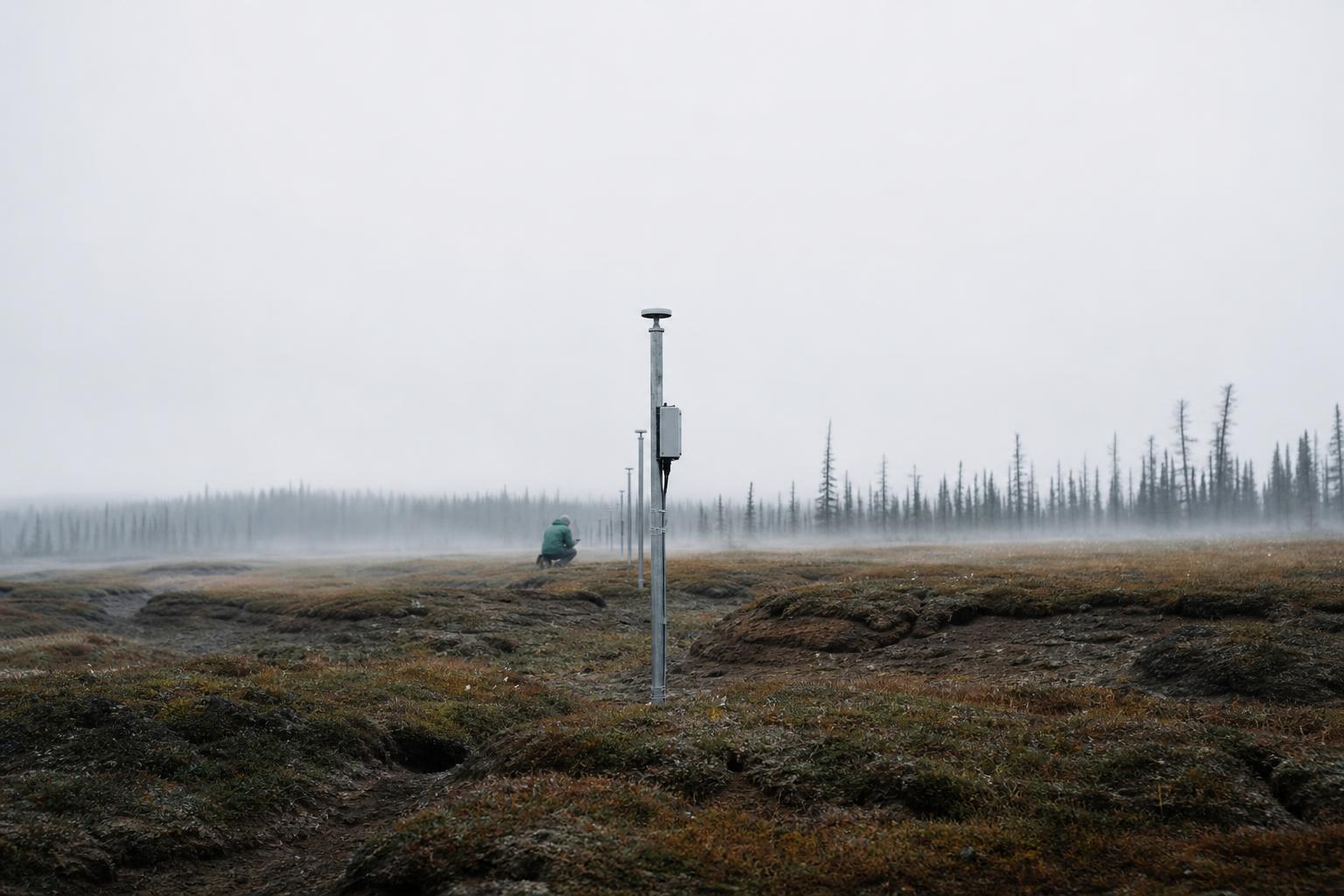
Every climate model used to set national carbon budgets leaves out a number that could add 0.4°C to global warming by 2100. That gap comes from forests, wetlands and permafrost that are starting to emit the carbon they once stored. A study published in Environmental Research Letters puts the missing multiplier at 20% to 30% of projected warming.
0.2°C to 0.4°C, and the range depends on what governments do next
The figure comes from Sam Abernethy, a scientist at Spark Climate Solutions Research, and Rob Jackson, a co-author at Stanford University. They modelled four natural sources: thawing permafrost, drying wetlands, warming freshwater lakes, and wildfires burning hotter as forests dry out. Under the fastest global emissions cuts, these sources add 0.2°C. Under a high-emissions path, they add 0.4°C. Either way, the addition is not in the baseline projections that inform the Paris Agreement targets.
That range brackets a meaningful policy gap. Climate Action Tracker already estimates current government policies put the world on track for 2.6°C above pre-industrial levels. Add the upper end of this feedback estimate, and the effective trajectory moves further from the 1.5°C threshold the United Nations conceded last week will be breached within years.
0.4°C sounds small. It isn't, at the tail of the distribution
A third of a degree reads like rounding error against a 2.6°C baseline. It isn't. Small shifts in the global average temperature move the frequency of extreme events disproportionately, because heatwaves, droughts and floods sit at the tail of a statistical distribution, not the middle. Half a degree separated the heatwaves and wildfires of this summer from a milder version of the same season. The paper's authors frame the 0.2°C-to-0.4°C range not as a rounding correction but as the difference between manageable and severe outcomes for specific regions already near thresholds — Arctic permafrost zones, Amazon-adjacent wetlands, boreal forests prone to fire.
The mechanism is a feedback loop, not a one-off release. Warming thaws permafrost, which releases methane and CO2, which adds warming, which thaws more permafrost. The same loop runs through wetlands drying into peat that burns, and lakes warming enough to release stored carbon faster. Scientists have described these loops for decades. What's new is a quantified estimate of how much they add on top of fossil fuel emissions, isolated across four specific natural systems rather than treated as a footnote.
The carbon budget everyone is using was never built to include this
Abernethy's central claim is blunt: models guiding climate policy are "likely underestimating how much warming is coming — and overestimating how much carbon we can still afford to emit." That second half matters more than the first. A carbon budget is a spending limit — the total tonnage of CO2 the world can still emit and hold to a given temperature target. If natural feedbacks add 0.2°C to 0.4°C on top of that spending, the real budget is smaller than governments have been planning against, without anyone changing the number on the page.
This is not a hypothetical accounting error. National climate pledges, carbon trading schemes and corporate net-zero targets are all built on budgets calculated from models that, by Abernethy and Jackson's account, don't fully price in permafrost, wetland, freshwater and wildfire emissions. If the paper holds up under scrutiny, every one of those budgets needs a downward revision — not because ambition changed, but because the baseline math was incomplete.
The counter-argument: uncertainty this size cuts both ways
The strongest challenge to this study isn't that the mechanism is wrong — permafrost thaw releasing methane is well-documented — but that a 20% to 30% range is wide enough to be more caution than calculation. Natural carbon cycle feedbacks are among the hardest quantities in climate science to pin down, because they depend on regional variables — soil composition, precipitation, fire suppression policy — that don't scale globally in a straight line. A number expressed as a range spanning 50% of itself (20% to 30%) signals genuine scientific uncertainty, not settled fact.
That uncertainty, though, has historically resolved toward the pessimistic end. Arctic permafrost thaw was projected to be gradual as recently as a decade ago; abrupt thaw and lake formation are now documented faster than earlier models assumed. Wildfire seasons in boreal forests have already exceeded projections built five years ago. The direction of past model error argues for taking the upper bound seriously, even while the lower bound remains defensible.
What 0.4°C does to the number governments already can't hit
The immediate consequence isn't a new policy. It's a revision to an existing one. Climate Action Tracker's 2.6°C current-policy projection was calculated without this feedback loop. If regulators, insurers and central banks start incorporating natural-source emissions into their models — which Jackson explicitly calls for as a next step for policy — the number attached to today's commitments moves upward, even if no country changes a single emissions target.
That has a direct cost. Carbon prices, set in markets like the EU Emissions Trading System, are calibrated against a remaining carbon budget. A smaller effective budget implies a higher carbon price is needed to hit the same temperature target, all else equal. Insurers pricing climate risk into 30-year mortgages and infrastructure bonds work from the same baseline models Abernethy says are incomplete. Every one of those prices was set without this multiplier.
The people who pay first are not the modellers. They are the households in permafrost zones, wetland-adjacent farming regions and fire-prone forests who experience the feedback loop directly, and the taxpayers in every country who fund the adaptation budgets built against an underestimated number. The paper doesn't change what's already happening in Arctic Russia, Canada and Siberia. It changes how honestly that change gets counted.