The world will cross 1.5°C. The bill after that is the story
UNEP says warming will exceed 1.5°C this decade, making overshoot recovery, not prevention, the real budget question.
By The Ledger · · 5 min read
The world is going to cross 1.5°C of warming. The United Nations Environment Programme said so this week, not as a warning but as an accounting fact. The remaining question isn't whether the threshold breaks — it's how much it costs to come back down afterward, and who signs that cheque.
1.5°C was never a wall. It was a budget line, and it's spent
The figure UNEP's emissions gap report turns on is straightforward: at current national climate pledges, global temperatures are on track to exceed 1.5°C above pre-industrial levels within the next decade, likely peaking somewhere between 2.5°C and 2.9°C by 2100 without further cuts. That range comes from UNEP's own modelling of stated government commitments, cross-checked against the Climate Action Tracker consortium, which independently puts the 2100 range at 2.6°C to 2.8°C under current policies. Both trackers agree on the direction. They differ by roughly 0.2°C on the ceiling, and both say who reported which number: UNEP's Emissions Gap Report 2025, published this week, and Climate Action Tracker's most recent update in November.
The 1.5°C figure itself dates to the 2015 Paris Agreement, where it was set as an aspirational ceiling — the temperature rise scientists judged would keep the worst tipping points, coral collapse, ice-sheet acceleration, avoidable. It was never a hard physical boundary. It was a policy target backed by a carbon budget: a finite tonnage of CO2 the atmosphere could absorb before crossing it. The Global Carbon Project estimated that budget at roughly 500 billion tonnes as of 2020. Annual emissions run near 40 billion tonnes. The arithmetic was never generous. It has now run out.
The overshoot isn't the disaster. The return trip is the expensive part
Here is why the headline number is smaller than it sounds, and also larger. Smaller, because "crossing 1.5°C" doesn't mean instant catastrophe — UNEP is explicit that temporary overshoot, followed by a managed decline back toward 1.5°C later in the century, remains physically possible if emissions fall fast enough after the peak. The report's authors call this "limit, adapt to, and return from" — three separate verbs, three separate cost centers.
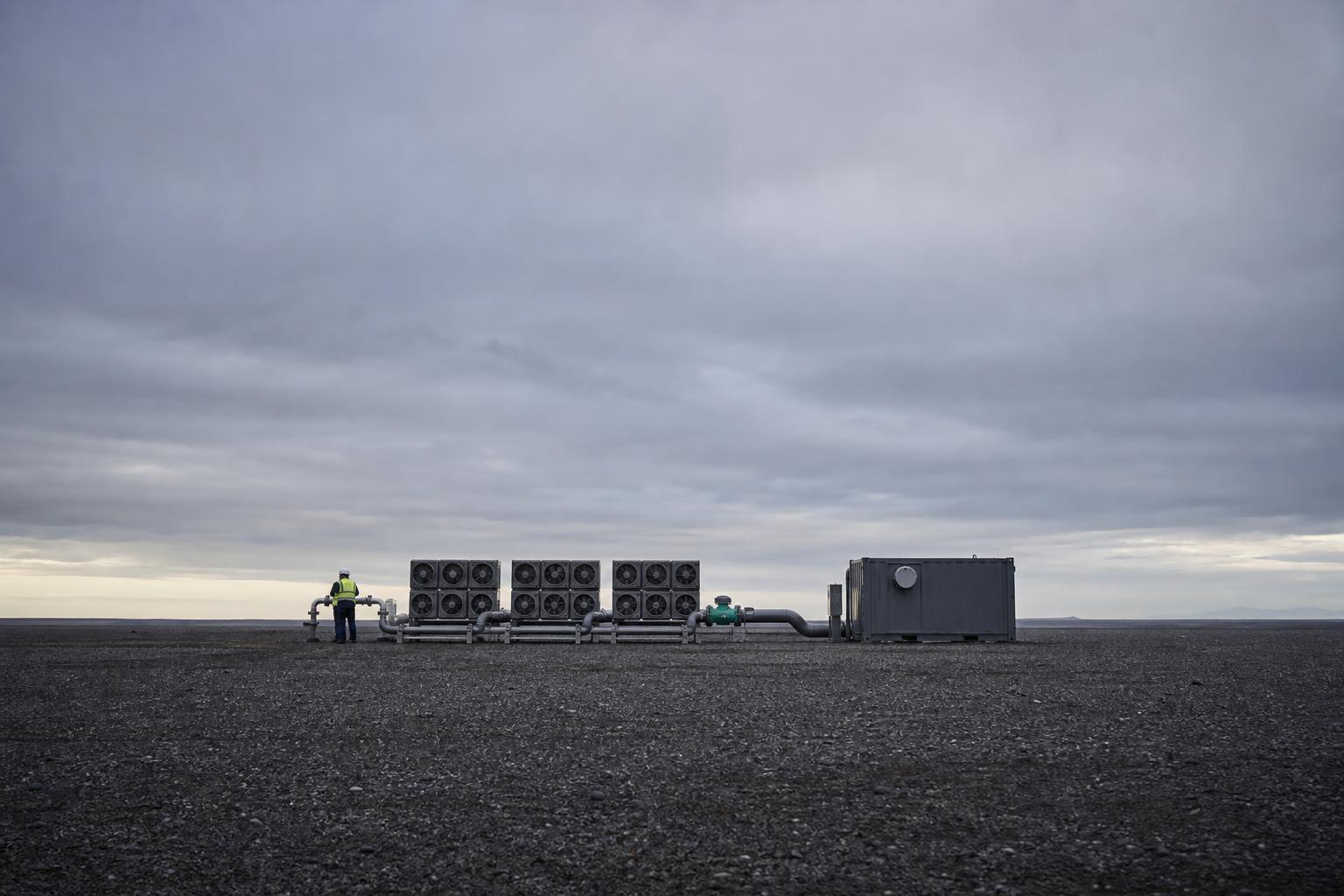
Larger, because "returning" from an overshoot requires net-negative emissions at global scale — pulling carbon out of the air faster than the world emits it — a technology that exists at demonstration scale, not planetary scale. Direct air capture currently removes roughly 0.01 million tonnes of CO2 per year worldwide, against a global emissions rate of 40,000 million tonnes. Closing that gap through carbon removal alone, rather than through emissions cuts, would cost an estimated $100 to $300 per tonne at current technology, according to the IPCC's Sixth Assessment costings. Multiply the low end by the volumes needed for meaningful overshoot reversal — tens of billions of tonnes over decades — and the return trip prices out in the tens of trillions of dollars, not the billions currently allocated to carbon removal research and pilot plants.
The gap between pledges and physics is 2025's real currency
UNEP measures this gap every year and gives it a name: the emissions gap. Countries' current pledges under the Paris Agreement — their Nationally Determined Contributions — would still leave global emissions in 2035 roughly 20 to 23 billion tonnes of CO2-equivalent above the level consistent with holding warming to 1.5°C, per the report's central estimate. That's not a rounding error. It's close to half of current annual global emissions, missing from the plan, every year, for a decade.
The gap has narrowed since the Paris Agreement was signed — UNEP's 2015 baseline projected warming near 3.5°C to 4°C by 2100 under then-current policy; the current 2.5°C-to-2.9°C range represents genuine progress, driven mostly by the falling cost of solar and wind generation and, more recently, by China's and the EU's emissions plateauing earlier than models expected. But narrowing a gap and closing it are different budget lines. The report credits roughly a full degree of avoided warming to policies adopted since 2015. It does not credit anyone with closing the remaining gap, because nobody has.
The counter-argument: overshoot forecasts have been wrong before, in both directions
The strongest case against treating this number as fixed comes from the forecast's own track record. Emissions gap reports issued in 2018 projected 2100 warming near 3.2°C under then-current policy; that figure has since fallen by roughly half a degree as renewable deployment outpaced projections repeatedly through the 2020s. Solar capacity additions in 2024 alone exceeded the International Energy Agency's 2019 forecast for the entire decade. If cost declines in batteries and clean generation keep compounding at the rate of the past five years, the 2.5°C-to-2.9°C range could compress further without any new policy commitment at all — it has happened before, and analysts at the IEA and Climate Action Tracker both flag it as the main source of forecasting error, historically in the optimistic direction.
The counter to the counter is timing. Cost declines in clean energy reduce future emissions; they do not reduce the carbon already accumulating in the atmosphere this decade, which is what determines whether 1.5°C is crossed on schedule. Even the most favorable technology curve doesn't reverse a budget that's already spent. UNEP's report treats the crossing of 1.5°C in the next decade as close to locked in regardless of how fast good news arrives afterward — a distinction the report's authors state plainly, and one the more optimistic reads of the data tend to elide.
What the number does next: it moves from a target to a floor
Practically, the number's function changes. For a decade, 1.5°C operated as a target — something governments negotiated toward, cited in national pledges, wrote into net-zero legislation. Once crossed, it becomes a floor: the level the world is trying to return to, from above, rather than avoid from below. That reframing shows up first in how adaptation finance gets argued over at the next UN climate summit, where negotiators will need to decide how much of the shortfall goes to emissions cuts versus the removal technology required for any future descent back under 1.5°C.
The money question resolves at national treasuries, not at UNEP. Every tonne of the 20-to-23-billion-tonne gap that isn't closed through policy becomes, eventually, a tonne someone has to remove mechanically, at $100 to $300 apiece, or a tonne of additional warming someone lives with — in heat deaths, crop losses, and insurance withdrawals already being priced into household bills from Florida to southern Europe. The report doesn't set that price. It just confirms the invoice is coming, and that the interval for avoiding it has closed.